
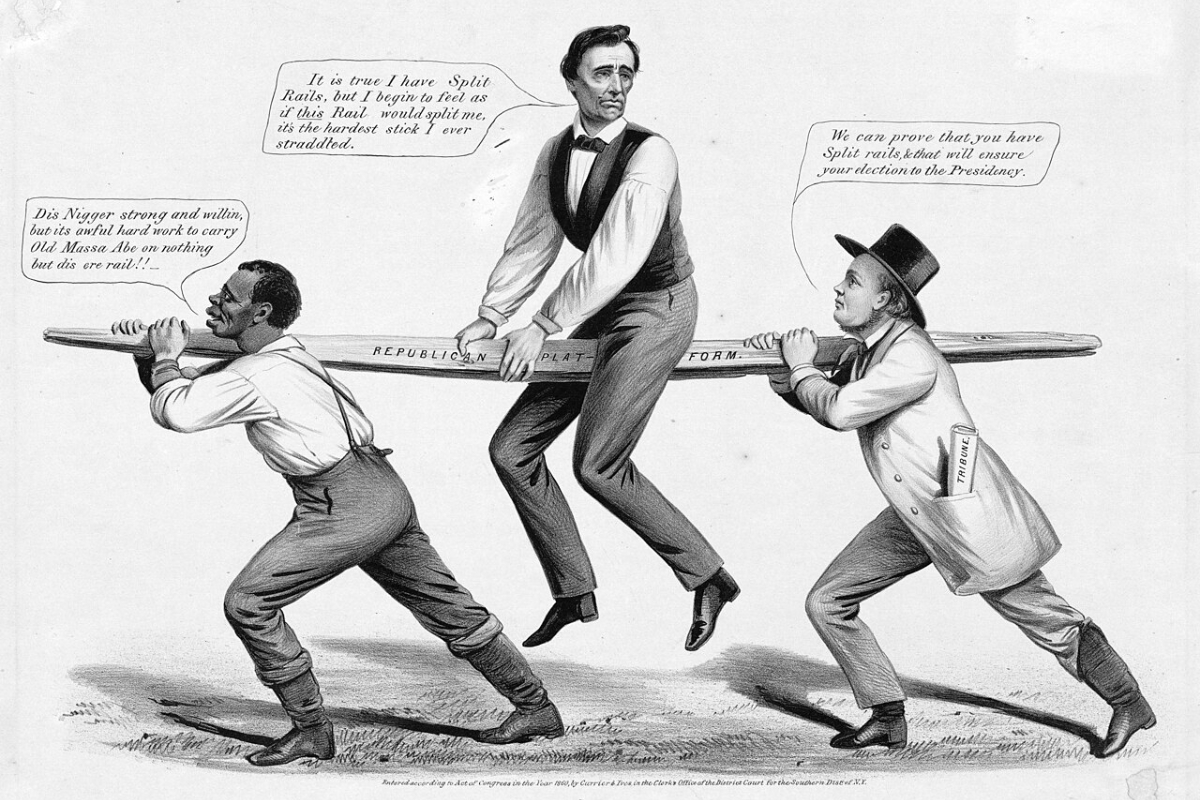
President Lincoln wordt door velen, geschiedenisboekjes incluis, gevierd als een held met bijna mythische status. Vraag de gemiddelde mens wat ze weten van Lincoln en bijna iedereen zal zeggen: “Hij schafte de slavernij in de USA af.” Hij wordt gezien als de grootste president die Amerika ooit had, en omdat hij vermoord is, als een martelaar.
Maar niet iedereen denkt er zo over en we zien in toenemende mate, zowel ter rechter- als ter linkerzijde, geluiden die hem zien als met gebreken of zelfs ronduit slecht. Steeds vaker zijn er kritische kanttekeningen te lezen die de mythe proberen door te prikken.
Maar een eerlijk, afgewogen tussengeluid lijkt er haast niet meer te bestaan. Hij wordt ofwel vereerd of gedemoniseerd. Dat is wel iets wat bij de huidige tijdgeest past, maar niet wenselijk. Dus als we eerlijk zijn en alles bekijken met de tijd en situatie van dat moment in het achterhoofd, was hij werkelijk zo’n mythische held of toch een monsterlijke hellehond? Of was hij misschien gewoon een mens, een politicus?
Lincoln: de mythe
De mythe is voor een deel in het zadel geholpen door de vermaarde acteur John Wilkes Booth, die Lincoln doodschoot, waardoor hij een martelaar kon worden. Maar de mythe is ook deels nadrukkelijk en bewust door Lincoln zelf gecreëerd. Hij stond aan de wieg van de narratief die hem naar grotere, morele hoogten bracht.
Door de jaren heen heeft hij behoedzaam een beeld van zichzelf geschapen als Log Cabin Lincoln en Honest Abe. Als hem gevraagd werd om zijn jonge jaren te beschrijven, dan antwoordde hij: “de korte en simpele annalen van de arme man”, waarbij hij verwees naar het gedicht ‘Elegy Written in a Country Churchyard’ van Thomas Gray. Hij belichaamde de Amerikaanse droom: zelfs als man van eenvoudige afkomst, geboren in een blokhut, kon je door hard werken en eerlijkheid opklimmen tot president.
Hij beweerde geen grote aspiraties te hebben en zei dat als mensen niet voor hem zouden stemmen, hij terug zou keren naar de anonimiteit, aangezien hij gewend was aan teleurstellingen. Maar dat is niet het beeld dat mensen die hem goed kenden, hadden. Zijn partner in de advocatuur, William Herndon, zei over hem: “Zijn ambitie was een kleine motor die geen rust kende.” Nu is ambitie niet verkeerd en zeker in die tijd werd het gezien als een groots goed, maar hij schilderde zichzelf heel anders af. En laten we eerlijk zijn: zou een man zonder ambitie het kunnen schoppen tot president van Amerika? Lincoln deed zich nederig voor, maar ik kan me niet voorstellen dat een echt nederig man zo ver zou komen in de politiek. Helaas moet je daar toch wel enigszins scrupuleloos voor zijn.
Ik ga heel hard proberen neutraal te blijven en geen aandacht te geven aan de extremisten die hem ofwel tot engel dan wel tot duivel verklaren. Ik ga dus bijvoorbeeld niet vallen over het feit dat hij tegen interraciale huwelijken was, want dat was toentertijd bijna iedereen. We mogen het tijdsbeeld niet buiten beschouwing laten. En evenmin ga ik vallen over wat zijn schoonfamilie – die voor het overgrote deel voor het zuiden vocht – aan kwalijks heeft gedaan, want daar had hij immers geen invloed op. Dat als argument gebruiken, is iemand zwartmaken zonder dat dit werkelijk betrekking heeft op de daden van de man zelf.
We mogen ook niet uit het oog verliezen dat hij een politicus was en bovendien een minderheidspresident. Een politicus moet soms dingen zeggen of besluiten nemen die hij niet meent of waar hij niet achter staat. Hij moet zichzelf soms anders voordoen om in een goed blaadje te blijven staan, om de partijen bij elkaar te houden. Zo besefte Lincoln dondersgoed dat de meeste mensen in het Noorden ook hevig anti-zwarte sentimenten koesterden en niet wilden vechten om de slaven te bevrijden, maar wel om het land bij elkaar te houden. En daar moest hij natuurlijk op inspelen.
Afschaffing slavernij
Laten we beginnen met waar hij het meest om geroemd wordt: het afschaffen van de slavernij.
Lincoln voerde een verkiezingscampagne waarin hij beloofde dat hij niet zou ingrijpen in slavernij die al bestond. Hij focuste zich nadrukkelijk op het voorkomen van uitbreiding van slavernij naar de westelijke territoria, die nog staat moesten worden. Hij herhaalde die belofte nog eens in zijn First Inaugural Address (Eerste Toespraak bij Inauguratie). Meermaals heeft hij gezegd: “Ik ben geen voorstander, en ben dat nooit geweest, van het teweeg brengen op welke manier dan ook van sociale en politieke gelijkheid van de witte en zwarte rassen.” Hij is dus tot president verkozen (met een minderheid aan stemmen) met valse verkiezingsbeloften. Nu is dat niets nieuws onder de zon onder politici, maar niet bepaald lovenswaardig of iets wat iemand tot een held maakt.
Pas toen de oorlog slecht ging voor het Noorden, en Engeland en Frankrijk zich ermee dreigden te gaan bemoeien ten voordele van het Zuiden, kwam hij met de Emancipatie Proclamatie. Let wel: een proclamatie, geen wet. Die wet kwam er pas in januari 1865.
En wat hield die proclamatie in? Schafte het de slavernij in het Noorden af? Nee! Nu zal menigeen zeggen: slavernij in het Noorden? Die waren toch slavernijvrij? Nee hoor! In een vorige blog heb je kunnen lezen hoe dit zat, maar bepaalde noordelijke staten hadden nog steeds slaven, sommige zelfs behoorlijke aantallen. En die veelbezongen proclamatie uit 1863 liet die slavernij bestaan. Waarom? Omdat hij bang was dat die staten dan alsnog over zouden lopen naar het Zuiden. Er zat dus wel een gedachte achter, maar het is tamelijk hypocriet om de man te bewieroken voor het afschaffen van uitsluitend de slavernij in de zuidelijke staten, waar hij geen enkele invloed op had. Met andere woorden: er werd nauwelijks één slaaf bevrijd met die proclamatie. Het was een politiek slimmigheidje, dat in de praktijk niets veranderde.
Dus mythe 1 is doorgeprikt: hij heeft in 1863 niet in één klap de slavernij afgeschaft, en al helemaal niet in het Noorden.
Deportatie en kolonisatie
Was Lincoln tegen slavernij? Ja. Stond hij positief tegenover zwarte mensen? Nee. Was hij een racist? Tot op zekere hoogte wel; door de bril van de 21e eeuw bekeken wel, door de bril van de 19e eeuw bekeken niet. Maar hij vond niet dat blanken en zwarten gelijkwaardig waren. Of hij dat echt vond of dat zijn politieke carrière hem dwong dat te zeggen, blijft onduidelijk, maar alles lijkt erop dat hij dat ook daadwerkelijk vond.
Hij was een voorstander van het ‘vrijwillig deporteren’ (een tegenstelling in zichzelf) naar een Afrikaanse kolonie of Midden-Amerika. Zelfs in augustus 1862 zag hij dit nog als de beste oplossing en daartoe nodigde hij een aantal zwarte vrije leiders uit in het Witte Huis om dit te bespreken. Dit is wat hij hun zei:
- “Jullie en wij zijn verschillende rassen. Er bestaat tussen ons een groter verschil dan tussen bijna elke andere twee rassen.”
- “Dit fysieke verschil is een groot nadeel voor ons beiden, aangezien ik denk dat jullie ras ernstig lijdt, velen van hen door te midden van ons te leven, terwijl wij lijden door jullie aanwezigheid.”
- “Er is onwil aan onze zijde, hoe wreed dit ook moge zijn, om jullie vrije gekleurde mensen bij ons te laten blijven. We kijken naar hoe we ervoor staan. Vanwege het bestaan van twee rassen op dit continent hoef ik u niet te vertellen, hoe de zaken er nu voorstaan, dat dit een zeer ernstige zaak is. Dit is net zo goed jullie land als het mijne, maar er is iets zo onnatuurlijks in het bestaan van twee rassen tezamen, en het is beter voor ons beiden als we gescheiden worden.”
- Zonder jullie ras te midden van ons zou er geen oorlog zijn… Desondanks herhaal ik, dat zonder het instituut van slavernij, met het gekleurde ras als basis, de oorlog geen bestaansrecht had.”
Hier klinkt toch wel racisme uit. Hij had zijn plan ook anders kunnen verwoorden, namelijk dat hij een vruchtbaar, gelukkig samenleven van zwart en blank niet voor zich zag, daarbij de oorzaken niet benoemend.
Datzelfde jaar haalde Lincoln het Congres over om fondsen goed te keuren voor zulke kolonisatieprojecten, aangezien die goed zouden zijn voor beide rassen. Hij zei letterlijk dat hij een sterke voorstander van kolonisatie was. Hij hoopte dat geleidelijke vrijlating van slaven, samen met kolonisatie van vrije zwarten, uiteindelijke de blanke weerstand tegen het beëindigen van de slavernij zou kunnen verkleinen. Maar het experiment faalde hopeloos.
Het meest berucht was de poging om vrije zwarten te vestigen op Île à Vache, voor de kust van Haïti, in 1863. Slechte planning, corruptie en ziekte verwoestten de gemeenschap. Overlevenden smeekten om terug te mogen keren naar de USA en het project stortte in elkaar. Toch bleef Lincoln er voorstander van. “Het is beter voor ons beiden, daarom, om gescheiden te worden. Jullie zijn vrijgemaakten en we hebben jullie de vrijheid gegeven; maar wat moeten we met jullie beginnen? Het bestaan van twee rassen in hetzelfde land is een voortdurende oorzaak van schade voor beide. Kolonisatie is de enige manier waarop een permanente scheiding van de rassen bereikt kan worden.”
Dus mythe 2 is doorgeprikt: Lincoln had wel degelijk discriminerende vooroordelen tegen zwarten en wilde liever niet met hen samenleven, alleen wilde hij ook niet dat slavernij bleef bestaan. Liever zag hij de rassen volledig gescheiden, dus Apartheid, en de zwarten vertrekken uit de USA. Laten we dus niet doen alsof hij de ultieme anti-discriminatie voorvechter was!
Oorlog geëindigd… of begonnen?
Voorstanders loven Lincoln ook, omdat hij de oorlog beëindigd zou hebben. Dat is feitelijk niet waar: hij is hem begonnen!
Het zuiden zag het voorkomen van slavernij in nieuwe staten in het westen, ook als die onder de zogenaamde Mason-Dixie Linie lagen, als een zo grote bedreiging (voor hun economie en politieke balans), dat er geen gulden middenweg meer mogelijk leek. Daarop besloot het zuiden zich vreedzaam af te scheiden.
Voor Lincoln was dat een brug te ver. Hij wilde de Unie koste wat kost behouden. Op 22 augustus 1862 schreef hij: “Als ik de Unie zou kunnen redden zonder ook maar een slaaf vrij te maken, zou ik het doen; als ik het zou kunnen redden door alle slaven vrij te maken, zou ik het doen; en als ik het kon doen door sommige vrij te maken en andere met rust te laten, zou ik dat ook doen.”
Was afscheiding constitutioneel legitiem? Het zuiden beweerde van wel, het noorden van niet. Beiden hadden gelijk, beiden hadden ongelijk. De Grondwet zegt er niets over, het zegt niet dat het mag, het zegt niet dat het niet mag. Het Zuiden beargumenteerde dat omdat de Constitutie een vrijwillig ‘pact’ tussen soevereine staten was, het Tiende Amendement de staten het recht gaf zich terug te trekken, aangezien het niet expliciet werd verboden. Het Noorden beargumenteerde dat de Constitutie een ‘voortdurende unie’ geschapen had, geratificeerd door ‘We the People’ (‘Wij het Volk’), wat betekende dat individuele staten de natie niet eenzijdig konden verwoesten.
Het is significant dat President Davis (de president van de Confederacy, het Zuiden) na de oorlog niet berecht is voor verraad en rebellie. Volgens een nieuw boek (“Secession on Trial: The Treason Prosecutio of Jefferson Davis” van professor Cynthia Nicoletti) is dat proces vier jaar lang uitgesteld en uiteindelijk heeft men het laten vallen, omdat men vreesde dat er een goede kans was dat de rechtszaak verontrustende vragen op zou kunnen roepen over de grondwettelijkheid van afscheiding, en als het muntje de verkeerde kant op zou vallen, de oorlog die het Noorden gevoerd had, onterecht zou zijn.
Lincoln had het kunnen laten rusten. Waarom moest de Unie zo nodig behouden worden? Ging het om economie? Kon het noorden niet voortbestaan zonder het zuiden? Was het ambitieuze grootheidswaanzin? Ging het om gezichtsverlies? Was het omdat Lincoln een minderheidspresident was, die zich door de afscheiding in een hoek gedrukt voelde?
En dus lokte Lincoln een gewapend conflict uit om met geweld afscheiding te kunnen voorkomen. Hij besloot Fort Sumter te herbevoorraden, hoewel hij wist dat dit de Confederatie bijna zou dwingen om te schieten, waarmee zij officieel het eerste schot gelost zouden hebben en op papier de oorlog begonnen zouden zijn.
De oorlog duurde langer dan vooraf gedacht
Niemand had geacht dat de oorlog vier jaar zou duren. Iedereen dacht zeker te weten dat het met een enkele slag over zou zijn. Lincoln kwam maar langzaam tot het besef dat er geen vreedzame oplossing of oorlogscompromis mogelijk was, hij schatte het zuidelijke sentiment volledig verkeerd in en maakte verkeerde strategische beslissingen, waardoor de oorlog gerekt werd, met afschuwelijke gevolgen.
De oorlog leverde ook ingewikkelde problemen op. Volgens toen geldende internationale wetten was een formele blokkade een oorlogsdaad tussen twee soevereine, onafhankelijke naties. Dus als Lincoln een formele blokkade af zou roepen, wat nodig was als hij wilde winnen, zou hij daarmee de Confederatie feitelijk erkend hebben en dat was juist wat hij met de oorlog wilde voorkomen. Toch riep hij op 19 april 1861 de blokkade af zonder officieel de oorlog te verklaren of het zuiden te erkennen, maar de blokkade te omschrijven als een maatregelen om rebellie de kop in te drukken en de wet te handhaven.
Overigens was de blokkade op zich geen oorlogsmisdaad. Het is pas sinds de 1970s dat blokkades alleen wettig zijn als zelfverdediging en niet ingezet mogen worden om een bevolking uit te hongeren of collectief te straffen. Dus dit gruwelijke gevolg voor het zuiden valt Lincoln wettig naar toenmalige maatstaven niet aan te rekenen.
De oorlog duurde voort, ondanks pogingen voor vrede. In december 1863 bood Lincoln het zuiden aan om terug te keren in de Unie met de garantie dat ze tijdelijk hun slaven konden behouden met compensatie voor vrijgelaten individuen. Het zuiden wees dat af. In 1865 waren er weer besprekingen, de Hampton Roads Conference, die ook op niets uitliepen. Wat daar precies besproken is, weten we alleen van wat de betrokkenen later opgeschreven hebben, maar er is geen officieel, betrouwbaar verslag. Het zuiden wilde in ieder geval een wapenstilstand, wat het noorden afwees. Lincoln eiste onvoorwaardelijke overgave, maar bood wel aan dat de zuidelijke staten dan ook mochten stemmen over het 13e Amendement (over slavernij) en mogelijke compensatie. Davis weigerde, want de Confederatie wilde onafhankelijk blijven.
Er was een hoop semantische haarkloverij, maar het kwam erop neer dat Lincoln de oorlog meteen had kunnen beëindigen als hij de onafhankelijkheid van het zuiden had erkend en dat Davis de oorlog meteen had kunnen beëindigen als hij diezelfde onafhankelijkheid had opgegeven.
Kort gezegd: het noorden begon de oorlog om de Unie te behouden, het zuiden deed de oorlog voortduren om onafhankelijkheid te behouden en Lincoln eindigde uiteindelijk de oorlog door Grant een oorlogsmisdaad te laten begaan. Hij wilde de Unie koste wat kost behouden… ten koste van 700.000 tot 800.000 doden, ontelbare gewonden, een ongekende economische schade en een verdieping van de haat tussen zwart en wit.
Dus deze mythe (dat hij de oorlog beëindigd heeft) kunnen we ook als doorgeprikt beschouwen.
Oorlogsmisdaden: opschorting Habeas Corpus
Heeft Lincoln oorlogsmisdaden begaan? Niet persoonlijk. Het is niet zo dat hij zelf aan het front stond en daar dingen deed die het daglicht niet konden verdragen. Maar hij heeft wel misstanden laten bestaan, daders niet bestraft of zelfs oorlogsmisdaden gesanctioneerd. Voor een deel valt dat goed te praten: er was immers een oorlog gaande en geen enkele oorlog kan zuiver gevoerd worden. Maar persoonlijk denk ik dat als hij de heilige was waarvoor velen hem houden, hij toch wel wat boter op zijn hoofd had.
Laten we de beschuldigingen één voor één bekijken en daarbij bedenken dat het 1) oorlog was en 2) midden 19e eeuw. Dus we moeten even onze huidige bril afzetten.
In 1861 schortte hij het constitutionele recht van Habeas Corpus op, wat het leger in staat stelde om verdachten van zuidelijke sympathieën en saboteurs te arresteren en gevangen te zetten zonder rechtszaak. Hij zag dit als een noodzakelijke maatregel voor de publieke veiligheid tijdens een gewapende opstand.
Dat kan wel zo zijn, maar het leidde onherroepelijk ook tot misbruik. Baltimore werd onder federale controle geplaatst en enkele duizenden Marylanders werden gearresteerd met verdenkingen van zuidelijke sympathieën, waaronder dertig leden van de staatswetgeving, een US-congreslid, de burgemeester en het hoofd van politie en het merendeel van de stadsraad. Zij werden opgesloten in Fort McHenry en Point Lookout (niet de meest prettige gevangenissen) zonder proces, in vele gevallen voor vele jaren.
Buitenspel zetten van het Congres
Lincoln heeft een aantal eenzijdige militaire beslissingen genomen zonder voorafgaande toestemming van het Congres. Of dit constitutioneel toegestaan was of niet, was ook toen al een lastige kwestie. Het gaat hierbij om:
- Het oproepen van 75.000 man staatsmilitie
- De hierboven al genoemde blokkade
- De hierboven ook al genoemde opschorting van de Habeas Corpus
- De autorisatie voor het gebruik van niet-gereserveerde fondsen voor militaire doeleinden.
- De invasie van het Zuiden.
Er zijn argumenten voor noodzaak van voorafgaande toestemming, zoals de Declare War Clause (Article I, Section 8) en de Militia Clause (Article I, Section 8). Er zijn ook argumenten voor het tegenovergestelde, zoals de Commander-in-Chief & Oath of Office (Article II) en de “Take Care” Clause. Daarnaast ratificeerde het congres met terugwerkende kracht de meeste noodmaatregelen alsnog.
Uiteindelijk heeft het Hooggerechtshof hier in 1863 naar gekeken en kwam met een 5 tegen 4 (!) beslissing dat Lincoln volgens de wet gehandeld had. Helemaal koosjer was het dus niet.
Verder stond hij toe dat militaire tribunalen burgers berechtten (bijvoorbeeld als ze zich tegen dienstplicht verzetten), waarbij het burgerrecht omzeild werd.
Ook het confisqueren van privé-eigendom, waaronder wapens, zouden ongrondwettelijk zijn (Tweede Amendement). In Maryland, een noordelijke staat met sterkte pro-secession facties, namen soldaten wapens van burgers in zonder rechtelijke uitspraak. Maar ook hier kun je je afvragen of oorlog geen uitzonderingen rechtvaardigt. Bovendien zie ik dit punt niet werkelijk als iets wat Lincoln tot een slecht mens zou maken.
Lieber Code en Total Warfare
Wel degelijk een smet op zijn blazoen is de Lieber Code van 1863. Er zijn heel veel General Orders tijdens de oorlog uitgevaardigd, waarvan je de haren te berge rijzen. Het gaat te ver om ze hier allemaal te noemen (wie wil kan ze gemakkelijk genoeg opzoeken), maar er zitten feitelijke vrijbrieven voor oorlogsmisdaden bij.
Ook de Lieber Code biedt (naast ook goede clausules) een wettige rechtvaardiging voor vreselijke wreedheden:
- Uithongering van burgers: Artikel 17 maakt het expliciet wettig om burgers (ook ongewapend) uit te hongeren om de onderwerping van de vijand te bespoedigen, wat tegenwoordig als een oorlogsmisdaad gezien wordt.
- Standrechtelijke executie van ‘irregular fighters’ (lees: guerrilla strijders, spionnen, burgers die b.v. een brug verbranden) zonder proces, wat de Geneva Conventie niet toestaat (die overigens pas in 1864 werd ingevoerd en toen niet door de USA is ondertekend).
- Wijdverspreide verwoesting van eigendom, huizen, voedsel en infrastructuur om het zuiden te verzwakken
- Executie van onschuldige burgers, krijgsgevangenen of gijzelaars als vergelding.
Dit maakte de weg vrij voor iets wat mijns inziens Lincoln nooit toe had mogen staan: Shermans March to the Sea. Dit was een ’total war’ tactiek waarbij land volledig verwoest wordt, van huizen tot voedsel, om het vijandige leger op de knieën te dwingen. In de praktijk was dit een plundertocht vol roof, verkrachting en moord, wat tot ongekend lijden van de burgerbevolking (ook de daar wonende slaven) heeft geleid, maar wat gezien werd als ‘collateral damage’. Historici beschouwen deze Mars naar de Zee algemeen als een van de allereerste keren dat een moderne vorm van totale oorlog werd toegepast. Niet bepaald een ‘uitvinding’ om trots op te zijn.
Ik vind beide, de Lieber Code, en het goedkeuren van de March to the Sea, oorlogsmisdaden, ook gezien door de bril van toen. Het waren wanhoopsdaden van een staat die de oorlog conventioneel niet leek te kunnen winnen en die de tegenstander bewust wilde straffen voor de afscheiding.
De verkiezingen van 1864
Lincoln weigerde de verkiezingen van 1864 uit te stellen. Daar valt tot op zekere hoogte nog wel iets voor te zeggen. Maar de verkiezingen liepen allesbehalve eerlijk.
Duizenden soldaten kregen verlof om te stemmen, maar in veel regimenten werden ze zo goed als gedwongen door officieren om op Lincoln te stemmen. Ongeveer 78% van de (noordelijke) soldaten stemden uiteindelijk op Lincoln. In staten als bijvoorbeeld New York werden er soms troepen ingezet om stemmers te screenen of ervoor te zorgen dat Democratische stemmen (van overzee) terzijde gelegd werden, en in grensstaten als Maryland en Kentucky, die vaak pro-zuidelijke sympathieën koesterden, grepen militaire commandanten in om deze sympathisanten weg te houden om deel te nemen. Democratische critici, zoals Ohio Congressman Clement Vallandigham, werden gearresteerd en verbannen.
Lincoln maakte van het bezette (meestal pro-noordelijke) deel van de zuidelijke staat Virginia een onafhankelijke staat en maakte ook Nevada tot nieuwe staat. Deels was dit uit strategische of financiële belangen, maar voor een groot deel werd dit ook gedaan om de Republikeinse meerderheid te behouden.
Dus hoewel Lincoln in 1860 wettig gekozen was, valt dat voor 1864 zeker te betwijfelen. Hier valt hij dus behoorlijk van zijn voetstuk.
Persvrijheid en de Dakota 38 Executie
Persvrijheid werd de facto afgeschaft tijdens de Burgeroorlog. Tientallen kranten (zoals de Chicago Times) die het niet met de oorlog eens waren of pro-Confederatie waren, werden gesloten en honderden kritische uitgevers, journalisten en telegrafisten werden gevangengezet.
De executie van 38 Dakota, die in opstand gekomen waren in 1862, wordt vaak ook aangehaald als oorlogsmisdaad. Ik vind dit een lastig geval. Je zou kunnen zeggen dat ze het recht hadden om in opstand te komen. Anderzijds was het een opstand en zijn er moorden gepleegd. Maar het proces is afgeraffeld, wat Lincoln ertoe bracht om de doodsstraf van meer dan 250 anderen op te schorten. Afgezien van het snelrecht en het ontbreken van advocaten voor de verdachten, vind ik dit een twijfelgeval.
Behandeling van krijgsgevangenen
Iedereen heeft de mond vol van Andersonville, het beruchte krijgsgevangenenkamp in het Zuiden. En terecht! Het was afschuwelijk. Maar afgezien van wreedheden begaan door individuele kampcommandanten of -bewakers, kun je bij de slechte omstandigheden van de meeste krijgsgevangenenkampen in het zuiden drie kanttekeningen zetten:
- Door de blokkade hongerde het zuiden en had het moeite om de eigen bevolking en soldaten te voeden, laat staan krijgsgevangenen
- Het zuiden heeft dikwijls om uitwisseling gevraagd om de druk op hun kampen te verlichten, wat het noorden categorisch weigerde.
- In het noorden waren meerdere minstens net zo slechte kampen, waar de honger en gruwelijke omstandigheden volledig bewust waren als vergelding en niet door overmacht.
Cijfers uit die tijd zijn altijd lastig en berekeningen kunnen afwijken, maar Andersonville (Camp Sumter) in het zuiden had een dodental van bijna 28%. Maar in het noorden, waar dus wel eten en medicijnen waren, lag het sterftecijfer in bijvoorbeeld Elmira (New York) op ongeveer 25%, in Camp Douglas (Chicago) op 15% en Rock Island Prison ook op ongeveer 15%.
Persoonlijk vind ik het laakbaar dat Lincoln hier niet ingegrepen heeft. Je kunt niet alles vergoelijken met ‘waar gehakt wordt vallen spaanders’ of ‘het was nu eenmaal oorlog’. Laten we niet vergeten dat hij heeft gezegd: “… totdat elke druppel bloed door de zweep getrokken, betaald zal zijn door een andere getrokken door het zwaard…”. Dit zei hij bij zijn tweede Inaugural Address, waarmee hij het bloedvergieten in de oorlog min of meer afschilderde als goddelijke straf voor de zonde van slavernij.
Vriendjespolitiek
Lincoln kan niet beschuldigd worden van puur nepotisme, maar hij hield sommige mensen wel onterecht de hand boven het hoofd.
Meerdere officieren hebben oorlogsmisdaden begaan, maar werden afgeschermd door de overheid (en in het verlengde daarvan dus ook door Lincoln), die hen behandelde als oorlogshelden ondanks de internationale woede. Voorbeelden hiervan zijn generaal Butler, generaal Turchin en generaal Paine.
Butler gaf in zijn General Order No. 28 expliciet toestemming om vrouwen die een Union officier beledigden or minachting toonden, te behandelen als hoeren, wat effectief soldaten toestond vrouwen lastig te vallen. Verder werd hij beschuldigd van het stelen van burgereigendommen en de onterechte executie van een burger. Zijn gedrag leidde zelfs tot diplomatieke klachten van Engeland en Frankrijk, maar Lincolns regering weigerde hem te straffen, omdat ze hem als zeer effectief beschouwden.
Turchin gaf zijn troepen groen licht om te plunderen en te verwoesten en zich anderszins te misdragen. Zijn commandant, generaal Buell, was woedend en eiste een krijgsraad, waar hij schuldig bevonden werd. Maar Lincolns regering verwierp het oordeel en promoveerde Turchin zelfs.
Paine werd door burgers maar zelfs door sommige van zijn eigen soldaten beschuldigd van ernstige wreedheden, zoals het platbranden van huizen zonder militaire noodzaak, willekeurige deportatie van burgers naar Canada zonder rechtszaak, afpersing en illegale belastingheffing voor eigen gewin. Een krijgsraad veroordeelde hem alleen voor een kleine disciplinaire overtreding (schelden), omdat de raad oordeelde dat de beschuldigingen politiek gemotiveerd waren.
Lincoln had ook een zwager, Ninian Wirt Edwards, een kapitein, politicus en windvaantje, die leveranciers contracteerde om o.a. vlees te leveren aan militaire kampen. Zij besteedden dat weer uit aan andere, die vlees van abominabele kwaliteit leverden aan de krijgsgevangenen van Camp Douglas en het gewin in eigen zak staken. Na onderzoek werden Ninian en zijn leveranciers vrijgesproken en werd de schuld bij de onderaannemers geplaatst. Persoonlijk vind ik dit geen excuus. De klachten waren talrijk en langdurig en hadden Edwards ertoe moeten brengen zijn onderaannemers in de gaten te houden. Ik kan me niet aan de indruk onttrekken dat Edwards verwantschap met de president hier iets mee te maken had.
Het meest begrijpelijk, maar zeker ook kwalijk vind ik dat hij zijn oudste zoon Robert Todd Lincoln eerst uit de oorlog gehouden heeft en toen de zoon zelf erop aandrong naar het front te gaan, hem een veilig baantje in de staf van Grant gegeven heeft. Ik denk dat de meeste ouders dit zouden doen, maar dan kun je niet met droge ogen tienduizenden anderen de dood insturen, zeker niet als je jezelf erop voorstaat zo moreel verheven en eerlijk en onkreukbaar te zijn. Andere ouders hadden niet de keuze om hun zonen uit de oorlog te houden.
Steken laten vallen
In het noorden mochten vanaf 1863 zwarte mensen als soldaat dienen. Echter, ze konden geen officier worden. Te allen tijde werden ze geleid door een blanke officier. Valt dat Lincoln aan te rekenen? Ik vind van niet, want dit was hoe het toen – helaas – was. Zelfs als Lincoln zelf dit wenselijk geacht zou hebben, wat ik betwijfel, zou het volk dit nooit geaccepteerd hebben.
In het begin kregen die zwarte soldaten ook minder soldij. De blanke soldaat kreeg $13 per maand plus een ‘clothing allowance’ van $3,50. De zwarte soldaat kreeg maar $10 per maand, waarvan $3 automatisch werd afgetrokken voor kleding, zodat er $7 overbleef. De regering herstelde dit op 15 juni 1864 met terugwerkende kracht tot januari 1864.
Wat wel een zwak punt van de president was, was dat hij in het begin maar bleef vasthouden aan aantoonbaar slechte generaals. Hij bleef maar vertrouwen op politieke, incompetente legerleiders. Twee jaar lang heeft hij gewacht voor hij daadwerkelijk het roer omgooide, waarmee hij de oorlog heeft verlengd. Verder stond hij erom bekend dat hij zijn generaals micro-managede en zich vaak met de militaire strategie bemoeide, zelden met het gewenste effect.
Zijn vrouw was omstreden. We laten hier haar mentale gezondheid buiten beschouwing, omdat die niet ter zake doet, net zomin als haar zuidelijke familie van belang is, maar dat ze het Witte Huis over-budget herinrichtte en veel geld uitgaf aan kleding tijdens een oorlog, zorgde ook toen al voor ophef. Lincoln was erg bezorgd om haar welzijn, maar had hier in moeten grijpen.
Ophef waar ik het niet mee eens ben, is dat ze na de dood van generaal Helm, een zuidelijke generaal die met haar zuster getrouwd was, de Lincolns de rouwende zuster een maand in het Witte Huis gehaald hebben om samen te rouwen. Dat mag controversieel zijn, ik zie niet in hoe dit de regering of het land geschaad zou hebben.
Kwalijker was dat Lincoln als vicepresident Johnson had gekozen. Na de dood van Lincoln bleek deze man politiek ongeschikt, terwijl hij openlijk de Reconstructie (het herstel van het zuiden na de oorlog) weerstreefde. Misschien had Lincoln dit van tevoren niet kunnen weten, maar het is duidelijk dat hij zelf ook geen specifiek plan had voor wat er na de oorlog moest gebeuren. Hij had kunnen weten dat de toch al bestaande discriminatie door de oorlog nog erger zou worden, dat er haat zou zijn tussen zuid en noord, tussen blank en wit, dat wrok en vernedering grote spelbrekers zouden kunnen zijn.
Als hij was blijven leven, was hij mogelijk niet succesvoller kunnen zijn dan wat er na zijn dood gebeurde. De reconstructie faalde en de meeste zwarten in het zuiden waren nauwelijks tot niet beter af dan voordat ze vrijgelaten waren. Hij wist dat als hij de Unie gered had en een einde had gemaakt aan slavernij, het onderliggende racisme, zowel in het noorden als zuiden, krachtig was en alleen maar krachtiger geworden zou zijn.
Helaas was hij een oorlogspresident en kunnen we hem alleen maar beoordelen op die oorlog, omdat diezelfde oorlog voorkwam dat hij zich ook op andere vlakken kon bewijzen.
Contraband Camps
Een dubieus hoofdstuk uit de oorlog zijn de zogenaamde Contraband Camps. Dit vertaal je letterlijk met ‘Smokkelwaar Kampen’, maar waren in feite kampen voor slaven die bevrijd waren wanneer hun staat door het Noorden bezet was.
Dat klinkt heel mooi, afgezien van de naam, maar de realiteit was weerbarstig. Op papier kregen ze hier bescherming, voedsel en soms zelfs scholing. In de praktijk lag dat toch een tikkeltje anders.
Allereerst waren ze niet echt vrij. Velen werden gedwongen te werken voor het leger. Ze moesten fortificaties graven, op in beslag genomen plantages werken, logistieke taken uitvoeren (denk aan het schoonhouden van de legerkampen). Ze werden geacht daarvoor loon te ontvangen, maar dit werd stond onder strikte controle van het leger en was vaak niets meer of minder dan onbetaalde uitbuiting. Ze waren dan zogenaamd vrij, maar waren nog steeds slaaf.
De leefomstandigheden in deze kampen was vaak abominabel. Er waren niet genoeg fondsen en het management was slecht. Het sterftecijfer in die kampen was enorm hoog.
En ook de noorderling had diepgewortelde, racistische gevoelens jegens de negers. Dit leidde vaak tot mishandeling, seksuele uitbuiting en een gebrek een wettige bescherming.
Verder gebeurde het dikwijls dat vrijgemaakte slaven, die in eerste instantie met het leger meetrokken op weg naar het noorden, ergens bij een rivier volledig aan hun lot overgelaten werden, wat tot schrijnende situaties leidde.
Lincoln wist van de problemen, want hij had wel eens zo’n kamp bezocht en doneerde ook geld aan groepen die probeerden te helpen, maar zijn regering leek niet in staat om dit probleem adequaat op te lossen.
Conclusie: een mens en politicus
Mijn conclusie is dat hij geen monster of slecht mens was, maar zeker ook geen heilige en de mythische status niet terecht is. Dat hij de beste president ooit was, vind ik nergens op slaan. Wat hij wel was? Een mens en familieman. En op en top politicus. Met alles wat daarbij hoort. Vul zelf maar in wat dat is…
Lincoln: myth, monster or man?
President Lincoln is celebrated by many, including history books, as a hero with almost mythical status. Ask the average person what they know about Lincoln and almost everyone will say, “He abolished slavery in the USA.” He is seen as the greatest president America ever had, and because he was assassinated, as a martyr.
But not everyone thinks that way and we increasingly hear, both on the right and on the left, voices that see him as flawed or even downright wicked. Increasingly, there are critical comments that try to debunk the myth.
But there seems to be almost no fair, balanced intermediate sound anymore. He is either deified or vilified. That is something that fits the current zeitgeist, but is hardly desirable. So if we are honest and look at everything with the time and situation of that moment in mind, was he really such a mythical honourable hero or a heinous hellhound? Or was he perhaps just a human being, a politician?
Lincoln: The Myth
The myth has been partly helped in the saddle by the renowned actor John Wilkes Booth, who shot Lincoln, allowing him to become a martyr. But the myth is also partly emphatically and consciously created by Lincoln himself. He was at the cradle of the narrative that took him to greater, moral heights.
Over the years, he has carefully created an image of himself as Log Cabin Lincoln and Honest Abe. When asked to describe his early years, he replied, “the short and simple annals of the poor man,” referring to Thomas Gray’s poem “Elegy Written in a Country Churchyard.” He embodied the American dream: even as a man of humble origins, born in a log cabin, you could rise to the presidency through hard work and honesty.
He claimed to have no great aspirations and said that if people didn’t vote for him, he would return to anonymity as he was used to disappointments. But that is not the image that people who knew him well had. His partner in the legal profession, William Herndon, said of him: “His ambition was a small engine that knew no rest.” Now ambition is not wrong and certainly at that time it was seen as a great good, but he portrayed himself very differently. And let’s be honest: could a man without ambition make it to the presidency of America? Lincoln pretended to be humble, but I can’t imagine a truly humble man getting this far in politics. Unfortunately, you have to be somewhat unscrupulous for that.
I am going to try very hard to remain neutral and not pay attention to the extremists who declare him either an angel or a devil. So I’m not going to fall over the fact that he was against interracial marriage, because that was almost everyone at the time. We must not ignore the ideas of the era. And neither am I going to fall over what his in-laws – who for the most part fought for the South – did wrong, because he had no influence on that. To use that as an argument is to slander someone without really relating to the actions of the man himself.
We should also not lose sight of the fact that he was a politician and also a minority president. A politician sometimes has to say things or make decisions that he does not mean or that he does not support. He sometimes has to present himself differently to stay in good grace, to keep the parties together. For example, Lincoln was well aware that most people in the North also harboured fierce anti-black sentiments and did not want to fight to free the slaves, but they were willing to do so to keep the country together. And of course he had to respond to that.
Abolition of slavery
Let’s start with what he is most praised for: the abolition of slavery.
Lincoln ran an election campaign in which he promised that he would not interfere with slavery that already existed. He focused explicitly on preventing the spread of slavery to the western territories, which had yet to become states. He reiterated that promise in his First Inaugural Address. He has repeatedly said: “I am not, nor ever have been, in favor of bringing about in any way the social and political equality of the white and black races.” So he was elected president (with a minority of votes) with false election promises. Now that is nothing new under the sun among politicians, but not exactly commendable or something that makes someone a hero.
Only when the war went badly for the North, and England and France threatened to interfere in favour of the South, did he come up with the Emancipation Proclamation. Note: a proclamation, not a law. That law was not passed until January 1865.
And what did that proclamation mean? Did it abolish slavery in the North? No! Now many will say: slavery in the North? They were slavery-free, weren’t they? Not at all! In a previous blog you could read how this worked, but certain northern states still had slaves, some even quite a few. And that much-sung proclamation from 1863 allowed slavery in the north to exist. Why? Because he was afraid that those states would then still defect to the South. So there was a thought behind it, but it is quite hypocritical to praise the man for abolishing slavery in the southern states alone, over which he had no influence whatsoever. In other words, hardly one slave was freed with that proclamation. It was a political cleverness, which did not change anything in practice.
So myth 1 has been debunked: he did not abolish slavery in one fell swoop in 1863, and certainly not in the North.
Deportation and colonization
Was Lincoln against slavery? Yes. Was he positive towards black people? No. Was he a racist? To a certain extent, yes; seen through the glasses of the 21st century, yes, but not through the glasses of the 19th century. But he did not think that whites and blacks were equal. Whether he really thought so or whether his political career forced him to say so remains unclear, but everything seems to indicate that he actually did.
He was a proponent of ‘voluntary deportation’ (a contradiction in itself) to an African colony or Central America. Even in August 1862, he still saw this as the best solution and to that end he invited a number of black free leaders to the White House to discuss it. This is what he told them:
- “You and we are different races. We have between us a broader difference than exists between almost any other two races.”
- “This physical difference is a great disadvantage to us both, as I think your race suffer very greatly, many of them, by living among us, while ours suffer from your presence.”
- There is an unwillingness on the part of our people, harsh as it may be, for you free colored people to remain with us. We look to our condition. Owing to the existence of the two races on this continent, I need not tell you, in the present state of things, that it is a very grave matter. This is your country as much as it is mine, but there is something so unnatural in the existence of the two races together, and it is better for us both to be separated.”
- “But for your race among us there could not be war… Nevertheless, I repeat, without the institution of slavery, and the colored race as a basis, the war could not have an existence.”
Surely this sounds like racism. He could also have expressed his plan differently, namely that he did not envision a fruitful, happy coexistence of black and white, not naming the causes.
That same year, Lincoln persuaded Congress to approve funds for such colonization projects, as they would be good for both races. He literally said that he was a strong supporter of colonization. He hoped that gradual freeing of slaves, along with colonization of free blacks, could eventually reduce white resistance to ending slavery. But the experiment failed miserably.
Most notorious was the attempt to settle free blacks on Île à Vache, off the coast of Haiti, in 1863. Poor planning, corruption and disease devastated the community. Survivors begged to be allowed to return to the USA and the project collapsed. Still, Lincoln remained in favour of it. “It is better for us both, therefore, to be separated. You are freemen and we have given you the liberty; but what shall we do with you? The existence of the two races in the same country is a perpetual cause of injury to both. Colonization is the only way in which a permanent separation of the races can be accomplished.”
So myth 2 has been punctured: Lincoln did have discriminatory prejudices against blacks and preferred not to live with them, but he also did not want slavery to continue. He preferred to see the races completely separated, so Apartheid, and the blacks leave the USA. So let’s not pretend that he was the ultimate anti-discrimination advocate!
Ended the war… or started it?
Proponents also praise Lincoln for ending the war. That is not actually true: he started it!
The South saw the prevention of slavery in new states in the West, even if they were under the so-called Mason-Dixie Line, as such a threat (to their economy and political balance) that there seemed to be no golden mean. The south then decided to secede peacefully.
For Lincoln, that was a bridge too far. He wanted to preserve the Union at all costs. On August 22, 1862, he wrote: “If I could save the Union without freeing any slave, I would do it; and if I could save it by freeing all the slaves, I would do it; and if I could do it by freeing some and leaving others alone, I would also do that.”
Was secession constitutionally legitimate? The South claimed it was, the North did not. Both were right, both were wrong. The Constitution says nothing about it, it does not say that it is allowed, it does not say that it is not allowed. The South argued that because the Constitution was a voluntary ‘pact’ between sovereign states, the Tenth Amendment gave the states the right to withdraw, since it was not explicitly prohibited. The North argued that the Constitution had created a ‘perpetual union’ ratified by “We the People,” which meant that individual states could not unilaterally destroy the nation.
It is significant that President Davis (the president of the Confederacy, the South) was not tried for treason and rebellion after the war. According to a new book (“Secession on Trial: The Treason Prosecutio of Jefferson Davis” by Professor Cynthia Nicoletti), that trial was delayed for four years and was finally dropped, out of fear that there was a good chance that the trial might raise troubling questions about the constitutionality of secession, and if the coin fell with the wrong side up, the war that the North had waged would be unjustified.
Lincoln could have let it rest. Why did the Union have to be preserved? Was it about economics? Couldn’t the North survive without the South? Was it ambitious megalomania? Was it about losing face? Was it because Lincoln was a minority president, who felt pushed into a corner by the secession?
And so Lincoln provoked an armed conflict in order to prevent secession by force. He decided to resupply Fort Sumter, although he knew that this would almost force the Confederacy to shoot, officially firing the first shot and starting the war on paper.
The war lasted longer than previously thought
No one had expected the war to last four years. Everyone thought they knew for sure that it would be over with a single battle. Lincoln was slow to realize that there was no peaceful solution or war compromise, he completely misjudged Southern sentiment and made wrong strategic decisions, prolonging the war, with horrific consequences.
The war also presented complicated problems. According to international laws in force at the time, a formal blockade was an act of war between two sovereign, independent nations. So if Lincoln were to declare a formal blockade, which was necessary if he wanted to win, he would have effectively recognized the Confederacy, and that was precisely what he wanted to prevent with the war. Nevertheless, on April 19, 1861, he called the blockade without officially declaring war or recognizing the South, but describing the blockade as measures to suppress rebellion and enforce the law.
Incidentally, the blockade in itself was not a war crime. It is only since the 1970s that blockades are only lawful in self-defence and may not be used to starve or collectively punish a population. So this horrific consequence for the South cannot be legally blamed on Lincoln by the standards of the time.
The war continued, despite attempts for peace. In December 1863, Lincoln offered the South to return to the Union with the guarantee that they could temporarily keep their slaves with compensation for freed individuals. The South rejected that. In 1865 there were talks again, the Hampton Roads Conference, which also came to nothing. What exactly was discussed there, we only know from what those involved later wrote, but there is no official, reliable report. In any case, the South wanted an armistice, which the North rejected. Lincoln demanded unconditional surrender, but did offer that the Southern states could also vote on the 13th Amendment (on slavery) and possible compensation. Davis refused, because the Confederacy wanted to remain independent.
There was a lot of semantic hair-splitting, but the bottom line was that Lincoln could have ended the war right away if he had recognized the independence of the South, and that Davis could have ended the war right away if he had given up that same independence.
In short: the North started the war to preserve the Union, the South continued the war to maintain independence, and Lincoln eventually ended the war by having Grant commit a war crime. He wanted to preserve the Union at all costs… At the cost of 700,000 to 800,000 deaths, countless injuries, unprecedented economic damage and a deepening of the hatred between black and white.
So myth #3 can also be considered debunked.
War crimes: suspension of Habeas Corpus
Did Lincoln commit war crimes? Not personally. It is not so that he himself was at the front and did things there that could not bear the light of day. But he has allowed abuses to exist, not punished perpetrators or has even sanctioned war crimes. To some extent, this can be justified: after all, there was a war going on and no war can be waged cleanly. But personally, I think that if he was the saint that many think he is, he has some things to answer for.
Let’s look at the accusations one by one, remembering that it was 1) war and 2) mid-19th century. So we have to take off our current glasses for a while.
In 1861, he suspended the constitutional right of Habeas Corpus, which allowed the army to arrest and imprison suspects of Southern sympathies and saboteurs without trial. He saw this as a necessary measure for public safety during an armed uprising.
That may be true, but it also irrevocably led to abuse. Baltimore was placed under federal control, and several thousand Marylanders were arrested on suspicion of Southern sympathies, including thirty members of state legislation, a U.S. congressman, the mayor and chief of police, and most of the city council. They were incarcerated in Fort McHenry and Point Lookout (not the most pleasant prisons) without trial, in many cases for many years.
Sidelining Congress
Lincoln made a number of unilateral military decisions without prior approval from Congress. Whether this was constitutionally permissible or not was already a difficult question at the time. These include:
- Calling up 75,000 state militia
- The blockade mentioned above
- The suspension of Habeas Corpus mentioned above
- The authorization for the use of unappropriated funds for military purposes.
- The invasion of the South.
There are arguments for the need for prior authorisation, such as the Declare War Clause (Article I, Section 8) and the Militia Clause (Article I, Section 8). There are also arguments to the contrary, such as the Commander-in-Chief & Oath of Office (Article II) and the “Take Care” Clause. In addition, the congress ratified most of the emergency measures retroactively.
Finally, in 1863, the Supreme Court looked at this and came up with a 5 to 4 (!) decision that Lincoln had acted according to the law. So it was not completely kosher.
He also allowed military tribunals to try civilians (for example, if they resisted conscription), circumventing civil law.
The confiscation of private property, including weapons, would also be unconstitutional (Second Amendment). In Maryland, a northern state with strong pro-secession factions, soldiers confiscated guns from civilians without court ruling. But here too, you can ask yourself whether war does not justify exceptions. Moreover, I don’t really see this point as something that would make Lincoln a bad person.
Lieber Code and Total Warfare
The Lieber Code of 1863 is indeed a blemish on his blazon. A lot of General Orders were issued during the war, which make your hair stand on end. It goes too far to mention them all here (anyone who wants to can look them up easily enough), but there are actual licenses for war crimes.
The Lieber Code also offers (in addition to good clauses) a legal justification for terrible atrocities:
- Starvation of civilians: Article 17 explicitly makes it lawful to starve civilians (even unarmed) to hasten the subjugation of the enemy, which is now considered a war crime.
- Summary execution of ‘irregular fighters’ (read: guerrilla fighters, spies, civilians who e.g. burn a bridge) without trial, which is not allowed by the Geneva Convention (which, by the way, was only introduced in 1864 and was not signed by the USA at that time).
- Widespread destruction of property, homes, food, and infrastructure to weaken the South
- Execution of innocent civilians, prisoners of war or hostages in retaliation.
This paved the way for something that in my opinion Lincoln should never have allowed: Sherman’s March to the Sea. This was a ’total war’ tactic in which land is completely destroyed, from houses to food, in order to bring the enemy army to its knees. In practice, this was a raid full of robbery, rape and murder, which led to unprecedented suffering of the civilian population (including the slaves living there), but which was seen as ‘collateral damage’. Historians generally consider this March to the Sea to be one of the very first times that a modern form of total warfare was practiced. Not exactly an ‘invention’ to be proud of.
I think both, the Lieber Code, and the approval of the March to the Sea, are war crimes, also seen through the eyes of the time. They were acts of desperation by a state that did not seem to be able to win the war conventionally and that deliberately wanted to punish the opponent for secession.
The elections of 1864
Lincoln refused to postpone the 1864 election. To a certain extent, there is still something to be said for that. But the elections were anything but fair.
Thousands of soldiers were given leave to vote, but in many regiments, they were virtually forced by officers to vote for Lincoln. About 78% of the (Northern) soldiers eventually voted for Lincoln. In states such as New York, for example, troops were sometimes deployed to screen voters or ensure that Democratic votes (from overseas) were set aside, and in border states such as Maryland and Kentucky, which often harboured pro-Southern sympathies, military commanders intervened to keep these sympathizers away from participating. Democratic critics, such as Ohio Congressman Clement Vallandigham, were arrested and ostracized.
Lincoln made the occupied (mostly pro-Northern) part of the Southern state of Virginia an independent state and also made Nevada a new state. Partly this was out of strategic or financial interests, but to a large extent it was also done to maintain the Republican majority.
So although Lincoln was legally elected in 1860, that is certainly doubtful for 1864. So here he falls quite a bit from his pedestal.
Press Freedom and the Dakota 38 Execution
Freedom of the press was de facto abolished during the Civil War. Dozens of newspapers (such as the Chicago Times) that disagreed with the war or were pro-Confederate were shut down, and hundreds of critical publishers, journalists, and telegraph operators were imprisoned.
The execution of 38 Dakota, who had revolted in 1862, is often cited as a war crime. I find this a difficult case. You could say that they had the right to rebel. On the other hand, it was an uprising and murders were committed. But the process has been rushed, prompting Lincoln to suspend the death sentences of more than 250 others. Apart from the fast-track trial and the lack of lawyers for the suspects, I think this is a doubtful case.
Treatment of prisoners of war
Everyone is talking about Andersonville, the notorious prisoner of war camp in the South. And rightly so! It was horrible. But aside from atrocities committed by individual camp commanders or guards, the poor conditions of most POW camps in the South can be made some reservations about:
- The blockade left the South starving and struggling to feed its own population and soldiers, let alone prisoners of war
- The South has often asked for exchanges to relieve pressure on their camps, which the North categorically refused.
- In the North there were several camps that were at least as bad, where the hunger and horrific conditions were fully conscious as retaliation and not by force majeure.
Figures from that time are always difficult and calculations can differ, but Andersonville (Camp Sumter) in the South had a death toll of almost 28%. But in the north, where there were food and medicine, the mortality rate in Elmira (New York) was about 25%, in Camp Douglas (Chicago) at 15% and Rock Island Prison also at about 15%.
Personally, I find it reprehensible that Lincoln did not intervene here. You can’t condone everything with ‘you cannot make an omelette without breaking an egg’ or ‘it was war after all’. Let us not forget that he said: “… until every drop of blood drawn with the lash, shall be paid by another drawn with the sword…” He said this in his second Inaugural Address, more or less portraying the bloodshed in war as divine punishment for the sin of slavery.
Nepotism
Lincoln cannot be accused of pure nepotism, but he did unfairly protect some people.
Several officers committed war crimes, but were shielded by the government (and by extension also by Lincoln), who treated them as war heroes despite the international outrage. Examples include General Butler, General Turchin, and General Paine.
Butler, in his General Order No. 28, explicitly authorized women who insulted or showed contempt to a Union officer to be treated as whores, effectively allowing soldiers to harass women. He was also accused of stealing civilian property and the unjust execution of a citizen. His behaviour even led to diplomatic complaints from England and France, but Lincoln’s government refused to punish him, as they considered him to be very effective.
Turchin gave his troops the green light to loot and destroy and otherwise misbehave. His commander, General Buell, was furious and demanded a court-martial, where he was found guilty. But Lincoln’s administration rejected the judgment and even promoted Turchin.
Paine was accused by civilians but even by some of his own soldiers of serious atrocities, such as burning down homes without military necessity, arbitrary deportation of civilians to Canada without trial, extortion, and illegal taxation for personal gain. A court-martial convicted him only of minor disciplinary offense (cursing), because the council ruled that the accusations were politically motivated.
Lincoln also had a brother-in-law, Ninian Wirt Edwards, a captain, politician and flip-flopper, who contracted suppliers to supply meat to military camps, among other things. They outsourced it to others, who supplied meat of abominable quality to the prisoners of war at Camp Douglas and pocketed the profit. After investigation, Ninian and his suppliers were acquitted, and the blame was placed on the subcontractors. Personally, I don’t think this is an excuse. The complaints were numerous and lengthy and should have led Edwards to keep an eye on his subcontractors. I can’t help feeling that Edward’s relationship with the president had something to do with this.
The most understandable, but certainly also reprehensible, is that he first kept his eldest son Robert Todd Lincoln out of the war and when the son himself insisted on going to the front, he gave him a safe job on Grant’s staff. I think most parents would do this, but then you can’t send tens of thousands of others to their deaths with dry eyes, especially if you pride yourself on being so morally elevated and honest and incorruptible. Other parents did not have the choice to keep their sons out of the war.
Dropping the ball
In the north, black people were allowed to serve as soldiers from 1863. However, they could not become officers. At all times they were led by a white officer. Can Lincoln be blamed for that? I don’t think so, because this was how it was – unfortunately – back then. Even if Lincoln himself would have considered this desirable, which I doubt, the people would never have accepted it.
In the beginning those black soldiers also received less pay. The white soldier got $13 a month plus a clothing allowance of $3.50. The black soldier only got $10 a month, of which automatically $3 was deducted for clothing, leaving him with $7. The government repaired this on June 15, 1864, retroactively to January 1864.
What was a weakness of the president was that in the beginning he stuck to demonstrably bad generals. He kept relying on political, incompetent army leaders. He waited two years before he actually changed course, thus prolonging the war. He was also known for micro-managing his generals and often interfering with military strategy, rarely to the desired effect.
His wife was controversial. We leave her mental health out of the equation here, because it is irrelevant, just as her Southern family is not important, but the fact that she redesigned the White House over-budget and spent a lot of money on clothing during a war caused a fuss even then. Lincoln was very concerned for her well-being, but should have intervened.
Fuss I don’t agree with is that after the death of General Helm, a Confederate general who was married to her sister, the Lincolns brought the grieving sister into the White House for a month to mourn together. That may be controversial, but I don’t see how it would have harmed the government or the country.
What was worse was that Lincoln had chosen Johnson as vice president. After Lincoln’s death, this man proved politically unfit, while he openly opposed Reconstruction (the restoration of the South after the war). Perhaps Lincoln could not have known this in advance, but it is clear that he himself did not have a specific plan for what should happen after the war. He could have known that the already existing discrimination would be exacerbated by the war, that there would be hatred between South and North, between white and white, that resentment and humiliation could be major spoilsport.
If he had lived, he might not have been more successful than what happened after his death. The reconstruction failed and most blacks in the South were hardly better off than before they were released. He knew that if he had saved the Union and ended slavery, the underlying racism, both in the North and South, was powerful and would only have become more powerful.
Unfortunately, he was a war president, and we can only judge him on that war, because that same war prevented him from proving himself in other areas as well.
Contraband Camps
A dubious chapter from the war are the so-called Contraband Camps. These were camps for slaves who were freed when their state was occupied by the North.
That all sounds very nice, apart from the name, but the reality was not so much. On paper, they received protection, food and sometimes even education. In practice, it was a bit different.
First of all, they were not really free. Many were forced to work for the army. They had to dig fortifications, work on confiscated plantations, carry out logistical tasks (think of keeping the army camps clean). They were expected to receive wages for this, but this was under strict control of the army and was often nothing more or less than unpaid exploitation. They were supposedly free, but were still slaves.
The living conditions in these camps were often abominable. There were not enough funds and the management was bad. The mortality rate in those camps was extremely high.
And the northerner also had deep-rooted, racist feelings towards the Negroes. This often led to abuse, sexual exploitation and a lack of legal protection.
Furthermore, it often happened that freed slaves, who initially travelled with the army on their way north, were completely left to their fate somewhere near a river, which led to harrowing situations.
Lincoln knew about the problems, as he had visited such a camp on occasion and also donated money to groups that tried to help, but his administration seemed unable to adequately solve this problem.
Conclusion: a man and politician
My conclusion is that he was not a monster or a bad person, but certainly not a saint either and the mythical status is not justified. That he was the best president ever makes no sense to me. What he was? A human being and family man. And a politician through and through. With everything that goes with it. Fill in what that is…

Comments (0)