
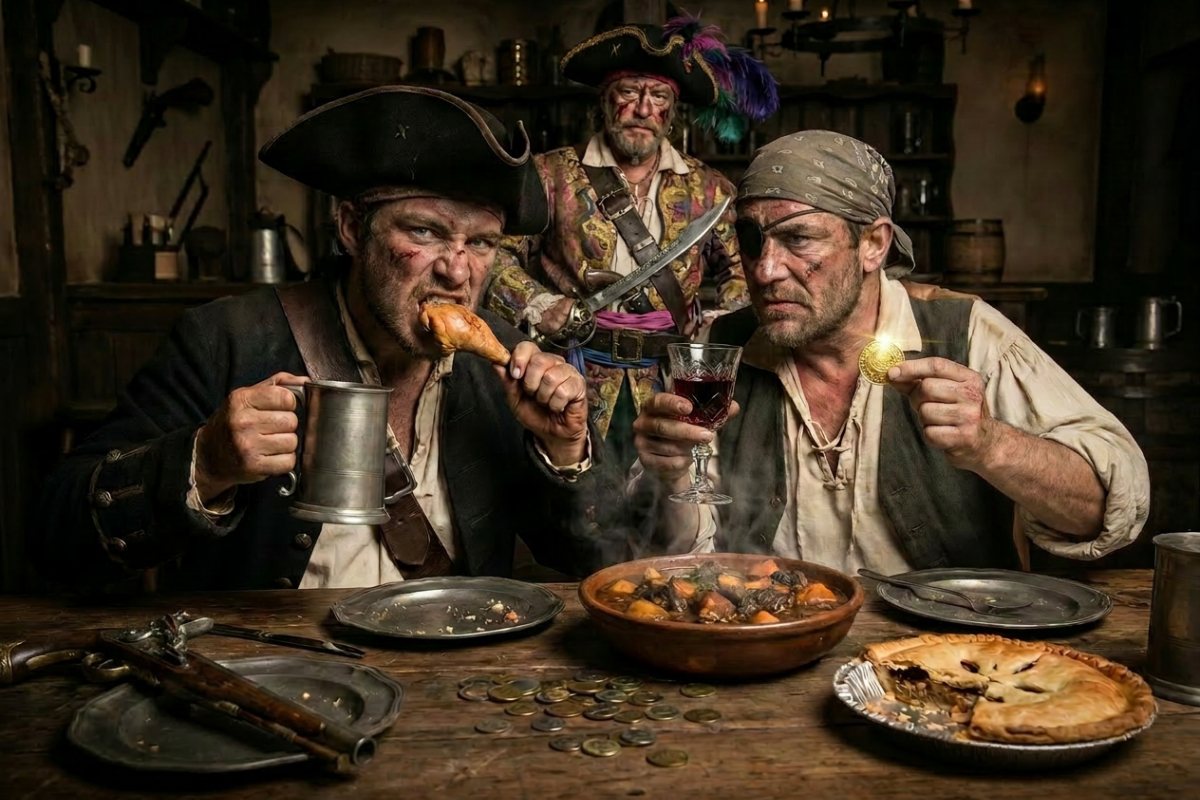
Ik ben al langere tijd gefascineerd door zeerovers (boekaniers, piraten, kapers) en dan niet zozeer het romantische Hollywood-beeld, maar de rauwe waarheid. En één van die aspecten is wat zij nu aten en of dat verschilde van andere zeelieden of burgerbevolking.
Ik ben ook al langere tijd van plan ooit eens een tuinfeestje te organiseren met uitsluitend piratenvoedsel en -drankjes. Het is er nog steeds niet van gekomen, maar het plan leeft nog wel. Maar ja, dan heb je wel recepten nodig. Maar hoewel een indrukwekkende rij piraten biografische werkjes hebben nagelaten, zijn er geen kookboeken.
Als de drankjes en maaltijden al beschreven worden, dan krijg je een lijst met ingrediënten, terwijl er ook nog eens een grote variëteit is tussen verschillende websites. Met andere woorden: zoek het maar uit.
En dat heb ik nu juist gedaan.
Salmagundi
Het maakt niet zo heel veel uit of we kijken naar de 17e of 18e eeuw (de Gouden Eeuw der Piraterij), maar wel naar welke streek. Ik heb me voor deze blog voornamelijk toegelegd op de Caraïben.
Dé piratenmaaltijd (volgens een bepaalde website niet zozeer dagelijkse kost als meer een feestelijke beloning na een succesvolle plundertocht) was salmagundi. In het Frans wordt dit gerecht salmigondis genoemd, toentertijd sprak men op Jamaica van Solomon Gundy.
In de 17e eeuw verwees het woord naar een grootse salade met allerlei ingrediënten, vaak kunstig opgediend in lagen of patronen, zoals in dure huizen geserveerd. Maar dat is niet hoe de piraten het aten. Uit alle bronnen blijkt duidelijk dat dit om een stoofpot ging, en naar ik vermoed, warm. Ze hadden dus hun eigen draai gegeven aan een al bestaand gerecht.
Het recept gaat als volgt:
- Benodigdheden: één ketel
- Ingrediënten: alles waar je maar de hand op kan leggen
- Bereiding: men pleure alles in één ketel en laat het borrelen tot het gaar is; als de vlammen uit je bek slaan, is het goed.
- Serveertip: spoel het weg met veel alcohol
Het was feitelijk een stoofpot met als ingrediënten vlees, vis/schaaldieren, groenten, fruit en specerijen, in elke bedenkbare combinatie.
Het enige ‘echte’ recept dat ik tot nu toe gevonden heb, luidt: “… whatever meats available, roasted, chopped into chunks and marinated in spiced wine, then combined with cabbage, anchovies, pickled herring, mangoes, hard-boiled eggs, palm hearts, onions, olives, grapes and any other pickled vegetable available, the whole highly seasoned with garlic, salt, pepper and mustard seed, and doused with oil and vinegar, and served with drafts of beer and rum…”
De reproductie van deze lekkernij kan lastig worden, omdat een groot deel van de ingrediënten hier niet verkrijgbaar zijn of zelfs op dit moment verboden zijn om te verhandelen. Een goede vriendin van me heeft met een collega eens een dappere poging gewaagd en naar eigen inzicht twee variaties gemaakt, die ik beide zeer smakelijk vond.
Maar welke ingrediënten stonden de Caraïbische piraten nu ter beschikking? Laten we één voor één de lijst doornemen per categorie: vlees en vis, groente en fruit, brood en overig.
Vleessoorten en voedsel uit de zee
Wat er eigenlijk altijd in zat, waren schildpad en duif.
Schildpad was bij alle zeelieden geliefd. In Port Royal op Jamaica (de inofficiële piratenhoofdstad van de Caraïben) was zelfs een heuse ‘turtle crawl’ (schildpadkraal, een omheind gebied aan de kust waar gevangen schildpadden levend – en dus vers – gehouden werden). Schildpadden kon je in het ruim gemakkelijk opstapelen en bleven zo lang in leven. Ja, niet erg diervriendelijk, maar daar maalde men toen niet om. Elke schildpad leverde 300-350 pond vlees en het vet kon tot olie om in te koken gebruikt worden. Volgens Exquemelin (een piraat die een belangrijk boek heeft geschreven over piraterij) zou te veel schildpad eten (3 weken niets anders dan dat) de huid vet gemaakt hebben, zozeer zelfs, dat je je hemd ‘uit kon wringen’. Bah!
Ander vlees dat vaak in de salmagundi te vinden was, was (verwilderd) varken en kip. En dat vlees was dus bijna altijd gezouten en/of gerookt om het houdbaar te maken. Geen wonder dat ze altijd dorst hadden!
Gezouten vlees moest eerst geweekt worden om het zout er zoveel mogelijk uit te krijgen. Wat overbleef was leerachtig spul dat na koken tot de helft gekrompen was. Roken werd gedaan op een soort barbecue (waarover later meer) gedurende drie uur, waarna de stroken vlees nog twee dagen in de zon gedroogd werden. Hierbij was weinig zout nodig. Dit gerookte vlees kon of zo of verwerkt gegeten worden, leek wel wat op wat wij kennen als beef jerky of biltong en bleef 6-12 maanden goed
Maar piraten waren niet kieskeurig en aten eigenlijk alles wat ze stelen of vangen konden. Rund, paard en geit, zeekoe, zeehond en dolfijn, leguaan en krokodil, gordeldier, hutia, agoeti en aap, papegaai, pelikaan, en flamingo, West-Indische fluiteend en Amerikaans purperhoen. Zeevogels, zoals noddy, waren niet populair en werden meer als noodvoedsel gezien. Wat ze pertinent niet aten, waren hun huisdieren.
En bij grote honger, zoals op de beruchte tocht van Morgan dwars door Panamá, gingen ze soms over tot het koken van leer.
Je zou zeggen dat er veel gevist werd, maar dat leek wel tegen te vallen. Vissen aan boord was tijdrovend en blijkbaar lastig, zodat het geen hoofdvoedsel was. Aan wal was er natuurlijk wel een ruime keuze aan vis, schaal- en schelpdieren en andere lekkernijen uit de zee.
In het recept werden al ansjovis en haring genoemd, en vooral de eerste schijnt toch wel een belangrijk ingrediënt geweest te zijn. Verder verorberden ze zo’n beetje alles, van haai tot kabeljauw, makreel en schelvis, van zeebaars tot vliegende vis, zeekomkommer en inktvis, landkrabben en kreeften, zeeslakken, mosselen en oesters.
Dampier noemt een recept voor haai. Het vlees werd gekookt, droog geknepen en gestoofd met azijn, peper en andere specerijen.
Zoals ik al zei: je kunt eigenlijk niet de mist ingaan. Het maakt ook niet uit welk deel van het dier je eet, want het merg was zeer geliefd en de ingewanden werden ook niet geschuwd.
Groenten en fruit
Aan boord van schepen die lang op zee bleven, was de keuze niet bepaald reuze. Daar bleef het voornamelijk beperkt tot bonen en erwten (kikkererwt, linze, tuinboon etc). Piraten bleven nooit lang op zee en waren dus veel minder afhankelijk van voedsel dat lang houdbaar was, dus zij hadden een gezonder dieet en een ruimere keuze, hoewel uit het recept duidelijk blijkt dat de groenten wel bijna altijd pickled (gepekeld of ingelegd in azijn) waren.
In het recept worden palmhart, ui en olijf genoemd (hoewel je olijf ook onder fruit zou kunnen scharen). Palmhart, ook wel tree cabbage genoemd, was erg geliefd en werd graag gekookt gegeten met een geroosterde geitenbout.
In het wild of van akkers van inheemse bevolking kwamen verder allerlei groenten, van wie de meest exotische yam, cassave, dasheen (taro) en callaloo (tayer of tannia) zijn. Daarnaast werden er in Amerika aardappelen aangeplant. En dat is waarschijnlijk een kleine greep uit het arsenaal.
Tomaat was bij de Engelsen niet erg geliefd, omdat velen geloofden dat het giftig was.
Verder komen in de annalen allerlei andere groenten voor, waarvan niet altijd duidelijk is wat er precies mee bedoeld werd, maar aangezien de piraten al heel goed door hadden dat ze scheurbuik kregen bij te weinig vers, groen voer, werd er zo’n beetje alles gegeten wat ze krijgen konden.
Als fruit worden druiven en de populaire mango genoemd, hoewel de mango pas in de 18e eeuw verscheen in die streken. Populair, maar eigenlijk nooit genoemd als ingrediënt voor de salmagundi, zijn kokosnoot (maar niet in de Caraïben), banaan en avocado. Bakbanaan werd als vervanger van meel gebruikt en de ikakopruim was geliefde vanwege de zoete smaak. We weten dat piraten zoetekauwen waren, dus als ze de mogelijkheid hadden, zal er weel veel fruit in de stoofpot gekieperd zijn.
Avocado was welbekend in de Caraïben en werd normalerwijze met een beetje zout en geroosterde bakbanaan gegeten. Verder kon het ook gemengd worden met suiker en limoen, de voorloper van de guacamole.
Daarnaast worden genoemd (afhankelijk van de plaats) ananas, banaan, sinaasappels, citroen en limoen.
Brood
In de Caraïben was een tekort aan tarwe en haver, zodat brood uiterst zeldzaam en kostbaar was. En aan de beruchte scheepsbeschuit hadden ze een hekel. Dat aten ze alleen in nood. Scheepsbeschuit werd gemaakt van tarwemeel, water, zemelen, zout of suiker dat twee (tweebak, zwieback) tot vier keer gebakken werd, zodat het keihard was en alleen met een kolf van een pistool kapotgeslagen kon worden of geweekt. De minder harde variant van fijner meel kennen wij als gewoon beschuit (rusk in Engels). Aan boord was scheepsbeschuit vaak volledig verziekt van maden en ander ongedierte. Hoewel die een goede bron van proteïnen geweest zouden zijn, werden die toch zoveel mogelijk verwijderd.
Ook geliefd onder zeerovers zouden ‘doughboys’ zijn, een soort dumplings, van meel en niervet (suet), die zowel hartig als zoet konden zijn. Die werden dan gekookt of gebakken in reuzel of olie en dan gegeten met boter of iets dergelijks.
Maïs, dat volop te krijg was in de Spaanse koloniën, werd gebruikt voor pap (grits) of tortilla’s. Daarnaast was er in sommige streken rijst te krijgen, vooral op Madagaskar.
Pannenkoeken waren bekend en werden hot cakes genoemd, maar meel werd dus voornamelijk gekookt tot pap, pudding, dumplings of in een stoofpot (burgoo genoemd).
Burgoo wordt pas voor het eerst genoemd in het midden van de 18e eeuw, wat niet wil zeggen dat het er al niet eerder was, en bestond uit een stoofpot van meel, boter en suiker waar dan weer van alles aan toegevoegd kon worden.
Er zijn wat puddingrecepten overgeleverd. Meestal bestond het uit meel, zout en niervet. Plumpudding wordt ook vermeld. Er kon in plaats van zout ook suiker toegevoegd worden. En een bijzonder recept was grof meel met zeewater en sweetmeats (suikergoed) dat dan met gedroogd vlees gegeten kon worden.
Er zijn de nodige alternatieven voor brood, zoals de broodvrucht (maar niet in de Caraïben), bakbananen, cassave, yam en zoete aardappel of zelfs de gewone aardappel.
Overige ingrediënten
Verder zaten er hardgekookte eieren in, wijn, knoflook, peper, zout, mosterd, olie en azijn.
Omdat voedsel vaak niet echt vers meer was, moest de smaak verdoezeld worden met veel specerijen. En mogelijk waren door overmatig gebruik van alcohol, tabak en zout de smaakpapillen van de piraten ook wel naar hun grootje. Zo zien we veelvuldig gebruik van gember, piment, nootmuskaat, kaneel en kruidnagel, wat in deze streken minder kostbaar was dan elders in de wereld.
In één van de annalen noemt een piraat pepersaus, gemaakt van piment, gekookt in water, gepekeld met zout en gemengd met limoensap.
Kruiden, zoals peterselie, postelein etc. werden meer als geneesmiddel dan als voedingsmiddel gezien.
Zuivel ben ik eigenlijk niet tegengekomen, ook al was kaas één van de hoofdingrediënten op zee. Kaas werd geïmporteerd en zal na de lange reis op zee wel niet echt lekker meer geweest zijn. Boter en melk werden wel gebruikt, maar olie van bijvoorbeeld schildpadden of niervet of reuzel waren veel populairder.
Aan suiker was geen gebrek, want er waren veel suikerrietplantages en de suiker (niet verkrijgbaar als kristalsuiker, maar als harde ‘broodjes’) was goedkoop. De rietsuikerstengels werden gekookt, het sap in vormen gegoten om te drogen. Je had dan een bruine suikerkegel, die wat naar melasse smaakte (muscovado). Witte suiker werd verkregen door verdere raffinage.
Een bijproduct is melasse, een soort stroop, dat zo gebruikt kon worden, maar meestal gebruikt werd om rum van te stoken.
Marmelade in die tijd was een soort stevige, geleiachtige snoep en er waren ook andere zoetwaren, die bijzonder geliefd waren.
En ten slotte was er cacao, wat vooral voor het ontbijt gedronken werd, zoals hierboven al genoemd. Wel hadden de piraten al door dat als dit het hoofdbestanddeel van je dieet was, zoals soms voorkwam bij tekorten van andere ingrediënten, je er dik van werd. Zo dom waren ze dus niet!
Boekaniers waren BBQ’ers
Een leuk weetje is dat het woord boekanier komt van een Arawak woord voor een houten grill (voor het roken van zeekoeienvlees), wat leidde tot het Franse boucaner, oftewel vlees op de BBQ roken. Dat was de naam voor de Franse jagers die het vlees van verwilderde dieren rookten om het houdbaar te maken.
Rond 1630 vluchtten de van Hispaniola verdreven Fransen naar Tortuga. Daar kregen ze gezelschap van andere Fransen, Nederlanders en Engelsen en toen de Spanjaarden hen daar wilden verdrijven, begonnen ze met kleine bootjes Spaanse schepen aan te vallen en vestigden daar een berucht piratenrijk. Zo werd het woord boucanier uiteindelijk synoniem met zeerover.
Overigens onderscheidden boekaniers zich in twee opzichten van andere piraten: ze werkten gedurende langere perioden samen om hun prooi en strategie vast te stellen en ze sloegen ook toe op het vasteland.
Hollandse ziekte
Over het algemeen aten de Spanjaarden vanwege hun mediterrane dieet gezonder dan Fransen, Engelsen en Nederlanders. Scheurbuik kwam op Spaanse schepen ook nauwelijks voor, zodat zij het de Hollandse Ziekte noemden.
Maar over het algemeen was scheurbuik (scorbut in die tijd genoemd) een vreselijke ziekte, misschien wel de nummer één van doodsoorzaken onder zeelui. Net zoals de Nederlanders tegenwoordig uniek zijn doordat wij ziekten als scheldwoord of scheld-voorvoegsel gebruiken, deden de Engelsen dat met het woord scurvy (scheurbuik), zoals ‘scurvy bullet’.
Overigens betekende het niet dat men niet wist hoe men het voorkomen kon, ook al werd de precieze werking nog niet begrepen. Officieel begint de strijd tegen scheurbuik in 1753 met de publicatie A Treatise of the Scurvy, maar empirisch was men al veel eerder achter de oorzaak gekomen. De Franse ontdekkingsreiziger Cartier (1536) en de Engelse chirurgijn Woodall (1617) wisten al dat citrusvruchten en verse groenten het konden genezen, maar die bevindingen werden vaak vergeten of terzijde geschoven. Maar piraten wisten donders goed dat ze vaak groenten en fruit moesten eten om niet ziek te worden en bewaarden hun houdbare voorraden ook voor het moment dat de sneller bedervende waren op waren.
Sterke drank
Piraten aten, maar ze dronken nog meer. Hun drankverbruik was iconisch.
Sir Thomas Modyford, de Gouverneur van Jamaica, schreef in 1665: “The Spanish wondered much at the sickness of our people, until they knew the strength of their drinks, but then wondered more that they were not all dead.”
Alexandre O. Exquemelin (een boekanier, die één van de belangrijkste informatieboeken over de piraterij in die eeuw schreef, De Americaensche Zee-Roovers) over de beroemde Nederlandse piratenkapitein Rok Brasiliano: “als hy droncken was, liep hy als een dol mensch langhs de Stadt, ende d’eerste die hem tegen quam, kapten hy een arm of een been af, sonder dat hem iemandt dorst berispen als met goede woorden, want hy was als een uytgelaten mensch.”
William Dampier (een andere piraat die een boek nagelaten heft) over Engelse logwood (bloedhout) kappers in de Laguna de Términos: “They had not forgot their old drinking bouts, and would still spend £30 or £40 at a sitting on board the ships that came hither from Jamaica, carousing and firing of guns three or four days together.”
Er was ruime keuze uit alcoholische dranken, de belangrijkste daarvan ongetwijfeld rum (ook wel rumbullion genoemd). De belangrijkste? Wel, het lijkt erop dat piraten net zoveel andere spiritualiën dronken en dat de iconische status van rum wat overdreven lijkt.
Hoe dan ook, piraten konden verder kiezen uit:
- arak (Oost-Azië)
- bier
- brandewijn
- chicha (gemaakt van bakbananen)
- cider
- mum (sterk, houdbaar, zwart bier)
- tepache (slechts 1-2%, van gefermenteerde ananas met suiker en kaneel)
- toke (een soort mede, vnl. in Madagaskar)
- wijn en dan vooral Madeira
Als je iets zonder alcohol wilde (uhhm…) dan had je limonade, dat, zoals de naam al zei, van limoenen gemaakt was, of cacao, koffie en thee. Vooral cacao was extreem populair en werd in grote hoeveelheden gedronken, vooral als ontbijt.
Cocktail time!
Maar al die alcohol kun je ook mixen, natuurlijk. Maar helaas zijn er ook geen recepten voor piratencocktails. Sites spreken elkaar nogal tegen en waarschijnlijk had iedereen zijn eigen variant. Als je de verschillende mixen naast elkaar zet, zie je ook nogal een behoorlijke overlap.
Kort samengevat nam je één of meerdere alcoholische dranken, voegde daar specerijen en soms fruit aan toe, vaak ook nog suiker, en naar believen kon je dat ook nog warm maken.
Dat heet maken werd met een pook gedaan, genaamd loggerhead of mulling iron. Het was een lange ijzeren staaf met een bal aan het einde. Ze werden gebruikt om iets heet te maken of te smelten, dus niet alleen voor drankjes. Zo gebruikten scheepsbouwers het om pek te smelten.
Grappig om te vermelden, misschien, is dat hier waarschijnlijk de uitdrukken ’to be at loggerheads’ vandaan kwam, wat zoveel betekent als in een pittig conflict verwikkeld zijn.
Dus welke cocktails hadden de benevelde breinen van piraten bedacht?
- blackstrap (vroege 18e eeuw): rum met veel (zwarte) melasse (of zware rum gedistilleerd van blackstrap melasse) met heet/koud water (ook wel black stripe genoemd)
- bumbo: rum met suiker, water, nootmuskaat en/of kaneel (tegenwoordig zit er ook grenadine en limoensap in)
- callibogus (18e eeuw): rum, melasse en spruce beer (sparrenbier)
- flip: dunbier of ale met brandewijn (of ook wel rum), altijd met suiker en soms met specerijen, zoals gember, maar altijd heet gedronken
- grog (sinds 1740): verdunde rum (pas later in de geschiedenis werd citroensap toegevoegd)
- kilduijvel: een eufemisme voor rum, soms met rauw ei, vaak met buskruit (waarover later meer).
- mobby: goedkope vervanging voor bier, gefermenteerde zoete bataten en waarschijnlijk suiker of melasse, soms met toevoegingen als limoen, niet te verwarren met mauby, de traditionele, Caribische drank van de bast van de Colubrina elliptica.
- mulled wine / glühwein: gezoete, gekruide wijn, zeker bekend, maar niet zo populair in de Caraïben.
- punch (zie ook bumbo): rum met fruit, honing en nootmuskaat
- rumfustian: jenever, sherry en bier (geen rum!), eigeel, suiker en specerijen (kaneel, nootmuskaat kruidnagel) en soms citroen, warm gedronken, vergelijkbaar met flip of hot toddy
- sangaree: wijn met fruit en suiker (sangría)
- stonewall (midden 18e eeuw): rum met cider (ook wel stone fence of sampson genaamd)
- tobacco rum: blijkbaar rum met tabak, maar hier heb ik verder niets over kunnen vinden
- toddy (late 18e eeuw): oorspronkelijk palmwijn, later ook rum of brandewijn, met heet water, suiker of honing en specerijen zoals kaneel
- zwarte aframmeling: rum met buskruit
Buskruit? Are you kiddin’ me?
Het is een hardnekkig gerucht, maar is het waar? Deden piraten, ofwel om zichzelf meer moed in te drinken, dan wel om stoer te doen of omdat gewone alcohol geen effect meer had, buskruit in hun rum? Het lijkt erop dat het geen broodje aap is, maar helemaal zeker is het niet. Maar als je ziet welke strapatsen ze in hun (dronken) kop soms uithaalden, dan zou het zomaar waar kunnen zijn.
Wat doet het met de smaak? Volgens internet geeft het een wat rokerige, geroosterde, aardse en pittige smaak. Een vriend van me heeft het geprobeerd (tja, wat zal ik zeggen?) en bevestigt dit. Het is niet echt wow.
Was het gezond? Nee. Was het gevaarlijk? Ja.
Dus tja, als ik dit ‘authentieke’ feestje wil geven, kan ik dat niet gebruiken. Wie veilige alternatieven zoekt, kan denken aan gunpowder tea, actieve kool (activated charcoal), gunpowder spice of milagai podi (maar dat is meer voor voedsel bedoeld) of Smoke & Oakum’s Gunpowder Rum.
Ik heb ook nog iets gelezen dat buskruit soms aan een sample van een batch rum werd toegevoegd en aangestoken, om te testen of de rum niet te verwaterd was. Wie weet? Volgens mij heb je geen buskruit nodig om dat te testen, want als het 40% of meer is, ontbrandt het ook zonder.
Dus wat ga ik maken?
Dus hoe nu verder als ik eindelijk eens werk wil maken deze zomer van mijn piratenfestijn?
Het menu zal er ongeveer zo uit moeten zien:
- salmagundi met wilde duif, varkensvlees, haring, kreeft, palmhart, mango, eieren, Amsterdamse uitjes, olijven, knoflook en mosterd
- tweede variant van salmagundi, misschien met kip, beef jerky, krokodil, kabeljauw, zeeslak, kool, ei en cassave
- lam van de barbecue met palmharten
- stoofpot van zoete aardappelen en taro
- avocado met geroosterde bakbanaan
- dougboys met reuzel en melasse
- tortillas of maïspap
- pudding met suikergoed (jelly)
- pepersaus van piment en limoen
- warme cacao
- flip
- punch of bumbo
- sangaree (sangría)
- rumfustian
Taveernes
Ik wil afsluiten met de taveernes op Port Royal.
Port Royal was klein qua oppervlakte (21 hectare of 51 acres) met zo’n tweeduizend gebouwen, maar er woonden volgens schattingen grofweg 6500 mensen, met pieken tot 10.000, opeengepakt als haringen in een ton. En een groot deel van de bevolking bestond uit zeelui van elk pluimage.
En die zeelui hadden dorst. Rond 1680 zouden er maar liefst meer dan 100 taveernes geweest zijn. Op zijn piek zou er één kroeg op tien inwoners geweest zijn, maar bovenstaand rekensommetje logenstraft die bewering.
Nu wil ons romantische Hollywood-brein natuurlijk dat die taveernes kleurrijke namen hadden, zoals De Kotsende Buizerd, of De Luis aan de Ketting (een bestaande kroeg overigens). Maar net als elders in de wereld waren de namen van de kroegen in Port Royal niet zo spannend.
Ik heb achttien historische namen terug kunnen vinden, vaak ook met aan welke straat ze precies lagen, en daar zaten best wel saaien namen tussen als The Blue Anchor, the Cat and Fiddles, the Cheshire Cheese, The Green Dragon, The King’s Arms, The Sign of the Mermaid, The Sugar Loaf en The Three Tunns. De meest spannende was misschien nog The Black Dogg, wat ook al best tam was.
Maar aan al het goede komt een einde zeggen ze, en de “wickedest city on earth” kreeg wat het, in de ogen van velen, verdiende. In 1692 zonk het bij een gigantische aardbeving in een paar minuten voor de helft in de zee, waarbij tweeduizend doden vielen, nog afgezien van degenen die daarna bezweken aan verwondingen en ziekten.
Overigens ligt de stad er nog steeds en hebben duikers het in kaart gebracht.
Eat and drink like a pirate
I have been fascinated by pirates (buccaneers, pirates, privateers) for a long time, and not so much the romantic Hollywood image, but the raw truth. And one of those aspects is what they really ate and whether it differed from other sailors or civilian populations.
I have also been planning for a long time to organize a garden party with only pirate food and drinks. It still hasn’t happened, but the plan is still alive. But then you do need recipes. But although an impressive list of pirates have left biographical works, there are no cookbooks.
If the drinks and meals are described at all, you get a list of ingredients, while there is also a wide variety between different websites. In other words: figure it out.
And that’s exactly what I did.
Salmagundi
It doesn’t matter so much whether we look at the 17th or 18th century (the Golden Age of Piracy), but it does matter at which region. For this blog, I mainly focused on the Caribbean.
The pirate meal (according to a certain website not so much a daily fare as a festive reward after a successful raid) was salmagundi. In French this dish is called salmigondis, at that time people in Jamaica spoke of Solomon Gundy.
In the 17th century, the word referred to a grand salad with all kinds of ingredients, often artfully served in layers or patterns, as served in expensive houses. But that’s not how the pirates ate it. From all sources it is clear that this was a stew, and I suspect, hot. So they had given their own twist to an already existing dish.
The recipe goes like this:
- Equipment: one kettle
- Ingredients: everything you can get your hands on
- Preparation: slam everything into one kettle and let it bubble until it is cooked; If the flames are coming out of your mouth, it’s done to perfection.
- Serving suggestion: wash it down with plenty of alcohol
It was actually a stew with meat, fish/shellfish, vegetables, fruit and spices as ingredients, in every conceivable combination.
The only ‘real’ recipe I have found so far is: “… whatever meats available, roasted, chopped into chunks and marinated in spiced wine, then combined with cabbage, anchovies, pickled herring, mangoes, hard-boiled eggs, palm hearts, onions, olives, grapes and any other pickled vegetable available, the whole highly seasoned with garlic, salt, pepper and mustard seed, and doused with oil and vinegar, and served with drafts of beer and rum…”
The reproduction of this delicacy could prove to be tricky, as a large part of the ingredients are not available here or are even currently forbidden to trade. A good friend of mine once made a brave attempt with a colleague and made two variations at her own discretion, both of which I found very tasty.
But what ingredients were available to the Caribbean pirates? Let’s go through the list one by one by category: meat and fish, fruit and vegetables, bread and other.
Meats and food from the sea
What was actually always in it were turtle and pigeon.
Turtle was loved by all sailors. In Port Royal on Jamaica (the unofficial pirate capital of the Caribbean) there was even a real ’turtle crawl’. Turtles could easily be piled up in the hold and thus stayed alive for a long time. Yes, not very animal-friendly, but people didn’t care about that at the time. Each turtle yielded 300-350 pounds of meat and the fat could be used into oil for cooking. According to Exquemelin (a pirate who has written an important book about piracy) eating too much turtle (3 weeks of nothing but that) would have made the skin greasy, so much so that you could ‘wring out’ your shirt. Ugh!
Other meat that could often be found in the salmagundi was (feral) pork and chicken. And that meat was almost always salted and/or smoked to make it shelf-stable. No wonder they were always thirsty!
Salted meat had to be soaked first to get the salt out as much as possible. What remained was leathery stuff that had shrunk to half after cooking. Smoking was done on a kind of barbecue (more on that later) for three hours, after which the strips of meat were dried in the sun for another two days. Little salt was needed for this. This smoked meat could be eaten either as it is or processed, resembled what we know as beef jerky or biltong and remained good for 6-12 months
But pirates were not picky and actually ate everything they could steal or catch. Cattle, horse and goat, manatee, seal and dolphin, iguana and crocodile, armadillo, hutia, agouti and monkey, parrot, pelican, and flamingo, West Indian whistling duck and American purple gallinule. Seabirds, such as noddy, were not popular and were seen more as emergency food. What they absolutely did not eat were their pets.
And when they were very hungry, such as on Morgan’s infamous journey right through Panamá, they sometimes turned to cooking leather.
You would think that there was a lot of fishing, but that seemed not to be the case. Fishing on board was time-consuming and apparently troublesome, so it wasn’t a staple food. On shore there was of course a wide choice of fish, crustaceans and shellfish and other delicacies from the sea.
Anchovies and herring were already mentioned in the recipe, and especially the first seems to have been an important ingredient. They also ate just about everything, from shark to cod, mackerel and haddock, from sea bass to flying fish, sea cucumber and squid, land crabs and lobsters, sea snails, mussels and oysters.
Dampier mentions a recipe for shark. The meat was boiled, squeezed dry and stewed with vinegar, pepper and other spices.
As I said, you can’t really go wrong. It doesn’t matter which part of the animal you eat, because the marrow was very popular and the intestines were not shunned.
Fruit and vegetables
On board ships that stayed at sea for a long time, the choice was not exactly huge. There it was mainly limited to beans and peas (chickpea, lentil, broad bean, etc.). Pirates never stayed at sea for long and were therefore much less dependent on food that had a long shelf life, so they had a healthier diet and a wider choice, although it is clear from the recipe that the vegetables were almost always pickled.
In the recipe, heart of palm, onion, and olive are mentioned (although you could also classify olive as fruit). Heart of falm, also known as palm cabbage, was very popular and was often eaten cooked with a roasted leg of goat.
In the wild or from fields of indigenous people, all kinds of vegetables were to be had, the most exotic of which are yam, cassava, dasheen (taro) and callaloo (tannia). In addition, potatoes were planted in America. And that’s probably a small selection from the arsenal.
Tomato was not very popular with the English, because many believed it to be poisonous.
Furthermore, all kinds of other vegetables appear in the annals, of which it is not always clear what exactly was meant by them, but since the pirates were already well aware that they got scurvy from too little fresh, green food, just about everything they could get was eaten.
Grapes and the popular mango are mentioned as fruits, although the mango only appeared in those regions in the 18th century. Popular, but never really mentioned as an ingredient for the salmagundi, are coconut (but not in the Caribbean), banana and avocado. Plantains were used as a substitute for flour and the cocoplum was popular because of its sweet taste. We know that pirates had a sweet tooth, so if they had the opportunity, a lot of fruit would have probably been thrown into the stew.
Avocado was well known in the Caribbean and was normally eaten with a little salt and roasted plantain. It could also be mixed with sugar and lime, the precursor of guacamole.
In addition, pineapple, banana, oranges, lemon and lime are mentioned (depending on the place).
Bread
In the Caribbean there was a shortage of wheat and oats, so bread was extremely rare and expensive. And they hated the infamous ship’s biscuits. They only ate that in need. Ship’s biscuits were made from wheat flour, water, bran, salt or sugar that was baked two (two-bake, zwieback) to four times, so that it was rock hard and could only be soaked or smashed with a butt of a gun. The less hard variant of finer flour is known as rusk. On board, ship’s biscuits were often completely crawling with maggots and other vermin. Although they would have been a good source of protein, they were removed as much as possible.
Also popular among pirates were ‘doughboys’, a kind of dumplings, made of flour and suet, which could be both savoury and sweet. These were then boiled or fried in lard or oil and then eaten with butter or something similar.
Corn, which was widely available in the Spanish colonies, was used for porridge (grits) or tortillas. In addition, rice was available in some regions, especially in Madagascar.
Pancakes were known and called hot cakes, but flour was mainly cooked into porridge, pudding, dumplings or in a stew (called burgoo).
Burgoo is only mentioned for the first time in the middle of the 18th century, which does not mean that it did not already earlier, and consisted of a stew of flour, butter and sugar to which all kinds of other things could be added.
There are some pudding recipes that have survived. Usually it consisted of flour, salt and suet. Plum pudding is also listed. Sugar could also be added instead of salt. And a special recipe was coarse flour with seawater and sweetmeats (candy) that could then be eaten with dried meat.
There are quite a few alternatives to bread, such as breadfruit (but not in the Caribbean), plantains, cassava, yam and sweet potato or even the regular potato.
Other ingredients
It also contained hard-boiled eggs, wine, garlic, pepper, salt, mustard, oil and vinegar.
Because food was often not really fresh anymore, the taste had to be covered up with a lot of spices. And possibly due to excessive use of alcohol, tobacco and salt, the taste buds of the pirates were also shot. For example, we see frequent use of ginger, allspice, nutmeg, cinnamon and cloves, which was less expensive in these regions than elsewhere in the world.
In one of the annals, a pirate mentions pepper sauce, made from allspice, boiled in water, pickled with salt and mixed with lime juice.
Herbs, such as parsley, purslane etc. were seen more as medicine than as food.
I didn’t actually come across dairy, even though cheese was one of the main ingredients at sea. Cheese was imported and after the long journey at sea it must not have been very tasty anymore. Butter and milk were used, but oil from, for example, turtles or suet or lard were much more popular.
There was no shortage of sugar, because there were many sugar cane plantations and the sugar (not available as granulated sugar, but as hard ‘loaves’) was cheap. The cane sugar stalks were boiled, the juice poured into molds to dry. You had then ended up with a brown sugar cone, which tasted a bit like molasses (muscovado). White sugar was obtained by further refining.
A by-product is molasses, a type of treacle, which could be used as is, but was usually used to distill rum.
Marmalade at that time was a kind of firm, jelly-like candy and there were also other confectionery, which were particularly popular.
And finally, there was cocoa, which was mainly drunk for breakfast, as mentioned above. However, the pirates already realized that if this was the main component of your diet, as sometimes happened with deficiencies of other ingredients, it made you fat. So they weren’t that stupid!
Buccaneers were BBQ guys
A fun fact is that the word buccaneer comes from an Arawak word for a wooden grill (for smoking manatee meat), which led to the French boucaner, or smoking meat on the BBQ. That was the name for the French hunters who smoked the meat of feral animals to make it last longer.
Around 1630, the French, expelled from Hispaniola, fled to Tortuga. There they were joined by other French, Dutch and English, and when the Spanish wanted to drive them out, they started attacking Spanish ships with small boats and established a notorious pirate empire there. This is how the word buccaneer eventually became synonymous with corsair.
Incidentally, buccaneers differed from other pirates in two respects: they worked together for longer periods of time to determine their prey and strategy and they also struck on the mainland.
Dutch disease
In general, the Spanish ate healthier than the French, English and Dutch because of their Mediterranean diet. Scurvy was also rare on Spanish ships, so they called it the Dutch Disease.
But in general, scurvy (called scorbut at the time) was a terrible disease, perhaps the number one cause of death among sailors. Just as the Dutch are unique today because we use diseases as a swear word or swear prefix, the English did so with the word scurvy, such as ‘scurvy bullet’.
Incidentally, it did not mean that people did not know how to prevent it, even if the exact effect was not yet understood. Officially, the fight against scurvy began in 1753 with the publication A Treatise of the Scurvy, but empirically the cause had been discovered much earlier. The French explorer Cartier (1536) and the English surgeon Woodall (1617) already knew that citrus fruits and fresh vegetables could cure it, but those findings were often forgotten or brushed aside. But pirates knew very well that they often had to eat fruit and vegetables to avoid getting sick and also saved their non-perishable supplies for the moment when the faster spoiling goods ran out.
Spirits
Pirates ate, but they drank even more. Their drink consumption was iconic.
Sir Thomas Modyford, the Governor of Jamaica, wrote in 1665: “The Spanish wondered much at the sickness of our people, until they knew the strength of their drinks, but then wondered more that they were not all dead.”
Alexandre O. Exquemelin (a buccaneer, who wrote one of the most important information books on piracy in that century, De Americaensche Zee-Roovers) about the famous Dutch pirate captain Rok Brasiliano: “When he was drunk, he walked like a madman along the city, and the first who came up against him, he cut off an arm or a leg, without anyone daring to reprimand him with good words, for he was like an man out of his mind.”
William Dampier (another pirate who left a book) about English logwood cutters in the Laguna de Términos: “They had not forgot their old drinking bouts, and would still spend £30 or £40 at a sitting on board the ships that came hither from Jamaica, carousing and firing of guns three or four days together.”
There was a wide choice of alcoholic beverages, the most important of which was undoubtedly rum (also called rum bullion). The most important one? Well, it seems that pirates drank just as many other spirits and that the iconic status of rum seems a bit exaggerated.
Anyway, pirates could also choose from:
- arak (East Asia)
- beer
- brandy
- chicha (made from plantains)
- cider
- mumme (strong, long-lasting, black beer)
- tepache (only 1-2%, from fermented pineapple with sugar and cinnamon)
- toke (a kind of mead, mainly in Madagascar)
- wine and especially Madeira
If you wanted something without alcohol (uhhm…) you had lemonade, which, as the name suggested, was made from limes, or cocoa, coffee and tea. Cocoa in particular was extremely popular and was drunk in large quantities, especially for breakfast.
Cocktail time!
But you can also mix all that alcohol, of course. But unfortunately, there are no recipes for pirate cocktails either. Sites contradict each other quite a bit and probably everyone had his own variant. If you put the different mixes next to each other, you can also see quite a bit of overlap.
In short, you took one or more alcoholic beverages, added spices and sometimes fruit, often sugar, and you could also heat it at will.
Heating alcoholic beverages was done with a poker, called loggerhead or mulling iron. It was a long iron bar with a ball at the end. They were used to make something hot or melt, not just for drinks. For example, shipbuilders used it to melt pitch.
Funny to mention, perhaps, is that this is probably where the expression ’to be at loggerheads’ came from, which means as much as being involved in a spicy conflict.
So what cocktails had pirates’ fogged minds come up with?
- Blackstrap (early 1700s): Rum with a lot of (black) molasses (or heavy rum distilled from Blackstrap molasses) with hot/cold water (also called Black Stripe)
- Bumbo: rum with sugar, water, nutmeg and/or cinnamon (nowadays it also contains grenadine and lime juice).
- Callibogus (18th century): rum, molasses and spruce beer
- Flip: thin beer or ale with brandy (or rum), always with sugar and sometimes with spices, such as ginger, but always drunk hot
- Grog (since 1740): diluted rum (lemon juice was added later in history)
- Kilduijvel: a euphemism for rum, sometimes with raw egg, often with gunpowder (more on that later).
- Mobby: cheap substitute for beer, fermented sweet potatoes and probably sugar or molasses, sometimes with additives such as lime, not to be confused with mauby, the traditional, Caribbean drink from the bark of the Colubrina elliptica.
- Mulled wine / glühwein: sweetened, spiced wine, certainly known, but not so popular in the Caribbean.
- Punch (see also Bumbo): rum with fruit, honey and nutmeg
- Rumfustian: gin, sherry and beer (no rum!), egg yolk, sugar and spices (cinnamon, nutmeg cloves) and sometimes lemon, drunk hot, similar to flip or hot toddy
- Sangaree: wine with fruit and sugar (sangría)
- Stonewall (mid 18th century): rum with cider (also called Stone Fence of Sampson)
- Tobacco rum: apparently rum with tobacco, but I haven’t been able to find anything else about this
- Toddy (late 18th century): originally palm wine, later also rum or brandy, with hot water, sugar or honey and spices such as cinnamon
- Zwarte aframmeling (“Black Thrashing”): rum with gunpowder
Gunpowder? Are you kiddin’ me?
It’s a persistent rumour, but is it true? Did pirates, either to get some Dutch courage, or to act tough or because ordinary alcohol no longer had any effect, put gunpowder in their rum? It seems that it is not an urban legend, but it is not entirely certain. But if you see what tricks they sometimes did dead drunk, it could just be true.
What does it do to the taste? According to the internet, it gives a somewhat smoky, roasted, earthy and spicy taste. A friend of mine has tried it (well, what can I say?) and confirms this. It’s not really wow.
Was it healthy? No. Was it dangerous? Yes.
So well, if I want to throw this ‘authentic’ party, I can’t use it. Those looking for safe alternatives can think of gunpowder tea, activated charcoal, gunpowder spice or milagai podi (but that is more intended for food) or Smoke & Oakum’s Gunpowder Rum.
I also read something that gunpowder was sometimes added to a sample of a batch of rum and lit, to test whether the rum was not too watered down. Who knows? I don’t think you need gunpowder to test that, because if it’s 40% or more, it will ignite without it.
So what am I going to make?
So what next if I finally want to make my pirate party work this summer?
The menu should look something like this:
- Salmagundi with wild pigeon, pork, herring, lobster, heart of palm, mango, eggs, Amsterdam (pickled) onions, olives, garlic and mustard
- Second variant of salmagundi, perhaps with chicken, beef jerky, crocodile, cod, sea snail, cabbage, egg and cassava
- Barbecue lamb with hearts of palm
- Sweet potato and taro stew
- Avocado with roasted plantain
- Dougboys with lard and molasses
- Tortillas or corn porridge
- Pudding with candy (jelly)
- Pepper sauce of allspice and lime
- Hot cocoa
- Flip
- Punch of bumbo
- Sangaree (sangría)
- Rumfustian
Taverns
I would like to conclude with the taverns at Port Royal.
Port Royal was small in size (21 hectares or 51 acres) with about two thousand buildings, but according to estimates, roughly 6500 people lived there, with peaks of up to 10,000, packed together like herrings in a barrel. And a large part of the population consisted of sailors of all sorts.
And those sailors were thirsty. Around 1680 there would have been no less than 100 taverns. At its peak, there would have been one pub for every ten inhabitants, but the above calculation belies that claim.
Now, of course, our romantic Hollywood brain wants those taverns to have colorful names, such as The Puking Buzzard, or The Louse on the Chain (an existing pub in the Netherlands, by the way). But just like elsewhere in the world, the names of the pubs in Port Royal were not so exciting.
I was able to find eighteen historical names, often with which street they were on, and there were some pretty boring names like The Blue Anchor, The Cat and Fiddles, The Cheshire Cheese, The Green Dragon, The King’s Arms, The Sign of the Mermaid, The Sugar Loaf and The Three Tunns. The most exciting was perhaps The Black Dogg, which was also quite tame.
But all good things must come to an end, they say, and the ‘wickedest city on earth’ got what it deserved, in the eyes of many. In 1692, a gigantic earthquake caused it to sink half into the sea in a few minutes, killing two thousand people, not to mention those who subsequently succumbed to injuries and diseases.
Incidentally, the city is still there and divers have mapped it.

Comments (0)