
Ik heb een aantal nieuwe boeken helemaal klaar en alleen het feit dat het als schrijver niet handig is om elke maand een boek ‘op de markt’ te brengen en de behoorlijke kosten die eraan verbonden zijn als je geen ‘reguliere’ uitgever hebt, weerhoudt me ervan ze uit te geven.
Eén is een lijvige roman genaamd Berkenmeisje die zich tienduizend jaar geleden afspeelt tijdens de laatste IJstijd. Het verhaal vertelt van een vrouw die door hongersnood gedwongen wordt haar thuisstreek te verlaten en naar het huidige Frankrijk trekt, waar ze in contact komt met andere Cro-Magnon-culturen. We volgen Berkenmeisje vele jaren van haar leven. Het is één van de eerste verhalen die ik schreef en nog steeds een favoriet van mijn moeder.
Prehistorische fictie
Het idee kreeg ik door de Clan of the Cave Bear van Jean M. Auel. Ik vond dat boek fantastisch en het is dan ook geen wonder dat mijn jongste dochter naar de hoofdpersoon vernoemd is. Helaas haalden de volgende delen in de Earth’s Children serie, op misschien deel 3 na, bij lange na dit niveau niet, maar dat doet geen afbreuk aan het feit dat ze een heel nieuw genre in gang zette.
Want na het succes van dit boek gingen meer schrijvers zich op deze periode storten. Michael en Kathleen O’Neal Gear begonnen aan de zeer omvangrijke First North Americans series. In heb een groot aantal delen in de kast staan, inclusief het eerste boek People of the Wolf. Ik las William Sarabandes First Americans serie en het trieste, spirituele Reindeer Moon van Elizabeth Marshall Thomas.
En toen wou ik zelf ook over die tijd schrijven. Zoals gezegd was dit één van mijn eerste verhalen. Ik heb er daarna nog wel aan geschaafd, maar het is grotendeels nog in de oorspronkelijke versie.
De research was lastig, want het was in de tijd voor de massale intrede van de PC en toegang tot internet. Ik moest dus nog in mijn vrije tijd naar de bibliotheek en daar ter plekke notities maken. Aan de hand daarvan heb ik meerdere stammen gecreëerd met elk een eigen cultuur, die in het boek met elkaar in contact komen, soms vreedzaam, soms minder vriendschappelijk.
Actuele thema’s
Toen ik het vorig jaar herlas voor ik het naar de drukkerij wilde sturen, kwam ik tot de ontdekking dat het nogal wat moderne, actuele thema’s bevat, zoals immigratie, integratie, vrouwenrechten, discriminatie, multiculturele samenlevingen, klimaatverandering en technologische vooruitgang. Daar schrok ik van, want dat was nooit opzettelijk de bedoeling geweest! Het was er vanzelf ingeslopen.
Dat is niet gebeurd, omdat de thema’s nu zo de media beheersen, maar eerder omdat het thema’s van alle tijden zijn. In Berkenmeisje is sprake van klimaatverandering, omdat de IJstijd zijn einde nadert, en dat leidt in het thuisland van de hoofdpersoon tot honger en ziekte, waardoor de overlevenden op pad gaan op zoek naar betere jachtgronden. Dat is iets wat door de eeuwen heen voortdurend gebeurd is. Honger of oorlog, natuurrampen en ziekten dreven een volk weg, wat een kettingreactie veroorzaakte. Denk alleen maar aan de Volksverhuizingen uit de Vroege Middeleeuwen.
Emigratie brengt volkeren ongewild met elkaar in contact en dat leidt onherroepelijk tot botsingen van culturen en opvattingen of tot problemen zoals voedselvoorziening. Soms gaat dit contact vrij pijnloos en ontstaat er al snel een symbiose, soms leidt dit tot heftige conflicten. Ook dat is niet een in deze tijden nieuw uitgevonden thema, maar iets wat we al talloze malen in de geschiedenis gezien hebben.
Collateral damage
Denk dus niet als je dit boek wilt lezen, dat het een maatschappelijk-sociocultureel werk is, bedoeld om aan het denken te zetten of om deze thema’s op de kaart te zetten, noch om een vermanend vingertje op te steken. Het is ‘collateral damage’, iets wat als rode draad in het boek speelt zonder dat er een waardeoordeel of mening over gegeven wordt. Het bestaat en het stuurt de avonturen van de personages.
Uiteraard spelen er ook nog conflicten in de familiaire en relationele sfeer, die niets met tijden of maatschappelijke problemen te maken hebben. Jaloezie, bijvoorbeeld, is niet gebonden aan welk volk of welke eeuw dan ook.
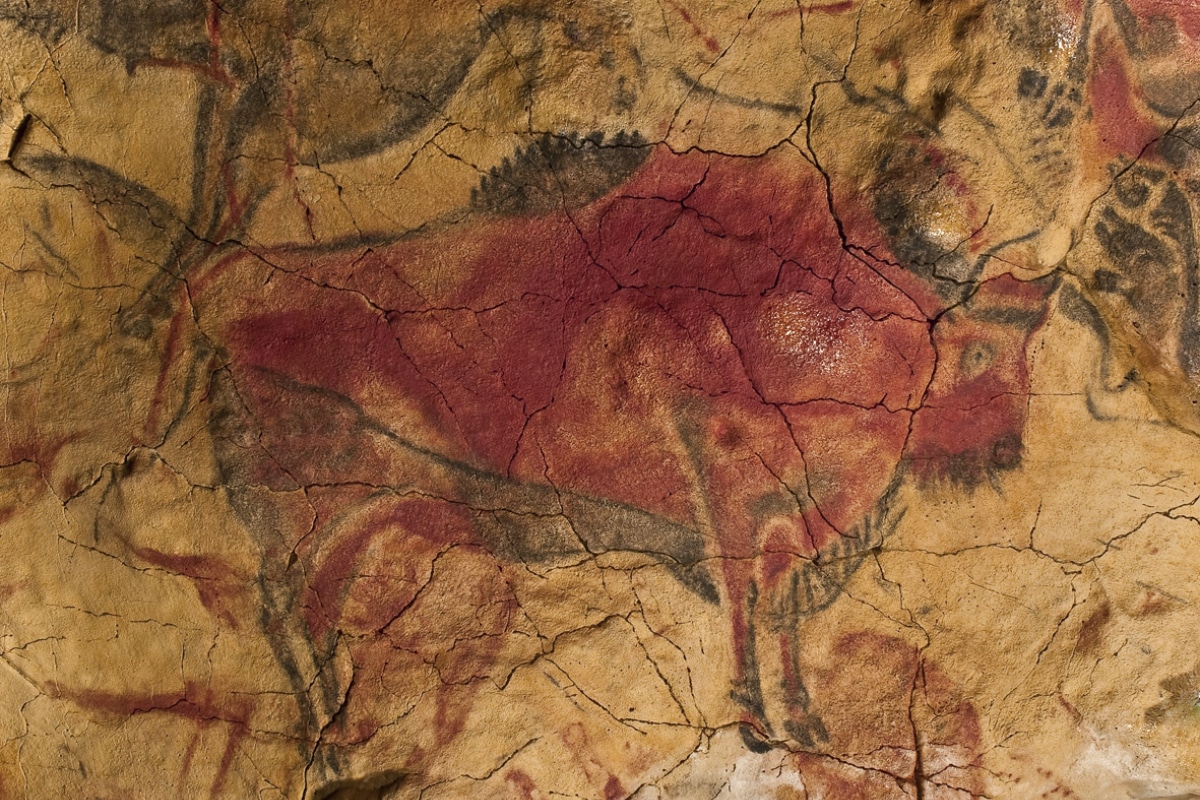
De kaft, ten slotte, is een foto van de reproductie in het Museo del Mamut in Barcelona van de grotschildering van een bizon in de zogenaamde grote zaal der polychromen in Altamira.
Birch Girl
I have a number of new books all ready and only the fact that as a writer it is not convenient to ‘market’ a book every month and the considerable costs involved if you do not have a ‘regular’ publisher keeps me from publishing them.
One is a voluminous novel called Birch Girl that takes place ten thousand years ago during the last Ice Age. The story tells of a woman who is forced by famine to leave her home region and move to present-day France, where she comes into contact with other Cro-Magnon cultures. We follow Birch Girl for many years of her life. It’s one of the first stories I wrote and still a favorite of my mother’s.
Prehistoric fiction
The idea came to me through the Clan of the Cave Bear by Jean M. Auel. I loved that book and it’s no wonder that my youngest daughter is named after the main character.
Unfortunately, the next installments in the Earth’s Children series, except for maybe part 3, didn’t reach this level by a long shot, but that doesn’t detract from the fact that the author set a whole new genre in motion.
Because after the success of this book, more writers started to focus on this period. Michael and Kathleen O’Neal Gear began work on the massive First North Americans series. I have a large number of volumes on my shelf, including the first book People of the Wolf. I read William Sarabande’s First Americans series and Elizabeth Marshall Thomas’s sad, spiritual Reindeer Moon.
And then I wanted to write about that time myself. As I said, this was one of my first stories. I did polish it afterwards, but it’s mostly still in the original version.
The research was difficult, because it was in the time before the mass introduction of the PC and access to the internet. So I still had to go to the library in my spare time and take notes on the spot. Based on this, I have created several tribes, each with its own culture, which come into contact with each other in the book, sometimes peacefully, sometimes less amicably.
Topical themes
When I reread it last year before sending it to the printer, I discovered that it contains quite a few modern, topical themes, such as immigration, integration, women’s rights, discrimination, multicultural societies, climate change and technological progress. I was shocked by that, because that had never been the intention! It had crept in on its own.
This has not happened because the themes now dominate the media, but rather because they are themes of all times. In Birch Girl, there is climate change, as the Ice Age nears its end, and this leads to hunger and disease in the protagonist’s homeland, causing the survivors to set out in search of better hunting grounds. This is something that has happened all the time over the centuries. Hunger or war, natural disasters and diseases drove people away, causing a chain reaction. Just think of the Migration Period of the Early Middle Ages.
Emigration brings peoples into contact with each other unwillingly, which inevitably leads to clashes of cultures and attitudes or to problems such as food supply. Sometimes this contact is quite painless and a symbiosis quickly develops, sometimes it leads to fierce conflicts. That, too, is not a newly invented theme in these times, but something we have seen countless times in history.
Collateral damage
So if you want to read this book, don’t think that it is a socio-cultural work, intended to make you think or to put these themes on the map, nor to raise an admonishing finger. It is ‘collateral damage’, something that runs as a common thread through the book without a value judgment or opinion being given about it. It exists, and it directs the adventures of the characters.
Of course, there are also conflicts in the family and relational sphere, which have nothing to do with times or social problems. Jealousy, for example, is not tied to any nation or period whatsoever.
Finally, the cover is a photograph of the reproduction in the Museo del Mamut in Barcelona of the cave painting of a bison in the so-called Great Hall of the Polychromes in Altamira.
Comments (0)