
PTSS is iets wat me interesseert. Waarom? Eenvoudig: ik ben opgegroeid met een vader die eraan leed. Hij kwam uit de Berlijnse kampen tijdens de WWII terug en was nooit meer dezelfde. Toen ik oud genoeg was om het te beseffen, waren de scherpste randjes al weggesleten, maar helemaal genezen is hij nooit.
Als hij lag te slapen en er werd vuurwerk in onze stenen buitenhal gegooid (wat een enorme knal gaf), dan schrok hij wakker en was hij even terug in de huis-tot-huis-gevechten, de bombardementen en schuilkelders. k zag als kind wat het deed, ik herkende het in zijn ogen.
En omdat ik nogal wat (ex-)militairen in mijn familie-/kennissenkring heb, heb ik het verschijnsel wel vaker mogen zien, helaas.
Wat is PTSS precies?
Nu kun je van veel meer trauma’s PTSS oplopen, maar het fenomeen is voor het eerst beschreven en erkend in relatie tot de oorlog, dus wil ik me daarop focussen. De vraag is: leden de soldaten van vroeger, van voor de massale wereldoorlogen er ook al aan of niet?
Laten we beginnen met een korte beschrijving van wat het eigenlijk is. Het U.S. Department of Veterans Affairs definieert het aldus: ‘een mentaal gezondheidsprobleem dat sommigen ontwikkelen na het ervaren of zien van een levensbedreigende gebeurtenis, zoals strijd’.
Eén van de vele symptomen is het herbeleven (flashbacks) van de gebeurtenis(sen), bijvoorbeeld in nachtmerries, of na een triggermoment. Vaak kunnen slachtoffers ook niet echt meer hun weg vinden in het gewone leven en hebben ze allerlei aanpassingsproblemen.
Er zijn ook lichamelijke symptomen, zoals bijvoorbeeld hartkloppingen. Andere bekende symptomen zijn verder depressie en hyperactiviteit, overgevoeligheid voor geluid, ‘acute stress responses’, depressie, een laag zelfbeeld en misbruik.
Harde vooroordelen
Het moet al zo oud zijn als sinds oorlog bestond. Of toch niet? Dat wilde ik uitzoeken. Dat er vroeger niet over geschreven werd, wil niet betekenen dat het er niet was.
Lang werd het niet erkend voor wat het was en vaak rustte er ook een taboe op. Men dacht dat de symptomen voortkwamen uit hartziektes of uit lafheid of andere karakterzwaktes. Zelfs Patton wilde er niet aan en sloeg in 1943 twee soldaten die leden aan wat toen nog ‘battle fatigue’ of ‘shell shock’ heette. Hij verbood het zelfs in zijn legereenheid als reden om uit te vallen!
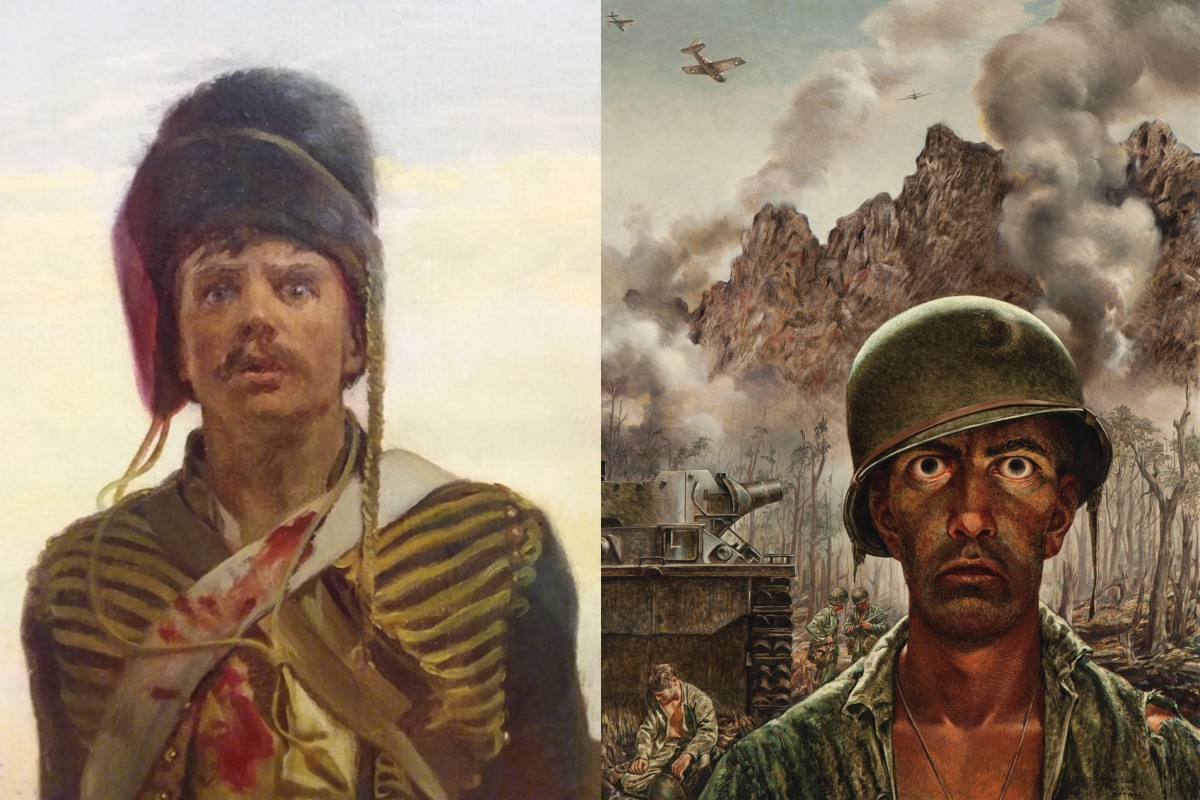
Die vooroordelen zien we tot zeer recent terug. Na de traumatische, afschuwelijke slachting van de beruchte charge van de lichte brigade in de Slag bij Balaclava (1854) tijdens de Krimoorlog, schilderde lady Butler in 1876 een gelijknamig schilderij. Centraal op het doek staat huzaar W.H. Pennington met een geschokte blik (zie linkerdeel van het plaatje bij deze blog). Hij was bij de charge aanwezig en heeft voor het schilderij geposeerd.
Toen het schilderij voor het eerst aan het publiek getoond werd, werd het geprezen, afgezien van Penningtons figuur. Dat werd keihard afgekraakt. Waarom? Omdat het slecht geschilderd was? Nee, vanwege de geschokte blik op het gezicht van de huzaar, die we tegenwoordig de Thousand-yards Stare noemen en één van de uiterlijke kenmerken van PTSS is.
Eén van de kritieken zei: “Het zou beter geweest zijn als u, meneer Pennington, nooit van de charge teruggekeerd was. U bent theatraal – niet dramatisch – simpelweg ruïneus opdringerig en onecht.” Een krant noemde zijn pose “ontzet en dronken met de wijn van de strijd”.
Gilgamesh en Xenophon
Laten we om te weten of het een jong fenomeen is gerelateerd aan de moderne manier van oorlog voeren of dat het al bestond vanaf het moment dat de mens de wapenen tegen elkaar opnam, dus eerst eens kijken wanneer we de eerste betrouwbare beschrijvingen van PTSS vinden en welke namen eraan gegeven werden en hoe het werd geïnterpreteerd.
In het epos Gilgamesh (2100 v.C.) lijkt de reactie van de hoofdpersoon op de dood van zijn vriend op PTSS, maar dat is een epos. We mogen aannemen dat het geïnspireerd is door ware gebeurtenissen of ervaringen, maar het is vaag ‘bewijs’.
Iets minder oud zijn de kleitabletten uit Mesopotamië (1300 v.C.) die soldaten beschrijven die bezocht worden [in hun slaap] door geesten die ze in de strijd tegengekomen waren.
Nog iets jonger in de geschiedenis beschrijven verschillende Oud-Griekse schrijvers gedrag dat mogelijk als PTSS geïnterpreteerd zou kunnen worden. Zeker weten kunnen we het niet, omdat het verschijnsel toen niet als zodanig bekend was, maar de signalen zijn sterk.
Euripides (480-406 v.C.) schreef in een tragedie over de Trojaanse Oorlog dat Ajax achtervolgd werd door vreselijke nachtmerries over zijn krijgservaringen nadat hij teruggekeerd was naar huis. Onder de invloed van die nachtmerries sloeg hij een kudde schapen dood, omdat hij dacht dat ze vijanden waren die hem achterna zaten. Toen hij bijkwam en zag wat hij gedaan had, pleegde hij in wanhoop zelfmoord. Dit is heel typerend gedrag voor PTSS en hoewel dit maar een toneelstuk betreft, geeft het wel aan dat Euripides dit soort situaties gekend moet hebben of ervan gehoord had.
Maar er zijn ook aanwijzingen in rapporten over de krijg. Xenophon (c.430-c.355 vC) beschrijft in de Anabasis de expeditie van een Grieks huurlingenleger in het Perzische Rijk, ingehuurd door prins Cyrus de Jongere tegen zijn broer koning Artaxerxes II. En Xenophon was niet zomaar een geschiedschrijver: hij had deel uitgemaakt van dat leger! En hij beschrijft een Spartaanse krijger, die hoogstwaarschijnlijk leed aan PTSS en na te lang in de krijg geweest te zijn, zijn weg in het burgerleven niet meer kon vinden.
Nog duidelijker is Herodotus (c.484-425 vC) in zijn beschrijving van de Grieks-Perzische Oorlogen. Hij spreekt aldus over Epizelus, een hopliet die bij Marathon vocht (490 vC):
“Epizelus (…) vocht in het heetst van de strijd en gedroeg zich zoals een dapper man hoort te doen, toen hij plotseling met blindheid geslagen werd, zonder slag van zwaard of pijl; en deze blindheid ging voort gedurende zijn hele leven daarna. Het volgende is het verslag dat hijzelf, zoals ik het gehoord heb, van de zaak gaf: hij zei dat een gigantische krijger, met een enorme baard, die zijn hele schild bedekte, tegenover hem stond, maar de spookachtige verschijning ging hem voorbij en sloeg de man naast hem dood.”
Dus de soldaat werd zonder verwonding blind, nadat zijn kameraad naast hem gedood was. En plotselinge (vaak tijdelijke) blindheid werd vaak tijdens de Wereldoorlogen gemeld als symptoom.
Overigens werd Epizelus bij thuiskomst als oorlogsheld ontvangen. Betekent dit dat de oude Grieken PTSS her- en erkenden?
Missio causaria
Als we iets opschuiven in de tijd komen we bij de Romeinen en we weten zeker dat PTSS toen al voorkwam en, belangrijker, erkend werd. Ze kenden namelijk de missio causaria, die het soldaten toestond, die niet langer konden vechten vanwege gebreken of verwondingen, het leger te verlaten met alle voordelen en het pensioen dat hij gehad zou hebben na eervol ontslag na het voltooien van zijn diensttijd.
En die gebreken hoefden niet uitsluitend fysiek te zijn! Men kon er ook een beroep op doen bij een ‘verwonde geest’! Dit riekt toch wel heel erg naar PTSS. Drie legerartsen moesten bepalen of hier inderdaad sprake van was. Wederom waren de Romeinen weer eens moderner dan de mensen uit de eeuwen na hen.
Zouden de gladiatoren er ook aan geleden hebben? Dat waren slaven en hadden dus geen recht op voortijdig ontslag. Maar het kan haast niet anders.
Een ander literair voorbeeld dat zou kunnen bewijzen dat PTSS ook vroeger bestond is het epos Ramayana (750-500 v.C.). De demon Marrich ervaart PTSS-achtige symptomen, zoals vecht-of-vlucht-reactie (hyper-arousal), herbeleving van het trauma en ontwijkingsgedrag, nadat hij bijna door een pijl gedood was.
Middeleeuwen
Maar als we kijken naar de Middeleeuwen, dan zien we nauwelijks enige aanwijzingen. Betekent dit dat het niet voorkwam? Laten we wel wezen: ook toen waren ze bekend met brute veldslagen en oorlogen! En de krijg was niet wezenlijk anders dan in Grieks-Romeinse tijden, dus we mogen aannemen dat het bestond.
We zien terugkerende nachtmerries zoals hierboven beschreven in Gísli Súrsson Saga. De hoofdpersoon droomt zo vaak van gevechten op het slagveld, dat hij duisternis vreest en ’s nachts niet alleen kan blijven.
Een ridder, genaamd Geoffroi de Charny, die in de eerste helft van de 14e eeuw leefde, heeft ooit een boek geschreven over het leven van een ridder. En daar zien we toch zaken die sterk PTSS doen vermoeden. Hij adviseert ridders hoe ze moeten omgaan met het feit dat ze in oorlog mensen moeten doden. Hij beschrijft dus stressfactoren die we bijvoorbeeld ook terugzien in rapporten van Vietnamveteranen. Hij maakt zich ook duidelijk druk om het mentale welzijn van zijn mede-ridders. Een stukje uit het boek:
“In dit beroep moet je hitte, honger en hard werk verdragen, weinig slapen en vaak op wacht staan. En uitgeput zijn en ongemakkelijk slapen op de grond om abrupt gewekt te worden. En je zult machteloos staan om die situatie te veranderen. Je zult vaak bang zijn als je de vijand op je af ziet komen met neergelaten lansen om je te doorboren en getrokken zwaarden om je neer te hakken. Bouten en pijlen komen op je af en je weet niet hoe je jezelf het beste kunt beschermen. Je ziet mensen elkaar doden, op de vlucht slaan, sterven en gevangengenomen worden en je ziet de lijken van je gesneuvelde vrienden rondom je liggen. Maar je paard is niet dood, en door zijn krachtige snelheid kun je in oneer ontsnappen. Maar als je blijft, win je eeuwige eer.”
De Teutoonse ridders in de Baltische Kruistochten (13e eeuw) schijnen soms last gehad te hebben van ‘rood zien’ en ‘zien door een tunnel’, wat op PTSS zou kunnen duiden.
Hotspur
Dan drogen de aanwijzingen een hele tijd grotendeels op, tenzij we het gedrag van het personage Hotspur in Shakespeare’s Henry IV (Part 1 – 2.3.39-67) meenemen. Het mag dan literatuur zijn, het is wel een zeer overtuigende beschrijving die Hotspurs vrouw in haar rede geeft. Beoordeel zelf of je het met me eens bent:
“O my good lord, why are you thus alone?
For what offense have I this fortnight been
A banished woman from my Harry’s bed?
Tell me, sweet lord, what is ‘t that takes from thee
Thy stomach, pleasure, and thy golden sleep?
Why dost thou bend thine eyes upon the earth,
And start so often when thou sit’st alone?
Why hast thou lost the fresh blood in thy cheeks
And given my treasures and my rights of thee
To thick-eyed musing and curst melancholy?
In thy faint slumbers I by thee have watched,
And heard thee murmur tales of iron wars,
Speak terms of manage to thy bounding steed,
Cry “Courage! To the field!” And thou hast talk’d
Of sallies and retires, of trenches, tents,
Of palisadoes, frontiers, parapets,
Of basilisks, of cannon, culverin,
Of prisoners’ ransom and of soldiers slain,
And all the currents of a heady fight.
Thy spirit within thee hath been so at war
And thus hath so bestirred thee in thy sleep,
That beads of sweat have stood upon thy brow
Like bubbles in a late-disturbèd stream;
And in thy face strange motions have appeared,
Such as we see when men restrain their breath
On some great sudden hest. O, what portents are these?
Some heavy business hath my lord in hand,
And I must know it, else he loves me not.”
Nostalgia
In de late 17e eeuw komt de Zwitserse arts Hofer met de term ‘nostalgia’ om soldaten te beschrijven die lijden aan wanhoop en heimwee, en klassieke PTSS-symptomen als slapeloosheid en onrust, beklemming en angst. Rond dezelfde tijd beschrijven Duitse, Franse en Spaanse artsen vergelijkbare ziekten bij hun militaire patiënten.
In 1761 schrijft de Oostenrijkse arts Auenbrugger in het boek Inventum Novum ook over nostalgia, een term die tot ver in de 19e eeuw in zwang bleef, bij soldaten die een trauma meegemaakt hadden. Hij schrijft dat de soldaten lusteloos werden en zich van anderen afkeerden en dat weinig hen uit hun staat kon halen.
Tijdens de Napoleontische oorlogen zijn er duidelijke tekenen dat de arme zielen die de tocht naar Rusland overleefden, eraan leden en ook maarschalk Ney zou na 1812 erdoor aangedaan zijn. Maar hard bewijs is er niet. We kunnen slechts concluderen dat er symptomen beschreven werden die er sterk op duiden.
Soldatenhart
En dan verandert er iets. Tijdens de Krimoorlog (1853-1856) en Amerikaanse Burgeroorlog (1861-1865) zien we de eerste tekenen dat men langzaam begint te beseffen dat er sprake is van een serieuze, niet gefakete aandoening die met de strijd te maken heeft, ook al beseft men nog niet dat de oorzaak psychisch is. Maar nostalgia werd een veelvoorkomende medische diagnose. En hoewel sommige artsen het zagen als een teken van zwakte en zeiden dat openlijke spot de beste genezing was, waren er ook al vooruitstrevende zielen die een andere opinie hadden.
Na de oorlog bestudeerde dokter Mendez Da Costa veteranen en ontdekte dat velen leden aan fysieke problemen die niets met verwondingen te maken hadden, zoals hartkloppingen, benauwdheid bij ademen en andere cardiovasculaire symptomen. Men dacht dat die ontstonden door overmatige stimulatie van het zenuwsysteem van het hart en de nieuwe naam werd nu ‘soldatenhart’, ‘geïrriteerd hart’ of ‘Da Costa’s syndroom’. Een echte bewustwording dat het psychisch was, is er dan nog steeds niet, maar een begin is gemaakt om van de gebaande paden af te (durven) wijken.
We zien na deze oorlog overigens ook een enorme piek in scheidingen, iets wat toen niet zo gebruikelijk of geaccepteerd was, wat vaak ook een sterke indicator is dat er iets aan de hand is. Een andere duidelijke indicator is het aantal zelfmoorden.
Overigens is het in die tijd ook wel Railway Shaking of Railway Spine genoemd, toen de symptomen waargenomen werden bij getuigen en overlevenden van vreselijke treinongelukken. Doktoren dachten dat het kwam door het schudden van de ruggengraat.
Shell shock
En dan komt de Eerste Wereldoorlog. Oorlog verandert wezenlijk van aard en plotseling is PTSS een enorm probleem (hoewel dat het zeker na de Amerikaanse Burgeroorlog ook al was, maar daar was weinig oog voor). En weer krijgt het een nieuwe naam: ‘shell shock’. Men denkt nu dat het een medische aandoening is die veroorzaakt wordt door de schok van exploderende granaten. Dus nog steeds wordt de link met de psyche niet afdoende gelegd.
De term shell shock ontstaat al vrij snel na het begin van de oorlog, namelijk februari 1915. Kapitein Myers (Royal Army Medical Corps) beschrijft soldaten met een groot aantal ernstige aandoeningen, waaronder angst, nachtmerries, trillen, slecht zien en horen, nadat ze blootgesteld zijn geweest aan exploderende granaten. Hij denk dat het zenuwstelsel een ‘hersenschudding’ als het ware opgelopen heeft.
Maar in 1916 zien artsen deze symptomen ook bij soldaten die helemaal niet in de buurt van explosies geweest zijn. Men kwam toen met twee categorieën: ‘concussive shock’ en ‘emotional shock’, welke laatste men weet aan onvolledige training van de dienstplichtige. Hun aandoening werd beschouwd als neurasthenie (zenuwinstorting door de oorlog), maar het werd nog steeds samengevat door shell shock of oorlogsneurose.
Vaak keerden patiënten al na een paar dagen rust naar het front terug en zij die langer behandeld werden, kregen vaak hydrotherapie (b.v. wisselbaden) of elektrotherapie.
Aan het einde van de oorlog waren er alleen al in het Engelse leger 80.000 gevallen van shell shock.
Battle fatigue
In de Tweede Wereldoorlog werden deze aandoeningen toegeschreven aan ‘battle fatigue’, ‘combat fatigue’ en ‘combat stress reaction’, wat aangeeft dat men dacht dat het gerelateerd was aan (te) lange tijd aan het front. Maar ook de term ‘shell shock’ werd nog gebruikt of ‘psychoneurose’. Alle slachtoffers met een psychologische aandoening werden onder de noemer uitputting weggezet en hoewel artsen al wel bekend waren met de oorzaken en symptomen, wilde het leger er niet echt aan.
Halverwege de oorlog leerden ze wel dat neuropsychiatrische slachtoffers wel zo snel mogelijk behandeld moesten worden en niet eerst geëvacueerd van het strijdtoneel, wat resulteerde in slechts 15% die kon terugkeren in dienst. Na 1943 steeg het percentage dat na behandeling weer naar het front kon naar bijna 50%. Ongeveer de helft van de soldaten die uit dienst gestuurd werden, had mogelijk met PTSS te maken.
Kort na WWII stuurde Nederland zijn jongemannen naar Indonesië voor de Politionele Aktie. Ook deze jongens kwamen terug met PTSS, zoals mijn oom. Tropenkolder noemde men het in de volksmond, maar feitelijk was het niets anders dan wat alle soldaten voor hen ook al hadden.
Langzame kentering
In de decennia erna komt er een kentering, langzaam maar gestaag.
In 1952 voegde de American Psychiatric Association ‘gross stress reaction’ toe aan het eerste Diagnostic and Statistical Manual of Mental Disorders. Het was nu algemeen aanvaard dat de aandoening puur psychisch was, veroorzaakt door trauma (dus b.v. ook rampen). Helaas ging men er nog wel vanuit dat de ziekte binnen zes maanden wel over was. Zo niet, dan had het niets met de oorlog te doen.
In 1968 kwam het tweede handboek uit en bovengenoemde diagnose werd weggehaald, maar men voegde ‘aanpassingsreactie aan volwassen leven’ toe, wat niet echt doeltreffend de symptomen omvatte. Dit betekende dat veel veteranen die eraan leden, niet meer de juiste psychologische hulp konden krijgen. Overigens werd de aandoening rond die tijd (ook) Vietnam Veteran’s Disorder genoemd.
Het derde handboek kwam in 1980 uit en daarin werd onderzoek betrokken van allerlei mensen die zware trauma’s doorgemaakt hadden, dus niet alleen veteranen, maar ook overlevenden van de Holocaust en slachtoffers van verkrachtingen. De diagnose maakte een duidelijk onderscheid tussen traumatische gebeurtenissen en andere pijnlijke stressfactoren, zoals scheiding, armoede, ziekte, die niet dezelfde symptomen veroorzaken.
We hebben dus moeten wachten tot 1980 voor het eindelijk erkend werd als een officiële aandoening met een duidelijke omschrijving van oorzaken en symptomen, en het zijn huidige naam kreeg.
Nu wordt het niet langer gezien als een angststoornis, omdat het soms geassocieerd wordt met zowel andere emoties (depressie), als boos of roekeloos gedrag. Het valt nu onder een categorie genaamd Trauma- and Stressor-Related Disorders.
Het leek vroeger minder vaak voor te komen
Het aantal soldaten dat met PTSS uit moderne oorlogen (WWI e.v.) terugkwam, lag hoog (naar schatting 10% in WWII, 78% van de krijgsgevangenen uit het Pacifisch strijdntoneel tijdens WWII, bij Amerikaanse soldaten 15-30% in de Vietnamoorlog, 12% in de Golfoorlog, 10-20% in de Irakoorlogen), maar hoe zat het voor die tijd?
Dat is moeilijk te achterhalen vanwege de hiervoor genoemde redenen. Maar toch lijkt het erop dat het toen wel voorkwam, maar heel veel minder. Het idee dat de Napoleontische soldaat naar huis terugkeerde met zware symptomen, lijken we toch voorzichtig naast ons neer te moeten leggen. En dat heeft alles te maken met de aard van de oorlogen voor 1914. En een andere oorlog zorgt ook voor een ander trauma.
Waren die oorlogen minder bruut? Nee. En een verzwarende factor was dat er behalve de steun van een pastoor of dominee geen enkele psychologische behandeling bestond of dat er ook maar een greintje begrip voor was. Dus wat maakte het dan zo anders?
Daarop zijn een aantal antwoorden te geven:
- geen constante stress: PTSS lijkt immers voornamelijk te ontstaan door het voortdurend onder stress te staan.
- (na de intrede van grootschalige batterijen artillerie) geluid van artillerie: ‘shell shock’ was niet eens zo’n verkeerde naam, want het (langdurig) blootgesteld zijn aan de grote herrie van kanonnen is ook een factor van belang. Ik denk hierbij aan mijn vader, die ook voornamelijk getriggerd werd door harde knallen.
- (recent) moderne communicatie: een soldaat hoort nu voortdurend hoe het aan het thuisfront is, of er familieproblemen zijn, waardoor ze zich zorgen maken of schuldig voelen.
- (recent) bombardementen uit de lucht, van lange afstand of met raketten: het niet zien van de vijand en dus niet weten wanneer er gevaar dreigt, zorgt dat de soldaat voortdurend ‘aan’ staat, constant bang is (zie punt 1). Dit zien we ook bij guerrilla.
Als we bijvoorbeeld kijken naar de Napoleontische oorlogen, lagen er langere pauzes tussen de verschillende slagen. De gemiddelde veldslag was binnen een paar uur gestreden en dan was je er als soldaat meestal weer maanden van af en deed je niet veel meer dan rondhangen in een fort of marcheren. Negen van de tien keer had je geen idee van het grotere plaatje, waar je heen ging of wat je aan het eind van de tocht kon verwachten. In de winter stond een oorlog meestal stil, omdat de wegen dan onbegaanbaar waren of de manschappen ingekwartierd moesten worden om niet te bevriezen. De soldaat had geen idee hoe het thuis was en pas als je de vijand ook daadwerkelijk zag, begon je gevaar te lopen en kreeg je stress.
Daarnaast kostte het tijd om een musket te herladen, zodat je niet gek werd van het geratel van bijvoorbeeld mitrailleurs, en waren ze ook nog eens inaccuraat. Schuttersputjes en loopgraven (anders dan om een stad tijdens een beleg te benaderen) waren zo goed als onbekend. En ook tijdens de slag hing er zoveel rook, dat de soldaat voortdurend verward was en nauwelijks een idee had waar hij was en wat er een paar meter verderop gebeurde. Ze vochten half-blind en half-doof en volledig gedesoriënteerd.
Samengevat: strijd was een onheilspellende mars tot 50-100 meter van de vijand, dan enkele gewelddadige salvo’s in verblindende rook, en nadat één zijde gevlucht was of zich had teruggetrokken, een pauze. Het was geen niet-aflatende, luide strijd zoals later. De korte momenten van strijd waren mogelijk erger dan tegenwoordig (een soldaat liep recht het vuur in, verwondingen van kogels waren gruwelijker, er was slechte medische zorg), maar daartussen waren weken, maanden of soms zelfs jaren rust.
Verder had de soldaat in die tijd vaak geen familie, of in ieder geval zeer zelden vrouw en kinderen om zich druk over te maken. Ze hoefden zich ook geen zorgen over financiën te maken, want het leger gaf alles wat ze nodig hadden, ook al was dat vaak inadequaat. Maar de huidige soldaat weet dat thuis een gezin zit dat rond moet komen of heeft een financieel afhankelijke oude vader of andere familieleden.
Met andere woorden: in de meeste Napoleontische legers was het, met enkele uitzonderingen, ongewoon om in persoonlijk doodsgevaar te zijn de hele dag, elke dag, gedurende maanden achtereen. En daar zit het allergrootste verschil.
Het zien van de vijand was het geval in de traditionele manier van oorlogsvoeren, dus twee legers die opgesteld worden en na manoeuvreren pas ‘los’ gaan. Wezenlijk anders is dat bij guerrilla-oorlogsvoering. Zulke oorlogen, met altijd de angst voor hinderlagen, zoals we bijvoorbeeld zagen in de oorlog tussen de Germanen en Romeinen, de Teutonen en Pruisen, in de Amerikaanse oorlogen van de 18e eeuw, de Peninsula Oorlog etc., veroorzaakten ongetwijfeld meer PTSS dan ‘gewone’ positionele krijg.
Waarom de één wel en de ander niet?
Maar waarom krijgt onder dezelfde omstandigheden de één wel en de ander geen PTSS? Laten we met klem vooropstellen dat het niet te maken heeft met hoe sterk iemand van karakter is, noch met lafheid of andere zwakte. Er is veel discussie over, maar er schijnen een paar factoren van belang te zijn, die van persoon tot persoon, of van strijdtoneel tot strijdtoneel, kunnen verschillen:
- Leeftijd van de persoon: hoe jonger, hoe meer risico.
- Voorafgaande ervaring met de dood: vroeger was de dood altijd en overal door hoge sterftecijfers, openbare terechtstellingen etc., tegenwoordig kunnen mensen volwassen worden zonder ooit iemand te hebben verloren of te hebben zien sterven, zelfs zonder geweld mee te maken.
- Opvang thuis / publieke opinie: als een soldaat bij terugkeer uit de strijd met de nek aangekeken wordt of in de media wordt neergezet als babymoordenaar (denk aan de Vietnamoorlog) dan draagt dat enorm bij aan het ontwikkelen van een trauma
- Situatie thuis na terugkeer: als de oorlog gewoed heeft in het thuisgebied van een soldaat en hij treft bij terugkeer een verwoest huis en uitgedunde familie aan (zoals tijdens de Amerikaanse Burgeroorlog aan zuidelijke zijde), dan vergroot dat de kans op PTSS ook enorm
- Samenstelling eenheid: als soldaten schouder aan schouder dienden met broers, vaders, neven, buren, vrienden, omdat hele gemeenschappen en dorpen in één eenheid geplaatst zijn, hakt elke dode er extra hard in
- Uitslag oorlog: men denkt dat wie aan de verliezende zijde staat ook meer risico loopt
- Delen van ervaringen: hoe meer lotgenoten dezelfde oorlogservaringen delen, des te meer begrip je krijgt en des te beter kun je met PTSS omgaan, dus hoe kleiner het aantal werkelijk vechtende soldaten, des te meer risico
- Tijdsduur van de terugreis: een langere reis terug naar huis met lotgenoten helpt in verwerking
- Beroep na de oorlog: veteranen met een naoorlogse baan met hoge stresslevels (politie, brandweer) lopen meer risico
- Het gebrek aan ‘band of brothers’: oorlogssituaties veroorzaken verbroedering en een gevoel te leven op een ongekend niveau dat na de oorlog niet meer bereikt wordt en een soort afkickverschijnselen veroorzaakt
Schuldgevoelens
Eén van de problemen waar iemand die in de oorlog geweest heeft, vaak mee worstelt en die hogelijk bijdragen aan het krijgen van PTSS, is dat je mensen verwondt en doodt. Dat wordt ook van je verwacht. Als je dat dan vervolgens kwalijk genomen wordt, compliceert dit de zaak aanmerkelijk.
Zo moesten de soldaten na Hastings (1066) van de kerk boete doen voor elke persoon die ze verwond of gedood hadden (resp. veertig dagen en één jaar). Boogschutters, die niet wisten hoeveel mensen ze gedood hadden, moesten drie opeenvolgende Vastentijden boete doen en als je je niet meer kon herinneren om hoeveel het ging, kreeg je één dag per week voor de rest van je leven voor je kiezen. Tenzij je rijk was, want dan kon je het met een eenmalige gift aan de kerk afkopen.
En bijvoorbeeld na de Vietnamoorlog en de val van Srebrenica zien we ook hoe het publiek en soms de media de soldaat zijn noodgedwongen daden voor de voeten gooit.
En dan zijn er natuurlijk nog de wel terechte schuldgevoelens, over gruwelijkheden en wreedheden die men misschien in het heetst van de strijd of in een moment van verstandsverbijstering hebt gedaan of waartoe je gedwongen bent. Die schuldgevoelens knagen en drijven iemand tot waanzin.
Fysieke component
Overigens heeft PTSS wel degelijk ook een fysieke component. Gevaar veroorzaakt het vrijlaten van hormonen en chemicaliën in hersenen en lijf, die hevige veranderingen veroorzaken, wat weer invloed heeft op hoe iemand reageert. Oorlog conditioneert niet alleen blijvend het denkproces, maar omvat ook het niveau van cortisol, hormoonstressreacties, bloeddrukreacties, hartslag, oxytocin, dopamine, serotonine.
Die laatste drie veroorzaken een sterke connectie met kameraden, maar bij thuiskeer wordt het gemist en leidt het al snel tot depressie, gevoelens van isolatie, er niet bij horen. Sommigen proberen het dan te vinden in risicovol gedrag, alcohol en drugs etc. De soldaat moet als het ware afkicken.
Samengevat komt het er dus op neer dat PTSS wel degelijk al zo oud is als de weg naar Rome, echter tot het midden van de 19e eeuw zeldzaam is, maar daarna in sneltreinvaart steeds gewoner wordt.
PTSD – As old as the road to Rome?
PTSD is something that interests me. Why? Simple: I grew up with a father who suffered from it. He returned from the Berlin camps during WWII and was never the same again. When I was old enough to realize it, the sharpest edges had already worn away, but it never completely healed.
When he was asleep and fireworks were thrown into our stone outdoor hall (which gave a huge bang), he was startled awake and he was back in the house-to-house fighting, the bombings and bomb shelters. As a child I saw what it did, I recognized it in his eyes.
And because I have quite a few (ex-)soldiers in my family/circle of acquaintances, I have seen the phenomenon more often, unfortunately.
What exactly is PTSD?
Well, you can get PTSD from many more traumas, but the phenomenon has been described and acknowledged for the first time in relation to war, so I want to focus on that. The question is: did the soldiers of the past, from before the mass world wars, also suffer from it or not?
Let’s start with a brief description of what it actually is. The U.S. Department of Veterans Affairs defines it as follows: “a mental health problem that some develop after experiencing or seeing a life-threatening event, such as battle.”
One of the many symptoms is reliving (flashbacks of) the event(s), for example in nightmares, or after a trigger moment. Often victims can no longer really find their way in normal life and have all kinds of adjustment problems.
There are also physical symptoms, such as palpitations. Other well-known symptoms include depression and hyperactivity, hypersensitivity to sound, acute stress responses, depression, low self-esteem and abuse.
Harsh prejudices
It must be as old as war exists. Or isn’t it? I wanted to find out. The fact that it was not written about in the past does not mean that it was not there.
For a long time, it was not recognized for what it was and often there was a taboo on it. The symptoms were thought to stem from heart disease or from cowardice or other character weaknesses. Even Patton did not want to acknowledge it and in 1943 beat two soldiers who suffered from what was then called ‘battle fatigue’ or ‘shell shock’. He even forbade it in his army unit as a reason to drop out!
We see these prejudices until very recently. After the traumatic, horrific massacre of the notorious charge of the light brigade at the Battle of Balaclava (1854) during the Crimean War, Lady Butler painted a painting of the same name in 1876. In the centre of the canvas is hussar W.H. Pennington with a shocked look (see left part of the picture in this blog). He was present at the charge and posed for the painting.
When the painting was first shown to the public, it was praised, apart from Pennington’s figure. That was slammed hard. Why? Because it was badly painted? No, because of the shocked look on the face of the hussar, which we now call the Thousand-yards Stare and is one of the outward characteristics of PTSD.
One of the critics said: “It would have been better if you, Mr. Pennington, had never returned from the charge. You are theatrical – not dramatic – simply ruinously intrusive and unreal.” One newspaper called his pose “horrified and drunk with the wine of battle”.
Gilgamesh and Xenophon
To know if it is a young phenomenon related to the modern way of waging war or if it has existed from the moment man took up arms against each other, let’s first see when we find the first reliable descriptions of PTSD and what names were given to it and how it was interpreted.
In the epic Gilgamesh (2100 BC), the protagonist’s reaction to the death of his friend resembles PTSD, but that is an epic. We may assume that it is inspired by true events or experiences, but it is vague ‘evidence’.
Somewhat less old are the clay tablets from Mesopotamia (1300 BC) that describe soldiers who are visited [in their sleep] by spirits they had encountered in battle.
Still a little younger in history, several Ancient Greek writers describe behaviour that could possibly be interpreted as PTSD. We cannot know for sure, because the phenomenon was not known as such at the time, but the signals are strong.
Euripides (480-406 BC) wrote in a tragedy about the Trojan War that Ajax was haunted by terrible nightmares about his war experiences after he returned home. Under the influence of those nightmares, he beat a flock of sheep to death, thinking they were enemies who were chasing him. When he came to and saw what he had done, he committed suicide in despair. This is very typical behaviour for PTSD and although this is only a play, it does indicate that Euripides must have known or heard of this kind of situation.
But there are also indications in reports about the war. In the Anabasis, Xenophon (c.430-c.355 BC) describes the expedition of a Greek mercenary army into the Persian Empire, hired by Prince Cyrus the Younger against his brother King Artaxerxes II. And Xenophon was not just any historian: he had been part of that army! And he describes a Spartan warrior, who most likely suffered from PTSD and after being in the war for too long, could no longer find his way in civilian life.
Even clearer is Herodotus (c.484-425 BC) in his description of the Greco-Persian Wars. He speaks of Epizelus, a hoplite who fought at Marathon (490 BC) thus:
“Epizelus (…) fought in the heat of battle, and behaved as a brave man should, when suddenly he was struck blind, without a blow of sword or arrow; and this blindness continued throughout his life thereafter. The following is the account which he himself, as I have heard it, gave of the matter: he said that a gigantic warrior, with a huge beard, which covered his whole shield, was facing him, but the ghostly apparition passed him by and killed the man beside him.”
So the soldier went blind without injury, after his comrade next to him was killed. And sudden (often temporary) blindness was often reported as a symptom during the World Wars.
Incidentally, Epizelus was received as a war hero upon returning home. Does this mean that the ancient Greeks recognized and acknowledged PTSD?
Missio causaria
If we move on a little in time, we come to the Romans and we know for sure that PTSD already occurred then and, more importantly, was recognized. For they knew the missio causaria, which allowed soldiers, who could no longer fight because of defects or injuries, to leave the army with all the benefits and the pension he would have had after an honourable discharge after completing his service.
And those defects did not have to be exclusively physical! It could also be called upon for a ‘wounded mind’! This reeks very much of PTSD. Three army doctors had to determine whether this was indeed the case. Once again, the Romans were more modern than the people of the centuries after them.
Would the gladiators have suffered from it too? They were slaves and therefore had no right to early dismissal. But it can hardly be otherwise.
Another literary example that could prove that PTSD also existed in the past is the epic Ramayana (750-500 BC). The demon Marrich experiences PTSD-like symptoms, such as a fight-or-flight response (hyper-arousal), reliving the trauma and avoidance behaviour, after he was almost killed by an arrow.
Middle Ages
But if we look at the Middle Ages, we hardly see any clues. Does this mean that it did not occur? Let’s face it: even then they were familiar with brutal battles and wars! And the war was not substantially different from Greco-Roman times, so we can assume that it existed.
We see recurring nightmares as described above in Gísli Súrsson Saga. The protagonist dreams of battles on the battlefield so often that he fears darkness and cannot stay alone at night.
A knight, named Geoffroi de Charny, who lived in the first half of the 14th century, once wrote a book about the life of a knight. And there we see things that strongly suggest PTSD. He advises knights on how to deal with the fact that they have to kill people in war. So he describes stress factors that we also see, for example, in reports from Vietnam veterans. He is also clearly concerned about the mental well-being of his fellow knights. An excerpt from the book:
“In this profession you have to endure heat, hunger and hard work, sleep little and are often on guard. And being exhausted and sleeping uncomfortably on the floor only to be abruptly awakened. And you will be powerless to change that situation. You will often be scared when you see the enemy coming at you with lowered lances to pierce you and drawn swords to chop you down. Bolts and arrows are coming at you and you don’t know how best to protect yourself. You see people killing each other, fleeing, dying and being taken captived and you see the corpses of your fallen friends lying around you. But your horse is not dead, and its powerful speed allows you to escape in dishonour. But if you stay, you win eternal honour.”
The Teutonic Knights in the Baltic Crusades (13th century) sometimes seem to have suffered from ‘seeing red’ and ‘seeing through a tunnel’, which could indicate PTSD.
Hotspur
Then the clues largely dry up for a long time, unless we take into account the behavior of the character Hotspur in Shakespeare’s Henry IV (Part 1 – 2.3.39-67). It may be literature, but it is a very convincing description that Hotspur’s wife gives in her speech. Judge for yourself if you agree with me:
“O my good lord, why are you thus alone?
For what offense have I this fortnight been
A banished woman from my Harry’s bed?
Tell me, sweet lord, what is ‘t that takes from thee
Thy stomach, pleasure, and thy golden sleep?
Why dost thou bend thine eyes upon the earth,
And start so often when thou sit’st alone?
Why hast thou lost the fresh blood in thy cheeks
And given my treasures and my rights of thee
To thick-eyed musing and curst melancholy?
In thy faint slumbers I by thee have watched,
And heard thee murmur tales of iron wars,
Speak terms of manage to thy bounding steed,
Cry “Courage! To the field!” And thou hast talk’d
Of sallies and retires, of trenches, tents,
Of palisadoes, frontiers, parapets,
Of basilisks, of cannon, culverin,
Of prisoners’ ransom and of soldiers slain,
And all the currents of a heady fight.
Thy spirit within thee hath been so at war
And thus hath so bestirred thee in thy sleep,
That beads of sweat have stood upon thy brow
Like bubbles in a late-disturbèd stream;
And in thy face strange motions have appeared,
Such as we see when men restrain their breath
On some great sudden hest. O, what portents are these?
Some heavy business hath my lord in hand,
And I must know it, else he loves me not.”
Nostalgia
In the late 17th century, the Swiss physician Hofer coined the term “nostalgia” to describe soldiers suffering from despair and homesickness, and classic PTSD symptoms such as insomnia and anxiety, oppression and fear. Around the same time, German, French, and Spanish doctors describe similar diseases in their military patients.
In 1761, the Austrian physician Auenbrugger also wrote in the book Inventum Novum about nostalgia, a term that remained in vogue until well into the 19th century, among soldiers who had experienced trauma. He writes that the soldiers became lethargic and turned away from others and that little could get them out of their state.
During the Napoleonic Wars, there are clear signs that the poor souls who survived the journey to Russia suffered from it, and Marshal Ney is also said to have been affected by it after 1812. But there is no hard evidence. We can only conclude that symptoms were described that strongly indicate it.
Soldier’s heart
And then something changes. During the Crimean War (1853-1856) and the American Civil War (1861-1865) we see the first signs that people are slowly starting to realize that there is a serious, not faked disorder that has to do with the battle, even if they do not yet realize that the cause is psychological. But nostalgia became a common medical diagnosis. And although some doctors saw it as a sign of weakness and said that open ridicule was the best cure, there were also progressive souls who had a different opinion.
After the war, Dr. Mendez Da Costa studied veterans and found that many suffered from physical problems unrelated to injuries, such as palpitations, tightness in breathing, and other cardiovascular symptoms. These were thought to be caused by excessive stimulation of the heart’s nervous system and the new name now became ‘soldier’s heart’, ‘irritated heart’ or ‘Da Costa’s syndrome’. There is still no real awareness that it was psychological, but a start has been made to (dare to) deviate from the beaten track.
We also see, by the way, a huge spike in divorces after this war, something that was not so common or accepted at the time, which is often also a strong indicator that something is going on. Another clear indicator is the number of suicides.
Incidentally, it was also called Railway Shaking or Railway Spine at that time, when the symptoms were observed in witnesses and survivors of terrible train accidents. Doctors thought it was due to the shaking of the spine.
Shell shock
And then comes the First World War. War changes fundamentally in nature and suddenly PTSD is a huge problem (although it certainly was after the American Civil War, too, but little attention was paid to it). And again it gets a new name: ‘shell shock’. It is now thought to be a medical condition caused by the shock of exploding shells. So the link with the psyche is still not sufficiently made.
The term shell shock arises fairly soon after the start of the war, namely February 1915. Captain Myers (Royal Army Medical Corps) describes soldiers with a host of serious ailments, including anxiety, nightmares, trembling, poor vision and hearing, after being exposed to exploding shells. He thinks that the nervous system has suffered a ‘concussion’, as it were.
But in 1916, doctors also see these symptoms in soldiers who have not been near explosions at all. Two categories were then introduced: ‘concussive shock’ and ‘emotional shock’, the latter being attributed to incomplete training of the conscript. Their condition was considered neurasthenia (nerve breakdown from war), but it was still summed up by shell shock or war neurosis.
Patients often returned to the front after a few days of rest and those who were treated for a longer period of time often received hydrotherapy (e.g. alternating baths) or electrotherapy.
At the end of the war, there were 80,000 cases of shell shock in the British army alone.
Battle fatigue
In World War II, these conditions were attributed to ‘battle fatigue’, ‘combat fatigue’, and ‘combat stress reaction’, indicating that it was thought to be related to (too) long at the front. But the term ‘shell shock’ was also still used or ‘psychoneurosis’. All victims with a psychological condition were put away under the heading of exhaustion and although doctors were already familiar with the causes and symptoms, the army did not really want to accept it.
Halfway through the war, they did learn that neuropsychiatric victims had to be treated as soon as possible and not evacuated from the theatre of war first, which resulted in only 15% being able to return to service. After 1943, the percentage that was able to return to the front after treatment rose to almost 50%. About half of the soldiers who were sent out of service may have been dealing with PTSD.
Shortly after WWII, the Netherlands sent its young men to Indonesia for the Police Action. These boys also came back with PTSD, like my uncle. It was popularly called tropical madness (’tropenkolder’), but in fact it was nothing different from what all soldiers before them already had.
Slow turnaround
In the decades that followed, there was a turnaround, slowly but steadily.
In 1952, the American Psychiatric Association added ‘gross stress reaction’ to the first Diagnostic and Statistical Manual of Mental Disorders. It was now generally accepted that the condition was purely psychological, caused by trauma (so e.g. also disasters). Unfortunately, it was still assumed that the disease would be over within six months. If not, it had nothing to do with the war.
In 1968 the second manual came out and the above diagnosis was removed, but they added ‘adaptive response to adult life’, which did not really effectively encompassed the symptoms. This meant that many veterans who suffered from it could no longer get the proper psychological help. Incidentally, the condition was (also) called Vietnam Veteran’s Disorder around that time.
The third handbook was published in 1980 and included research from all kinds of people who had experienced severe trauma, so not only veterans, but also Holocaust survivors and victims of rape. The diagnosis made a clear distinction between traumatic events and other painful stressors, such as separation, poverty, illness, which do not cause the same symptoms.
So we had to wait until 1980 before it was finally recognized as an official condition with a clear description of causes and symptoms, and it got its current name.
Now it is no longer seen as an anxiety disorder, as it is sometimes associated with other emotions (depression), as well as angry or reckless behaviour. It now falls under a category called Trauma- and Stressor-Related Disorders.
In the past it seems to have been more rare
The number of soldiers who returned from modern wars with PTSD (WWI and after) was high (an estimated 10% in WWII, 78% of the prisoners of war from the Pacific theatre during WWII, among American soldiers 15-30% in the Vietnam War, 12% in the Gulf War, 10-20% in the Iraq Wars), but what about before that time?
That is difficult to find out because of the reasons mentioned above. But it seems that it did happen then, but much less frequently. The idea that the Napoleonic soldier returned home with severe symptoms seems to be something we should carefully dismiss. And that has everything to do with the nature of the wars before 1914. And another war also causes another trauma.
Were those wars less brutal? No. And an aggravating factor was that apart from the support of a pastor or reverent, there was no psychological treatment or understanding whatsoever. So what made it so different?
There are a number of answers to this:
- no constant stress: after all, PTSD seems to arise mainly from being constantly under stress.
- (after the arrival of large-scale batteries of artillery) sound of artillery: ‘shell shock’ was not even such a bad name, because being exposed (for a long time) to the great noise of cannons is also an important factor. I think of my father, who was also mainly triggered by loud bangs.
- (recently) modern communication: a soldier now constantly hears how things are on the home front, whether there are family problems, which make them worry or feel guilty.
- (recently) air raids, from long range or with rockets: not seeing the enemy and therefore not knowing when danger threatens, ensures that the soldier is constantly ‘on’, constantly afraid (see point 1). We also see this with guerrilla.
If we look at the Napoleonic Wars, for example, there were longer pauses between the different battles. The average battle was fought within a few hours and then as a soldier you were usually months ‘off the hook’ and you didn’t do much more than hang around in a fort or march. Nine times out of ten, you had no idea of the bigger picture, where you were going, or what to expect at the end of the trip. In winter, a war usually came to a standstill, because the roads were impassable or the men had to be billeted to avoid freezing. The soldier had no idea what it was like at home and only when you actually saw the enemy, you started to be in danger and you got stressed.
In addition, it took time to reload a musket, so that you didn’t go crazy with the rattling of, for example, machine guns, and they were also inaccurate. Foxholes and trenches (other than to approach a city during a siege) were virtually unknown. And also during the battle there was so much smoke that the soldier was constantly confused and hardly had a clue where he was and what was happening a few meters away. They fought half-blind and half-deaf and completely disoriented.
In summary, battle was an ominous march to 50-100 yards from the enemy, then a few violent volleys in blinding smoke, and after one side had fled or retreated, a pause. It was not a relentless, loud battle like later. The brief moments of battle may have been worse than today (a soldier walked straight into fire, bullet injuries were more gruesome, there was poor medical care), but in between there were weeks, months, or sometimes even years of rest.
Furthermore, the soldier in those days often had no family, or at least very rarely his wife and children to worry about. They also didn’t have to worry about finances, because the army provided everything they needed, even if it was often inadequate. But today’s soldier knows that there is a family at home that has to make ends meet or has a financially dependent old father or other family members.
In other words, in most Napoleonic armies, with a few exceptions, it was unusual to be in personal danger of death all day, every day, for months at a time. And that’s where the biggest difference lies.
Seeing the enemy was the case in the traditional way of warfare, so two armies that are deployed and only ‘let go’ after manoeuvring. It is fundamentally different in guerrilla warfare. Such wars, with always the fear of ambushes, as we saw for example in the war between the Germans and Romans, the Teutons and Prussians, in the American wars of the 18th century, the Peninsula War etc., undoubtedly caused more PTSD than ‘ordinary’ positional war.
Why the one and not the other?
But why does one person get PTSD and the other does not under the same circumstances? Let us insist that it has nothing to do with how strong a person’s character is, nor with cowardice or other weakness. There is a lot of debate about it, but there seem to be a few factors of importance, which can vary from person to person, or from battlefield to battlefield:
- Age of the person: the younger, the more risk.
- Prior experience of death: in the past, death was always and everywhere due to high mortality rates, public executions, etc., nowadays people can grow up without ever having lost or seen anyone die, even without experiencing violence.
- Support at home / public opinion: if a soldier is looked down upon on his return from battle or portrayed in the media as a baby killer (think of the Vietnam War), this contributes enormously to the development of trauma
- Situation at home after return: if the war has raged in a soldier’s home area and he finds a destroyed house and depleted family on his return (as during the American Civil War on the Confederate side), this also greatly increases the risk of PTSD
- Composition of the unit: when soldiers served shoulder to shoulder with brothers, fathers, cousins, neighbours, friends, because entire communities and villages are placed in one unit, every death hits extra hard
- Outcome of the war: it is thought that those who are on the losing side are also more at risk
- Sharing experiences: the more fellow sufferers share the same war experiences, the more understanding you will gain and the better you can deal with PTSD, so the smaller the number of soldiers actually fighting, the more risk
- Duration of the return journey: a longer journey back home with fellow sufferers helps to process
- Post-war profession: veterans with post-war jobs with high stress levels (police, fire brigade) are more at risk
- The lack of ‘band of brothers’: war situations cause fraternization and a feeling of living at an unprecedented level that is no longer reached after the war and causes a kind of withdrawal symptoms
Feelings of guilt
One of the problems that someone who has been in the war often struggles with and that contributes greatly to getting PTSD, is that you injure and kill people. That is also expected of you. If you are then blamed for that, this complicates the matter considerably.
For example, after Hastings (1066) the church demanded the soldiers to do penance for every person they had wounded or killed (forty days and one year respectively). Archers, who did not know how many people they had killed, had to do penance for three consecutive Lent and if you could no longer remember how many, you were given one day a week for the rest of your life. Unless you were rich, because then you could buy it off with a one-time donation to the church.
And after the Vietnam War and the fall of Srebrenica, for example, we also see how the public and sometimes the media throw his forced actions at the soldier’s feet.
And then, of course, there are the justified feelings of guilt, about atrocities and cruelties that one may have committed in the heat of the moment or in a moment of bewilderment or that you have been forced to do. Those feelings of guilt gnaw and drive someone crazy.
Physical component
Incidentally, PTSD also has a physical component. Danger causes the release of hormones and chemicals in the brain and body, which cause violent changes, which in turn affects how a person reacts. War not only permanently conditions the thought process, but also includes the level of cortisol, hormone stress responses, blood pressure responses, heart rate, oxytocin, dopamine, serotonin.
The latter three cause a strong connection with comrades, but when they return home it is missed and quickly leads to depression, feelings of isolation, not belonging. Some then try to find it in risky behaviour, alcohol and drugs etc. The soldier has to kick the habit, as it were.
In summary, it comes down to the fact that PTSD is indeed as old as the road to Rome, but is rare until the middle of the 19th century, but then becomes more and more common.
Comments (0)