
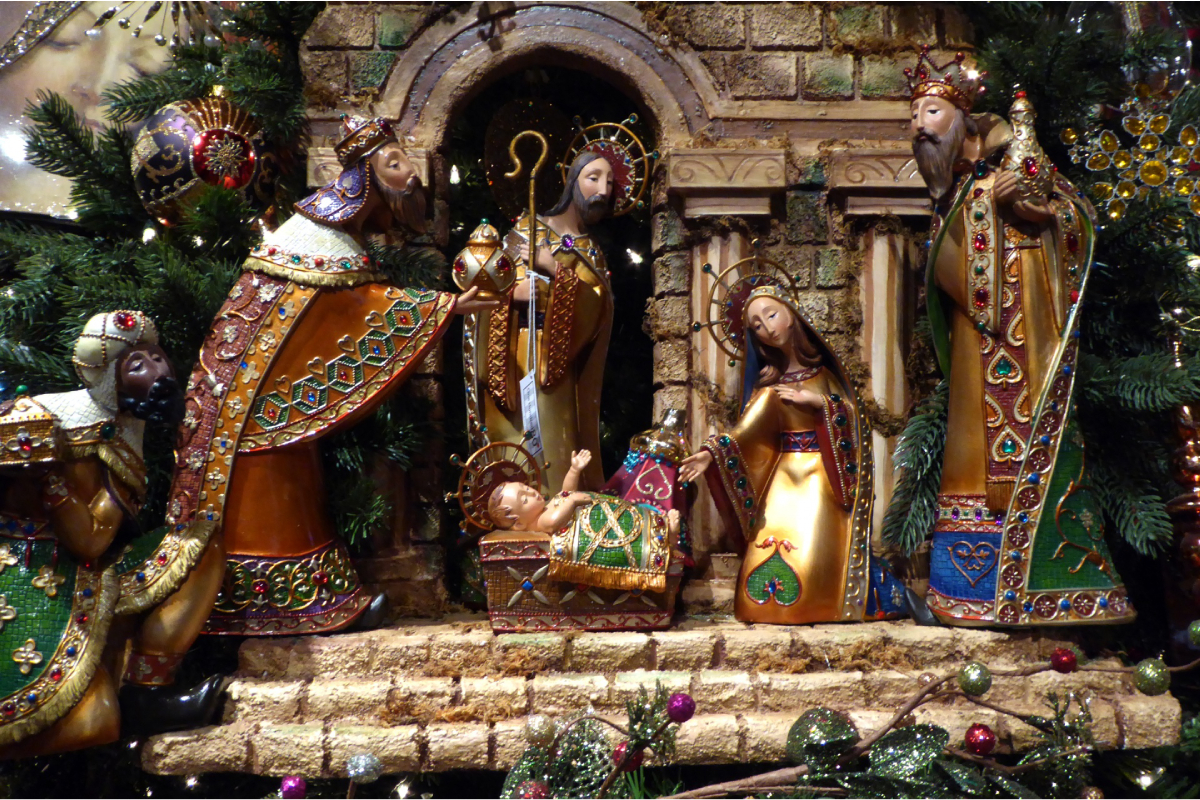
Het is bijna Kerstmis. Een mooie tijd van het jaar. Ik ga helemaal over de top met het versieren van het huis en de tuin. Al die lichtjes, ik vind dat zo warm en gezellig! De kerstboom kan me niet lang genoeg staan. Als klein kind gingen we al in deze tijd van het jaar ‘lichtjes kijken’ in winkelstraten.
We hadden geen kerststal
Thuis hadden wij ook een kerstboom. Mijn moeder vond dat net zo belangrijk als ik nu. Maar wat we niet hadden, was een kerststal eronder. Hoewel ze zelf niet gelovig is, komt ze uit een protestants nest en als zodanig heeft ze een aangeleerde afkeer van kerststallen, die in haar ogen iets katholieks zijn. Ik wilde er als kind wel één, maar dat ging niet gebeuren.
Als kind heb ik die kerststallen bij anderen en op school dus wel altijd heel mooi gevonden, nu ik ouder ben vind ik er niet zo heel veel meer aan, maar dat heeft niets te maken met het geloof. Ze spreken me als volwassene gewoon niet meer zo aan. Als kind was het toch meer een soort poppenhuis voor de kerst, dat je zelf mooi kon indelen. Maar dat terzijde.
Franse Revolutie zette alles op zijn kop
Ik schrijf hierover, omdat ik bij research naar kerstmis tijdens de Franse Revolutie op weer een interessant weetje stuitte dat ik hier met jullie wil delen. En dat is waarom we eigenlijk van die kleine kerststalletjes onder de boom plaatsen! Hoe is dat gebruik ontstaan en waarom? Hoe lang doen we dit al en met welke reden?
Oorspronkelijk deden mensen dit niet. Kerstallen bestonden al wel, maar alleen op ware grootte in de kerk, met of zonder levende have. Volgens Wikipedia wordt de invoering van de kerststal toegeschreven aan Franciscus van Assisi, die in 1223 een ‘levende’ kerststal liet maken. Daarna kwam het steeds meer in zwang in plaats van alleen de kribbe naast het altaar tijdens de mis.
Toen deed de Franse Revolutie aan het einde van de 18e eeuw haar intrede. En dat zette alles op zijn kop. Alles moest anders, overal moest de bezem door. Werkelijk niets van het oude mocht overeind blijven.
En vooral alles wat met de kerk te maken had, werd verketterd. Weg met het geloof, weg met de kerk, weg met de geestelijken! Kerken en kloosters werden gevangenissen of werden gesloopt, geestelijken werden gedeporteerd of onthoofd als ze geen revolutionaire eed af wilden leggen, God werd verbannen en vervangen door het Opperwezen. En dus werd ook kerstmis verboden. Dat kon al helemaal niet, omdat er ook nog eens drie koningen bij aanbeden werden! Koningen! Hadden ze zich daar juist niet van ontdaan? En dus weg met kerstmis! De kerken moesten die dag dicht blijven, uiterlijke vertoon op straat was uit den boze. En dus werden er ook geen kerststallen (‘crèches’) in de kerk meer opgebouwd, tot groot verdriet van het geplaagde volk.
Bloed kruipt waar het niet gaan kan
Maar bloed kruipt waar het niet gaan kan. Verbied het protestantisme, en je krijgt hagenpreken. Verbied Sinterklaas, en je krijgt een ‘oproer van elfjarigen’ (Amsterdam, 1663). Verbied de jaarlijkse kermis, en je krijgt een oproer (Amsterdam, 1876). En zo was het ook met kerstmis in Frankrijk tijdens de revolutie. Een oproer kwam er niet, want niemand zag een gang naar de guillotine zitten. Maar men ging gewoon ‘ondergronds’, wat in de praktijk betekende stiekem thuis achter gesloten gordijnen.
Dus in plaats van een levensgrote ‘crèche’ in de kerk ging men over tot het maken van ‘santons’ of kleine heiligen. Eerst van deeg en later van klei maakte men poppetjes die de verschillende beroepen uitbeeldden, van bakker tot venter, van smid tot ambtenaar. En dan was het toch niet verdacht als daar ’toevallig’ ook een ouderpaar met een baby bij was? Men ‘verstopte’ er ook altijd een paar heiligen (‘santons’) tussen en zo ontstond de miniatuurkerststal in huis.
Dus als je de kerststal straks neerzet – of misschien staat hij al – besef dan dat dit een daad van verzet was tegen een dictatoriaal regime! Je kunt het volk proberen van alles af te nemen waaraan het gehecht is, maar uiteindelijk wil men vrij zijn om zijn tradities voort te zetten.
Nativity scenes
It’s almost Christmas. A beautiful time of the year. I go all the way and over the top with decorating the house and garden. All those lights, I think it’s so warm and cozy! The Christmas tree can’t be in our room long enough for me. As a small child, we already went ‘light looking’ in shopping streets at this time of year.
We did not have a nativity scene at home
We also had a Christmas tree at home. My mother thought that was just as important as I do now. But what we didn’t have was a nativity scene underneath. Although she is not religious herself, she comes from a Protestant family and as such she has an acquired aversion to nativity scenes, which in her eyes are something Catholic. I wanted one as a child, but that wasn’t going to happen.
As a child I always liked those nativity scenes at other people’s houses and at school, now that I’m older I don’t think much of them anymore, but that has nothing to do with religion. They just don’t appeal to me as an adult anymore. As a child, it was more like a doll’s house for Christmas, which you could arrange yourself. But that’s beside the point.
French Revolution turned everything upside down
I’m writing about this because while researching Christmas during the French Revolution, I stumbled upon another interesting tidbit that I want to share with you here. And that’s why we actually put those little nativity scenes under the tree! How did that custom come about and why? How long have we been doing this and for what reason?
Originally, people didn’t do this. Nativity scenes already existed, but only in full size in the church, with or without livestock. According to Wikipedia, the introduction of the nativity scene is attributed to Francis of Assisi, who had a ‘living’ nativity scene made in 1223. After that, it came more and more into vogue instead of just the manger next to the altar during mass.
Then, at the end of the 18th century, the French Revolution made its appearance. And that turned everything upside down. Everything had to change, everything had to be swept clean. Really nothing of the old was allowed to remain.
And above all, everything that had to do with the church was condemned. Down with the faith, down with the church, down with the clergy! Churches and monasteries became prisons or were demolished, clergy were deported or beheaded if they did not take a revolutionary oath, God was banished and replaced by the Supreme Being. And so Christmas was also banned. That was especially horrible, because three kings were worshipped! Kings! Hadn’t they just gotten rid of him? And so away with Christmas! The churches had to remain closed that day, outward display on the streets was out of the question. And so no more nativity scenes (‘crèches’) were erected in the church, much to the chagrin of the troubled people.
Blood is thicker than water
But blood is thicker than water. Ban Protestantism, and you’ll get hedge sermons. Ban Sinterklaas, and you get a ‘riot of eleven-years-olds’ (Amsterdam, 1663). Ban the annual fair, and you’ll get a riot (Amsterdam, 1876). And so it was with Christmas in France during the Revolution, too. There was no riot, because no one felt the need to be put under the guillotine. But people just went ‘underground’, which in practice meant secretly at home behind closed curtains.
So instead of a life-size ‘crèche’ in the church, they started making ‘santons’ or little saints. First from dough and later from clay, people made puppets that depicted the different professions, from baker to peddler, from blacksmith to civil servant. And in that way it wasn’t suspicious if a parent couple with a baby ‘coincidentally’ was there as well, was it? They always ‘hid’ a few saints (‘santons’) between them and so the miniature nativity scene was created in the house.
So when you put up the nativity scene – or maybe it is already there – realize that this was an act of resistance against a dictatorial regime! You can try to take away from the people everything to which they are attached, but in the end they want to be free to continue their traditions.

Comments (0)