
Het is weer 31 december, voor mij de leukste feestdag van het hele jaar. Laat 2024 maar komen: na drie slechte jaren ben ik klaar voor wat voorspoed!
Deze dag staat in het teken van tradities, die soms wijdverbreid en soms lokaal zijn. Maar hoe oud zijn die tradities? En hoe zijn ze ontstaan? Ik ben er vanochtend na het bakken van de oliebollen en appelbeignets even ingedoken (dus vergeef me stijl- en spelfouten, want ik had maar weinig tijd).
1 januari niet altijd de eerste dag
Laten we beginnen met vast te stellen dat 1 januari niet altijd ook de eerste dag van het nieuwe jaar was. Natuurlijk bepaalde Julius Caesar dat die dag het nieuwe jaar begon, maar de kerk ging daar later niet in mee. Die koos vaak een belangrijkere, christelijke feestdag als begin van het kerkelijke nieuwe jaar, zoals 25 december of 25 maart. Pas in 1582 bepaald paus Gregorius dat 1 januari ook echt het begin was.
Dat wil niet zeggen dat er rond die tijd niet gevierd werd. De hele periode rond de kortste dag van het jaar is al sinds jaar en dag een periode van feestvieren, waarbij boze geesten verdreven moeten worden en geluk voor het nieuwe jaar afgedwongen. Er is dan ook een aanzienlijke overlapping van gebruiken tussen Kerstmis, Oudjaar en Driekoningen.
De oliebol
Een typisch Nederlands gebruik is de oliebol. Wel, typisch Nederlands… Ja, de oliebol zelf is zo Nederlands als maar kan, maar ook in andere landen worden er op Oudjaarsavond zoete bakwaren gegeten. Waar komt dat vandaan? Men beweert wel dat de Friezen en Bataven al vette deegwaren offerden. Feit is dat de deegwaren gemaakt worden van ingrediënten die lang goed blijven, wat handig is in de winter, en dat de vette hap ook best geschikt is voor de winterkoude.
Maar goed, terug naar de oliebol. Dat ding is al heel oud. De oudste afbeelding is uit 1652, het oudste recept uit 1667, maar ze moeten ouder zijn. Overigens heetten ze eerst nog oliekoek; het woord oliebol komt voor het eerst in de Van Dale voor in 1868.
Ze waren ook anders dan het huidige baksel. Allereerst waren ze platter. Dat kwam omdat ze niet vrij ronddobberden in een enorme pan met olie. Dat was te duur. Ze werden gebakken in 1 liter en dus waren ze platter.
En de naturel oliebol zou nooit gegeten zijn. Foei, zulk armeluisvoedsel bliefde men niet op een feestdag! Nee, het oude recept spreekt van een vulling van rozijnen, appels, amandelen, kaneel, gember en kruidnagel. En ze werden ook niet met poedersuiker gegeten, want dat is een industrieel product.
De huidige versie en vorm zien we ergens in de 20e eeuw terug. Dat zegt althans de bronnen die ik geraadpleegd heb. Maar mijn moeder is geboren in 1927 en in jaar jongste jaren hadden ze al de moderne oliebol, dus als het inderdaad de 20e eeuw is, dan moet het heel vroeg in die eeuw zo ontstaan zijn. Persoonlijk vermoed ik eerder een datum laat in de 19e eeuw.
Dat zou ook aansluiten bij de periode dat het eten van oliebollen van het hele jaar door verschuift naar exclusief op (en rond) oudejaarsavond. In die tijd ging men ze ook zelf thuis bakken. Mogelijk heeft die verschuiving plaatsgevonden, omdat ze rond de jaarwisseling uitgedeeld werden aan de armen, maar dat blijft speculeren. In ieder geval was de moderne oliebol goedkoop en lekker vet, dus bij uitstek geschikt voor een koude feestdag, die in de 19e eeuw nog grotendeels op straat gevierd werd.
Rond de jaarwisseling eten we niet alleen oliebollen. In het noorden en oosten kent men kniepertjes en natuurlijk is er de appelflap. De geschiedenis van de appelflap en appelbeignet gaat een beetje hand in hand met die van de oliebol. Al in de 15e eeuw vinden we recepten voor appelbeignets.
De controverse over vuurwerk
De volgende traditie is vuurwerk. Vuurwerk wordt over de hele wereld op oudjaarsdag afgestoken, maar nergens gaat zoveel de lucht in als in Nederland. We zijn ’s werelds grootverbruikers. Ook zijn er maar weinig landen waar het zo gebruikelijk is dat men zelf afsteekt.
Maar waar komt het vandaan?
Het gebruik om herrie te maken bij het aanbreken van het nieuwe jaar is al zo oud als de weg naar Rome… en ouder. De kwade geesten moeten immers verdreven worden, zodat ze niet het nieuwe jaar binnen kunnen dringen. Je ziet dat wel vaker dat oude heidense gebruiken de weg effenen voor nieuwe tradities, die er naadloos op aansluiten. We zijn in ons cultureel DNA al voorgeprogrammeerd en omarmen dan nieuwe versies gemakkelijk.
Dus vroeger was oudjaarsdag een dag van herrie, overmatig drinken en feesten op straat en ging het ook toen al gepaard met enorm veel overlast. In de 16e eeuw probeerde het stadsbestuur van Amsterdam het ‘nieuwjaarszingen’ te verbieden, een gebruik dat we nu niet meer kennen, maar in Engelstalige landen in een iets andere vorm nog wel voorkomt. Overigens had deze poging geen effect en ging het gewoon door. Dordrecht deed in de 18e eeuw de vreugdevuren in de ban.
Die vreugdevuren komen nu ook nog steeds in Nederland voor, zij het erg lokaal. Niet elke gemeente doet eraan mee. Vaak heeft er een verschuiving plaatsgevonden na een week later, wanneer traditioneel de afgedankte kerstbomen in de hens gaan. Ook hier zie je weer een verschuiving en overlapping van gebruiken, met een zeer oude oorsprong.
Dus vuurwerk met oudjaar is niet zo vreemd. Het heeft het schieten met vuurwapens vervangen. En dat verving weer andere vormen van herriemaken.
Vuurwerk komt in de Middeleeuwen vanuit China naar Europa en tijdens festiviteiten gaven koningen en stadsbesturen graag grote vuurwerkshows, zoals bij kroningen of het tekenen van de vrede na een oorlog. Het einde van de Tachtigjarige Oorlog werd bijvoorbeeld groots gevierd met een enorm vuurwerk op de Dam in Amsterdam.
Maar hoe is het gekomen dat de Nederlander zo massaal zelf is gaan afsteken? Er wordt beweerd dat dit in de jaren 60 en 70 is ontstaan, maar ik denk dat het wat eerder geweest moet zijn. Mijn broer is uit 1957 en in zijn jongste jaren bestond het al, niet zo massaal als nu, maar toch. Ik denk dat het kort na de oorlog opgekomen is.
In een bron las ik dat de Oud-Indiëgangers het gebruik uit Indonesië meegebracht hebben en dat het in eerste instantie werd opgepikt door de straatschoffies in Den Haag, waar velen immigranten uit Insulinde zich gevestigd hadden. De stijgende welvaart en de toegenomen import uit China vergemakkelijkten de toegankelijkheid van de burgerconsument.
Dus ook vuurwerk is al een oude traditie, maar is in zijn huidige vorm misschien 70 jaar oud.
Overigens is het carbidschieten pas in het begin van de 20e eeuw ontstaan, maar dat terzijde.
De kerstboom
En de kerstboom? Ja, zul je zeggen, dat is een kerstboom. Jawel, maar hij staat in veel gezinnen nog wel op oudjaarsdag en in sommige landen wordt er pas een boom op de laatste dag van het jaar opgericht of pas op die dag versierd met altijdgroene takken. En boomverering is ook al een oeroud gebruik.
Er gaan veel ideeën rond over waar het gebruik vandaan kwam. Zeker is het niet, maar het is wel duidelijk dat het versieren van het huis met altijdgroene takken en dergelijke wijdverbreid was, van Egypte tot China en van Rome tot Scandinavië.
Er wordt ook wel gedacht dat het wellicht voortgekomen is uit de paradijsboom, versierd met appels, die tijdens kerst bij het spel over Adam en Eva gebruikt werd. Wie zal het zeggen? Misschien hebben meerdere oudere gebruiken wel bijgedragen aan het ontstaan van de moderne kerstboom.
Maar onze moderne kerstboom is al vrij oud. Het is ontstaan in Centraal-Europa en de Baltische staten tijdens de Renaissance.
In 1441 werd er in Lijfland een met zoetigheid versierde boom in de gildehal opgericht voor de kinderen van de leden. In de 15e eeuw is er in een klooster in Portugal sprake van een kersttak van laurier met sinaasappels met een kaars erin bij het hoogaltaar. In 1539 werd er een kerstboom geplaatst in de kathedraal van Straatsburg. In Bremen staat in de gildehal een boom met appelen, noten, dadels, pretzels en papieren bloemen. Er wordt traditioneel beweerd dat Luther voor het eerst kaarsjes toevoegde aan de versieringen.
In ieder geval is het dus een Lutheraans Duits-Baltisch gebruik. Na de Reformatie wilden de protestanten niet langer katholieke kerststallen (waarover in een vorige blog meer) en stapten over op de kerstboom, die teruggreep op oudere gebruiken.
Begin 18e eeuw is de kerstboom een gewoon fenomeen in de steden (!) van het noordelijke (protestantse) Rijnland. Vandaar verspreidde het zich in het begin van de 19e eeuw over Europa door de Napoleontische Oorlogen, wanneer soldaten en officieren ermee in contact komen. In 1814 bereikt de kerstboom Wenen, in 1840 Frankrijk. De massa-emigratie van de 19e eeuw van arme Duitsers brengt het gebruik buiten Europa, hoewel Hessische soldaten het in 1781 al in Amerika geïntroduceerd hadden. En het nam pas echt een grote vlucht, toen het Duitse leger besloot kerstbomen te plaatsen in de barakken en militaire hospitalen tijdens de Frans-Duitse Oorlog.
En andere tradities
Nog even kort een paar andere tradities, die niet ongenoemd kunnen blijven.
De eerste oudejaarsconference werd in 1954 uitgezonden, maar het idee is veel ouder. Al sinds het begin van de 18e eeuw werd het toneelstuk Gijsbrecht van Amstel van Vondel eind december steevast gevolgd door de klucht De Bruiloft van Kloris en Roosje. Daarin zat een nieuwjaarswens die altijd vooraf gegaan werd door een passage waarin humoristisch werd teruggeblikt op het afgelopen jaar.
Champagne bestaat nog niet zo heel lang. Pas na de Industriële Revolutie groeit champagne uit tot het massaproduct waar we tegenwoordig mee proosten. Oorspronkelijk was dit natuurlijk alleen voor de crème de la crème weggelegd.
En dan de vaste prik op 1 januari: de nieuwjaarsduik. Dat is een jong gebruik. De eerste werd in 1960 gehouden. Maar in 1920 besloot de Canadees Peter Pantages om de al bestaande polar bear plunges tijdens nieuwjaar te organiseren.
We kunnen dus wel zeggen dat de meeste van onze oudjaarstradities in de huidige vorm kort door de bocht in de 19e eeuw ontstaan zijn, maar teruggrijpen op oeroude gebruiken. Het alomtegenwoordige bijgeloof is naar de achtergrond gedrongen. Vroeger stond de dag er bol van, die van land tot land verschilden. Men at peulvruchten (die lijken op munten, wat voorspoed moet brengen), men at varkensvlees (nu verschoven naar kerst), rond voedsel moest de levenscirkel, het voltooide jaar voorstellen, de eerste bezoeker mocht geen blonde man zijn (een Vikingkrijger voor je deur is een slecht begin van het jaar), je doet geen onaangename klusjes, je voorspelt de toekomst door appelschillen.
Ik weet niet welk bijgeloof er op deze dag allemaal in Nederland was (en is?), maar bovenstaande voorbeelden komen uit andere landen van Europa.
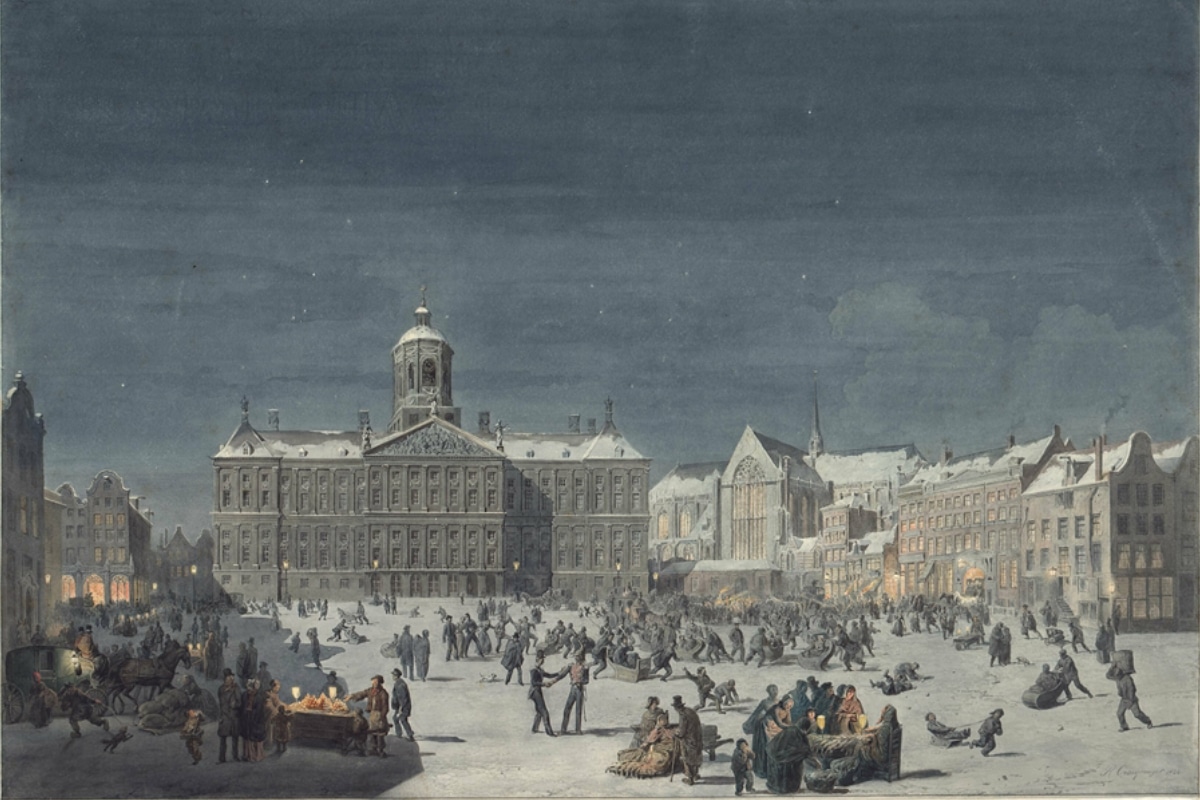
En het plaatje bij deze blog? Dat is een schilderij van Reinier Craeyvanger, die de Dam tekende op oudejaarsavond 1854. Het is druk op de Dam en iedereen komt er samen in de maanbelichte sneeuw. Je ziet een met fakkels verlichte stoet sledes. Er wordt een sleewedstrijd gehouden. Jongens gooien sneeuwballen. Er wordt gedanst. Er worden vis en citroenen verkocht. Er wordt een avonddienst in de Nieuwe Kerk gehouden. Rechts zie je de diligence-postdienst van Van Gend en Loos en naast het paleis de felverlichte winkel van Heyman. Al wat er ontbreekt, is een oliebollenkraam.
Hoe dan ook: ik toost vanavond met mijn familie op een gelukkig en vooral beter 2024.
Gelukkig Nieuwjaar!
New Year’s Eve
It’s December 31st again, for me the best holiday of the whole year. Bring on 2024: after three bad years, I’m ready for some prosperity!
This day is dedicated to traditions, some of which are widespread and some of which are local. But how old are those traditions? And how did they come about? I dived into it this morning after frying the oliebollen and appelflappen (so forgive me for spelling mistakes, because I didn’t have much time).
January 1st has not always been the first day
Let’s start by noting that January 1 wasn’t always the first day of the new year. Of course, Julius Caesar decreed that the new year began that day, but the church did not go along with that later on. They often chose a more important, Christian holiday as the beginning of the church new year, such as December 25 or March 25. It was not until 1582 that Pope Gregory decided that January 1 was really the beginning.
That’s not to say there wasn’t a celebration around that time. The whole period around the shortest day of the year has long been a period of festivities, during which evil spirits must be driven away and happiness for the new year enforced. As a result, there is a considerable overlap of customs between Christmas, New Year’s Eve and Epiphany.
The “oliebol” (oilball)
A typical Dutch custom is the oliebol (literally: oil ball, essentially deep-fried balls of dough, out of which the American doughnut evolved). Well, typically Dutch… Yes, the oliebol itself is as Dutch as it gets, but sweet baked goods are also eaten on New Year’s Eve in other countries. Where does that come from? It is said that the Frisians and Batavians already sacrificed greasy pastries. The fact is that the pastry is made from ingredients that last a long time, which is useful in winter, and that the fatty snack is also quite suitable for the winter cold.
Anyway, back to the oliebol. That thing is very old, indeed. The oldest image is from 1652, the oldest recipe from 1667, but they must be older. IncideBy the way, they were first called oliekoek (oil cookie); the word oliebol appears for the first time in the Van Dale dictionary in 1868.
They were also different from today’s baking. First of all, they were flatter. That was because they weren’t floating around freely in a huge pot of oil. That was too expensive. They were baked in 1 liter and so they were flatter.
And the regular oliebol would never have been eaten. Shame, no one could be bothered by such poor man’s food on a feast day! No, the old recipe speaks of a filling of raisins, apples, almonds, cinnamon, ginger and cloves. And they weren’t eaten with powdered sugar either, because that’s an industrial product.
The current version and form appears sometime in the 20th century. At least that’s what the sources I’ve consulted say. But my mother was born in 1927 and in her youngest years they already had the modern oliebol, so if it is indeed the 20th century, then it must have originated very early in that century. Personally, I suspect a date late in the 19th century.
That would also be in line with the period when eating oliebollen shifts from all year round to exclusively on (and around) New Year’s Eve. At that time, people also started baking them at home. This shift may have taken place, because they were distributed to the poor around the turn of the year, but that remains speculation. In any case, the modern oliebol was cheap and nice and fatty, so ideally suited for a cold holiday, which in the 19th century was still largely celebrated on the street.
Around the turn of the year, we don’t just eat oliebollen. In the north and east there are kniepertjes and of course there is the appelflap. The history of the appelflap and appelbeigneit goes hand in hand with that of the oliebol. As early as the 15th century, we find recipes for appelbeignets.
Controversy about fireworks
The next tradition is fireworks. Fireworks are set off all over the world on New Year’s Eve, but nowhere do they they illuminate the sky as much as in the Netherlands. We are the world’s largest consumers. There are also few countries where it is so common for people to set off their own fireworks.
But where does it come from?
The custom of making noise at the dawn of the new year is as old as the road to Rome… and older. After all, the evil spirits must be driven away so that they cannot enter the new year. You often see that old pagan customs pave the way for new traditions, which fit in seamlessly. We are already pre-programmed in our cultural DNA and then embrace new versions easily.
So New Year’s Eve used to be a day of noise, excessive drinking and partying on the streets and even then it was accompanied by a lot of nuisance. In the 16th century, the city council of Amsterdam tried to ban ‘New Year’s singing’, a custom that we no longer know, but still occurs in English-speaking countries in a slightly different form. Incidentally, this attempt had no effect and it just continued as before. Dordrecht banned bonfires in the 18th century.
Those bonfires are still found in the Netherlands, albeit very locally. Not every municipality participates. Often there has been a shift to a week later, when traditionally the discarded Christmas trees go up in flames. Again, you see a shift and overlap of customs, with very ancient origins.
So fireworks on New Year’s Eve are not so strange. It has replaced shooting with firearms. And that replaced other forms of noise.
Fireworks came to Europe from China in the Middle Ages, and during festivities, kings and city councils liked to put on large fireworks displays, such as at coronations or signing peace after a war. The end of the Eighty Years’ War, for example, was celebrated with a huge fireworks display on Dam Square in Amsterdam.
But how did it come about that the Dutch started to set off so massively? It is claimed that this originated in the 60s and 70s, but I think it must have been a bit earlier. My brother was born in 1957 and in his younger years it already existed, not as massively as it does now, but still. I think it came up shortly after the war.
I read in a source that the colonials that had returned from Indonesia brought the custom with them and that it was initially picked up by the street urchins in The Hague, where many immigrants from Insulinde (modern Indonesia) had settled. Rising prosperity and increased imports from China facilitated the accessibility to the civilian consumer.
So fireworks are also an old tradition, but in their current form they may be perhaps 70 years old.
Incidentally, carbide shooting only originated at the beginning of the 20th century, but that aside.
Christmas tree
And the Christmas tree? Yes, I hear you say, that’s a Christmas tree. Yes, but in many families it is still standing on New Year’s Eve and in some countries a tree is not erected until the last day of the year or only decorated with evergreen branches on that day. And tree worship is also an ancient custom.
There are a lot of ideas going around about where the use came from. It is not certain, but it is clear that decorating the house with evergreen branches and the like was widespread, from Egypt to China and from Rome to Scandinavia.
It is also thought that it may have originated from the tree of paradise, decorated with apples, which was used in the play about Adam and Eve during Christmas. Who knows? Perhaps several older customs have contributed to the creation of the modern Christmas tree.
But our modern Christmas tree is quite old. It originated in Central Europe and the Baltic states during the Renaissance.
In 1441 a tree decorated with sweets was erected in the guildhall in Livonia for the children of the members. In the 15th century, in a monastery in Portugal, there is mention of a laurel Christmas branch with oranges with a candle in it at the high altar. In 1539, a Christmas tree was placed in Strasbourg Cathedral. In Bremen, there is a tree in the guildhall with apples, nuts, dates, pretzels and paper flowers. It is traditionally claimed that Luther first added candles to the decorations.
In any case, it is a Lutheran German-Baltic custom. After the Reformation, the Protestants no longer wanted Catholic nativity scenes (more about that in a previous blog) and switched to the Christmas tree, which harked back to older customs.
At the beginning of the 18th century, the Christmas tree was a common phenomenon in the cities (!) of the northern (Protestant) Rhineland. From there, it spread across Europe in the early 19th century through the Napoleonic Wars, when soldiers and officers came into contact with it. In 1814 the Christmas tree reached Vienna, in 1840 France. The mass emigration of poor Germans in the 19th century took the custom outside of Europe, although Hessian soldiers had already introduced it to America in 1781. And it really took off when the German army decided to place Christmas trees in the barracks and military hospitals during the Franco-Prussian War.
And other (Dutch) traditions
A few other traditions, which cannot be left unmentioned, are left to be discussed briefly.
The first New Year’s Eve conference (a cabaret performance in which a comedian looks back on the past year in a funny, but also sharp, sarcastic way) was broadcast in 1954, but the idea is much older. Since the beginning of the 18th century, at the end of December, Vondel’s play Gijsbrecht van Amstel has invariably been followed by the farce The Wedding of Kloris and Roosje. It contained a New Year’s wish that was always preceded by a passage in which the past year was humorously looked back on.
Champagne hasn’t been around for very long. It was only after the Industrial Revolution that champagne grew into the mass product we toast with today. Originally, of course, this was only reserved for the absolute top.
And then the unescapable event on January 1st: the New Year’s Dive (in which hundreds of people take a dive in the North Sea). That’s a young custom. The first was held in 1960. But in 1920, Canadian Peter Pantages decided to organize the already existing polar bear plunges during New Year’s Day.
So we can easily say that most of our New Year’s Eve traditions in their current form originated in the 19th century, but go back to ancient customs. The ubiquitous superstition has been pushed into the background. The day used to be full of them, which differed from country to country. People ate legumes (which resemble coins, which must bring prosperity), they ate pork (now shifted to Christmas), round food represented the circle of life, the completed year, the first visitor could not be a blond man (a Viking warrior on your doorstep is a bad start of the year), you don’t do unpleasant chores, you predict the future by peeling apples.
I don’t know what superstitions were (and are?) in the Netherlands on this day, but the above examples come from other countries of Europe.
And the picture for this blog? This is a painting by Reinier Craeyvanger, who drew the Dam on New Year’s Eve 1854. It’s busy on Dam Square and everyone gathers in the moonlit snow. You will see a torch-lit procession of sledges. A sleigh race is held. Boys throw snowballs. There is dancing. Fish and lemons are sold. An evening service is held in the Nieuwe Kerk (New Church). On the right you can see the diligence mail service of Van Gend en Loos and next to the palace the brightly lit shop of Heyman. All that’s missing is an oliebollen stall.
Anyway: tonight I toast with my family to a happy and, above all, better 2024.
Happy new year!
Comments (0)