
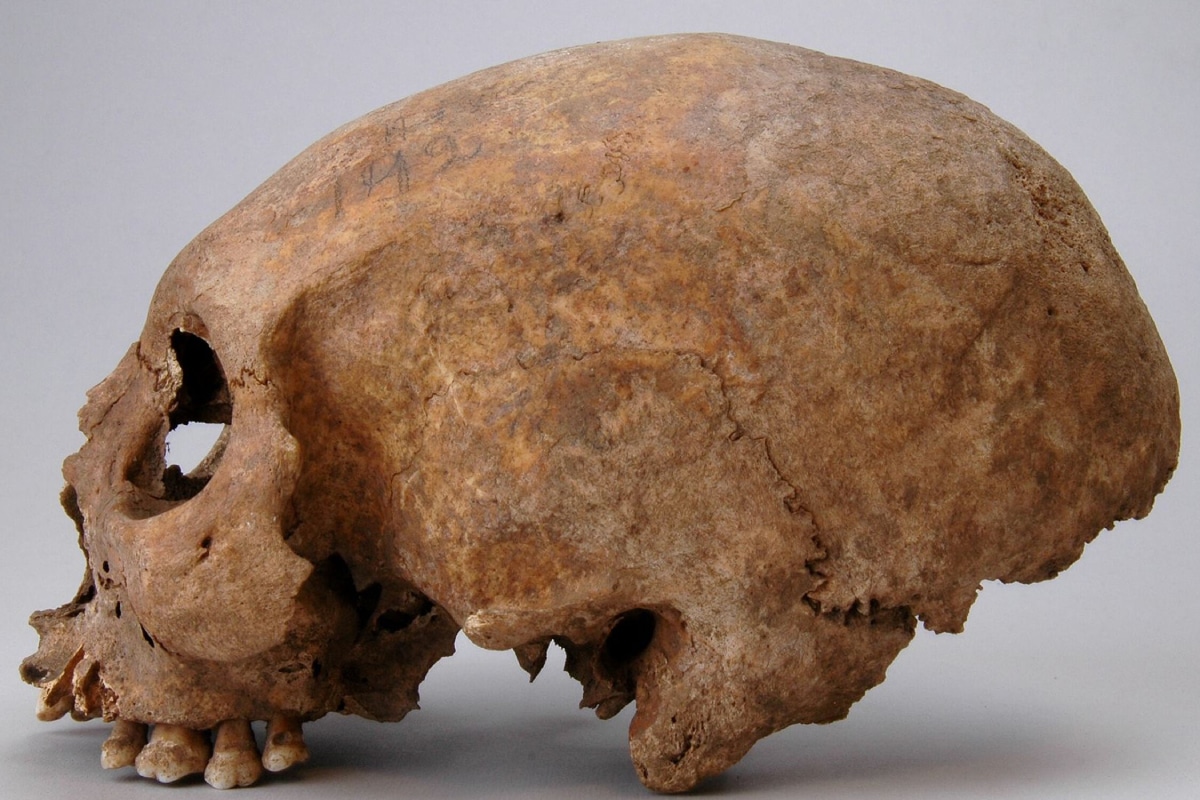
Wel, de titel is niet helemaal correct, want eigenlijk wil ik het hier hebben over lange schedels… en gevijlde tanden. Maar in eerste instantie lange schedels. En daarmee bedoel ik bewust gemanipuleerde schedels in een langgerekte vorm. De aanleiding is een intrigerende vondst van drie Vikingvrouwen met zo’n schedel. En hoewel mijn vorige blog nog geen twee weken oud is, wilde ik dit toch met jullie delen.
Een eens wijdverbreid gebruik
Op zich is dit gebruik niet vreemd. Wij kennen het (niet) meer, maar het was wijdverbreid over de wereld, vanaf het Neolithicum (en mogelijk zelfs daarvoor) tot nu.
Bekende voorbeelden van buiten Eurazië zijn de Maya, Inca, Chinook, Choctaw en Taino uit Amerika, verschillende stammen in de pre-koloniale Filippijnen, geïsoleerde gevallen in Tahiti, Samoa en Hawaii, en op Vanuatu (tot op heden) en de Bismarch-archipel in Papua-Nieuw-Guinea (tot de jaren 1930), de Mangbetu in Afrika (tot de jaren 1950). Maar de lijst is veel langer.
In Eurazië noemt Hippocrates in 400 v.C. al de zogenaamde Macrocephali, die wellicht ergens in de Kaukasus gezocht moeten worden. Via de Hunnen en Alanen kwam het in Oost-Europa terecht in de tijd van de Volksverhuizingen. In de jaren 300-600 zien we het bij de door de Hunnen geregeerde Gepiden, Ostrogoten, Herulen, Rugiërs en Bourgondiërs, later ook bij de Lombarden en Thuringers. In de 9e tot de 11e eeuw was het wijdverbreid in Polen (Wolin), Slowakije en vooral Bulgarije.
Tot n de 20e eeuw zien we gevallen in delen van West-Rusland, de Kaukasus, bij de Sami in Scandinavië en in de omgeving van Toulouse, hoewel het in dit laatste geval mogelijk onopzettelijk gebeurde.
Het gebruik wordt zowel bij jongens als meisjes uitgevoerd, maar in Europa voornamelijk bij meisjes.
Er worden vele redenen om dit te doen geopperd, van puur esthetisch tot de idee dat bepaalde gedachten zo beter vastgehouden kunnen worden, van status tot groepsidentificatie.
We mogen het niet verwarren met aangeboren schedelvervormingen, zoals we in Oud-Egypte wel zien, want de schedelvervormingen waarover ik het hier heb, werden bewust gedaan door al op heel jonge leeftijd (meestal vanaf de eerste maand na geboorte en dan gedurende een half jaar, maar in ieder geval onder de drie jaar oud) de schedel op of tussen plankjes te binden of strak in doeken te wikkelen. Zo konden platte en verlengde, ronde en conische vormen verkregen worden.
Verlengde schedels op Gotland
Dan nu terug naar de Vikingvrouwen.
Tot nu toe kenden we dit gebruik niet onder de Vikingen en ook nu moet het als een exotisch gebruik gezien worden, dat niet algemeen verspreid was en misschien op deze drie geïsoleerde gevallen na helemaal niet voorkwam.
Want tot op heden zijn er dus maar drie van zulke schedels opgegraven.
Ze zijn alle drie op Gotland gevonden, in Havor, Ire en Kvie, dus op drie verschillende begraafplaatsen. Ze zijn alle drie vrouwen uit de tweede helft van de 11e eeuw. Eén vrouw (Ire, graf 503) was tussen de 25 en 30, en één (uit graf 192 in Havor) tussen de 55 en 60. Van de derde vrouw hebben ze de leeftijd niet vast kunnen stellen. Zij lag in een graf van zes personen en haar schedelvervorming is erg mild.
De schedels zijn al een tijd terug al gevonden, de laatste in de jaren 1930, maar zijn nu met nieuwe technieken opnieuw onderzocht in de hoop meer te weten te komen over het hoe en waarom dit buitenlandse gebruik op Gotland terechtgekomen kan zijn.
De nieuwe studie is door Matthias Toplak en Lukas Kerk gepubliceerd in Current Swedish Archaeology. Het artikel heet Body Modifications on Viking Age Gotland: Filed Teeth and Artificially Modified Skulls as Embodiment of Social Identities. Je kunt het lezen onder https://publicera.kb.se/csa/article/view/10726. Ik heb het ook in pdf-formaat en kan het doorsturen als je dat wilt. Toplak is het hoofd van het Vikingmuseum in Hedeby en Kerk is een doctoraalstudent aan de Universiteit van Munster, waar hij zich toelegt op archeologische lichaamsmodificatie.
Waren deze vrouwen importbruiden?
Dit nieuwe onderzoek heeft een verrassende uitkomst. De vrouwen waren niet alle drie van buitenlandse komaf, zoals te verwachten zou zijn! Op voorhand ging men ervan uit dat het vrouwen waren die in Bulgarije waren geboren en door huwelijk en handel in Scandinavië terechtgekomen waren.
Dat was namelijk ook het geval bij de negen (veertien als de vijf ‘tussenliggende’ gevallen meegerekend worden) van de veertig schedels uit de late 5e en vroege 6e eeuw in Beieren, die ook een verlengde vorm hadden. Deze vrouwen kwamen genetisch uit Zuidoost-Europa en dan specifiek uit Bulgarije en Roemenië. Er is een hypothese dat ze uit rijke geslachten kwamen en als bruid in verband met politieke allianties naar Duitsland kwamen, maar daar is niet iedereen het mee eens.
Hoe dan ook, deze verwachting kwam niet uit bij de drie schedels op Gotland. De oudere vrouw uit graf 192 was namelijk hoogstwaarschijnlijk Gotlands, de jongere vrouw Baltisch (mogelijk Litouws). Waarom werd bij een Gotlands meisje de schedel vervormd? Had ze wellicht buitenlandse ouders? Maar Gotland was een handelsknooppunt en zouden we dan niet meer van zulke gevallen moeten vinden?
En wat betekende dit voor de vrouwen? Ongetwijfeld zijn ze opgevallen en werden ze als apart of bijzonder beschouwd. Maar was dat negatief of positief? Dus werden ze gediscrimineerd of hadden ze een bijzondere positie?
De oudere vrouw, die dus Gotlandse roots had, was zeer rijk begraven, zelfs ‘overequipped’, dus dat duidt niet op een status als paria. Ze had zelfs vier dierenkopspelden, spelden die uniek en karakteristiek voor Gotland zijn. Slechts in twee andere graven is ook zo’n overdreven groot aantal gevonden. Opvallend genoeg is de eveneens typische Gotlandse doosspeld in geen van de drie graven aangetroffen.
In ieder geval toonde het de vrouwen als behorend tot een bijzondere groep, welke groep dan ook, ook al zullen de inwoners van Gotland de precieze duiding mogelijk niet begrepen hebben. Wat verder nog opvalt, is dat de drie vondsten qua periode heel dicht bij elkaar liggen.
De huidige meest voor de hand liggende interpretatie is dat ze buitenlandse vrouwen waren of in ieder geval in het buitenland geboren, tot dezelfde groep behoorden en naar Gotland gekomen zijn, mogelijk door een huwelijk, waar ze verder volledig leefden in de Gotlandse cultuur, aangezien ze in Gotlandse stijl en met Gotlandse juwelen begraven zijn, en dit gebruik blijkbaar niet doorgegeven hebben aan volgende generaties. Noch heeft het navolging gevonden bij de plaatselijke bevolking.
Dat ze op Gotland zijn gevonden, is niet zo heel verrassend. Het was, zoals gezegd, een belangrijk handelseiland, op het knooppunt tussen Scandinavië en Oost-Europa. Gotland was in wel meer opzichten een buitenbeentje. Zo weken de juwelen van de vrouwen daar qua vorm af en is het ook de belangrijkste vindplaats van mannenschedels met gevijlde tanden uit die tijd.
Gevijlde tanden
In 1989 zijn die schedels van Vikingmannen met gevijlde tanden voor het eerst opgemerkt en tot op heden hebben we er ruim 130 gevonden, het overgrote merendeel daarvan op Gotland! Is er een overeenkomst tussen het voorkomen van twee unieke eigenschappen juist op dit eiland? In ieder geval behandelt het bovengenoemde wetenschappelijke artikel zowel de tanden als de schedels in één adem.
Het gaat hierbij niet om een lichaamsmodificatie die bij een zuigeling wordt toegepast, maar alle mannen waren minstens twintig en het valt dus aan te nemen dat ze het vrijwillig ondergaan hebben. Naar de reden laat zich gissen. Was het wellicht een initiatierite was, waarbij de jongeman moest bewijzen pijn te kunnen verdragen, een gebruik dat we wereldwijd terugzien, of de initiatie tot een bepaalde krijgergroep? Het ene sluit het andere natuurlijk niet uit. Of waren ze edelen? Of juist slaven? De oorspronkelijke interpretatie dat ze door slijtage bij bepaald handwerk ontstaan zijn, is al snel van de hand gewezen.
Hoe moeten we ons die groeven voorstellen? Ze zitten meestal in de bovenste snijtanden. Ze kunnen diep of ondiep zijn, meestal horizontaal, soms verticaal, meestal recht, maar ook wel halvemaanvormig. Ze zijn kundig aangebracht, waarschijnlijk door iemand anders.
Onzekere verklaringen
Modificatie aan het gebit is ook een wijdverbreid etnologisch gebruik. Denk hierbij aan de Mentawai in Indonesië Maar voor Europa zijn de vondsten uniek en puur Scandinavisch uit de vroege middeleeuwen. Bovendien bestaat de modificatie van tanden in andere culturen meestal uit het vijlen of beitelen in punten, terwijl deze groeven uniek zijn in hun vorm.
De eerste grote studie naar dit fenomeen is gedaan door Caroline Arcini in 2005. Toen hadden we er nog maar een paar dozijn gevonden. Ze heeft er later een boek over geschreven: The Viking Age: A Time of Many Faces.
Overigens hebben de mannen breed moeten lachen om de groeven te laten zien en er wordt vermoed dat ze die gekleurd hebben, bijvoorbeeld met was of vet vermengd met houtskool, iets wat ze na elke eet- en drinkbeurt wel opnieuw moesten doen. Ze konden dit kenmerk dus vrij gemakkelijk verborgen houden.
Hierin zit wel een beetje een paradox. De vervorming van de schedel is onvrijwillig en kon niet verborgen worden, terwijl de groeven in de tanden vrijwillig waren en wel verborgen gehouden konden worden.
Maar Arcini denkt niet dat ze krijgers waren, noch elite dan wel slaven. Want slechts weinigen hadden wapens in hun graf of krijgsverwondingen. Hun lichamen komen overeen met die van de gemiddelde Viking, dus zowel kort als extreem lang. Ondanks dat enkelen ritueel gedood waren, worden deze tandengroeven niet gezien als het teken van slaven, omdat velen grafgoederen hadden.
Maar als ze dan geen krijger, edelman of slaaf waren, wat dan wel? Was het dan toch een algemene initiatierite voor jongemannen? Volgens Arcini wijst er niets op een overgangsritueel, omdat alle mannen boven de twintig waren. Natuurlijk kunnen ze ook op jongere leeftijd aangebracht zijn, maar je zou verwachten dat er dan ook vondsten van tieners op zouden duiken.
Geen begrafenisritueel
Het enige dat we zeker weten, is dat het ruim voor de dood is aangebracht, dus het heeft ook niets te maken met een begrafenisritueel. Een religieuze context wordt eveneens uitgesloten, omdat ze zowel in heidense als in christelijke samenhang gevonden zijn.
Zij vermoed dat het om een specifieke groep handelaren zou kunnen gaan, die over grote afstanden reisden. Zie het als een soort gilde-teken, een laissez-passer om vriendelijk ontvangen te worden en betere voorwaarden te krijgen, bescherming te genieten of van andere voordelen te profiteren. Er lijken wel verschillen te zijn tussen de verschillende regio’s, wat op verschillende kringen zou kunnen duiden binnen een grotere groep. En dan zou het niet zo verrassend zijn dat ze juist op Gotland gevonden zijn en dat het gebruik hier vandaan gekomen lijkt te zijn. Want Gotland was misschien wel de rijkste handelsplek van heel Scandinavië, als we de juwelen van de vrouwen als dusdanig mogen interpreteren.
Wat hier ook op zou wijzen, is dat in Kopparsvik alle lichamen met zulke tanden in een apart deel van het grafveld gevonden zijn, dat wordt geïnterpreteerd als een begraafplaats van buitenstaanders of buitenlanders, aangezien hier nauwelijks vrouwen begraven liggen.
In ieder geval zijn ze bijna allemaal op Gotland gevonden. Van de 135 of 136 schedels met gevijlde tanden die tot nu toe gevonden zijn, kwamen er maar 37 niet uit Gotland. In Denemarken zijn er 34 gevonden, in Rusland 2 en in Engeland 1 (in het beroemde massagraf van vermoedelijk krijgers). Het merendeel van de Gotlandse vondsten kwam uit Kopparsvik (46) en nog eens 13 uit Slite torg. Een andere tamelijke grote concentratie (8 of 9) is te vinden in Sigtuna. Het handelt hier voornamelijk om kustplaatsen en/of havens.
Tot nu toe zijn ze niet in Noorwegen gevonden, maar dat kan te maken hebben met de slechte preservatie van het bot aldaar. Verder mogen we ook niet uit het oog verliezen dat waar meer archeologische opgravingen en onderzoek worden gedaan, ook meer gevonden wordt. Dus bovenstaand beeld kan nog veranderen als er meer vondsten opduiken.
Ook stammen ze bijna allemaal uit de latere Vikingperiode, hoewel er ook twee vondsten zijn uit de vroege Vikingtijd, en juist die zijn niet in Gotland gevonden. Kwam het gebruik van elders en is het in Gotland tot bloei gekomen?
Uniek voor Gotland
Arcini durft wel te concluderen dat het gebruik van gevijlde tanden op Gotland is ontstaan en uniek is voor dit eiland, en dat de overige vondsten ofwel Gotlandse mannen betreft die weggetrokken zijn, ofwel mannen die speciaal naar Gotland gingen om dit te laten doen dan wel dat Gotland een ontmoetings- of samenkomstplek was voor iets waarvoor die tanden stonden, wat dat dan ook was. De eerste analyse lijkt het meest voor de hand liggend, aangezien de meeste geanalyseerde mannen ook daadwerkelijk uit Gotland stamden.
Er is slechts één ander mogelijk verwant geval: een man uit Egypte uit de vroege 8e eeuw. Was dit toeval of duidt dit op contact? In ieder geval duiden die tanden op de uitdrukking van een identiteit, of status, net zoals die schedels, of zoals tatoeages.
Wie weet mag zeggen.
Ik had in mijn toekomstige roman die zich bij de Vikingen afspeelt en die ik dit of volgend jaar uit wil geven, de gevijlde tanden geïnterpreteerd als een teken van een krijgerelite, mogelijk zelfs berserkers. Maar dat blijk ik nu achteraf toch te moeten herschrijven, zeker omdat dit personage ook nog eens niet uit Gotland kwam. En die verlengde schedels dan? Hoe moet ik die zien?
Heeft iemand een interessante hypothese?
Long faces and long teeth
Well, the title is not entirely correct, because what I really want to do here is talk about long skulls… and filed teeth. But at first, long skulls. And by that I mean deliberately manipulated skulls in an elongated shape. The reason for this is an intriguing discovery of three Viking women with such a skull. And even though my previous blog is less than two weeks old, I still wanted to share it with you.
A once widespread custom
In itself, this custom is not unusual. We don’t know it anymore, but it was widespread around the world, from the Neolithic (and possibly even before) to the present day.
Well-known examples from outside Eurasia include the Maya, Inca, Chinook, Choctaw, and Taino of the Americas, various tribes in the pre-colonial Philippines, isolated cases in Tahiti, Samoa, and Hawaii, and on Vanuatu (to date) and the Bismarch Archipelago in Papua New Guinea (until the 1930s), the Mangbetu in Africa (until the 1950s). But the list is much longer.
In Eurasia, Hippocrates already mentions the so-called Macrocephali in 400 B.C., which may have to be sought somewhere in the Caucasus. Via the Huns and Alans, it ended up in Eastern Europe in the time of the Migrations. In the years 300-600 we see it among the Gepids, Ostrogoths, Heruls, Rugians and Burgundians ruled by the Huns, later also among the Lombards and Thuringians. In the 9th to the 11th centuries, it was widespread in Poland (Wolin), Slovakia, and especially Bulgaria.
Until the 20th century, we see cases in parts of western Russia, the Caucasus, among the Sami in Scandinavia and in the Toulouse area, although in the latter case it may have been unintentional.
Its use is carried out in both boys and girls, but in Europe it is mainly used in girls.
Many reasons for doing this have been suggested, from purely aesthetic to the idea that certain thoughts can be better held this way, from status to group identification.
We should not confuse it with congenital cranial deformities, as we see in Ancient Egypt, because the cranial deformations I am talking about here were deliberately done by tying the skull on or between planks or wrapping it tightly in cloths at a very young age (usually from the first month after birth and then for half a year, but in any case under three years old). In this way, flat and elongated, round and conical shapes could be obtained.
Elongated skulls on Gotland
Now back to the Viking women.
Until now we did not know this custom among the Vikings, and even now it must be regarded as an exotic practice, which was not widely distributed and perhaps did not occur at all except for these three isolated cases.
To date, only three such skulls have been excavated.
All three were found on Gotland, in Havor, Ire and Kvie, i.e. in three different cemeteries. All three are women from the second half of the 11th century. One woman (Ire, grave 503) was between 25 and 30, and one (from grave 192 in Havor) between 55 and 60. They have not been able to determine the age of the third woman. She was in a grave of six people and her skull deformation is very mild.
The skulls have been found some time ago, the last one in the 1930s, but have now been re-examined using new techniques in the hope of learning more about how and why this foreign custom may have ended up on Gotland.
The new study was published by Matthias Toplak and Lukas Kerk in Current Swedish Archaeology. The article is called Body Modifications on Viking Age Gotland: Filed Teeth and Artificially Modified Skulls as Embodiment of Social Identities. You can read it under https://publicera.kb.se/csa/article/view/10726. I also have it in pdf format and can forward it if you want. Toplak is the head of the Viking Museum in Hedeby and Kerk is a doctoral student at the University of Münster, where he focuses on archaeological body modification.
Were these women import brides?
This new research has a surprising outcome. Not all three of the women were of foreign origin, as might be expected! Beforehand it was assumed that they were women who were born in Bulgaria and ended up in Scandinavia through marriage and trade.
This was also the case with the nine (fourteen if the five ‘intermediate’ cases are included) of the forty skulls from the late 5th and early 6th centuries in Bavaria, which also had an elongated shape. These women came genetically from southeastern Europe and specifically from Bulgaria and Romania. There is a hypothesis that they came from wealthy lineages and came to Germany as brides in connection with political alliances, but not everyone agrees.
In any case, this expectation did not come true for the three skulls on Gotland. The older woman from grave 192 was most likely Gotlands, the younger woman Baltic (possibly Lithuanian). Why was a Gotland’s skull deformed? Could she have had foreign parents? But Gotland was a trading hub, and shouldn’t we find more such cases?
And what did this mean for the women? Undoubtedly, they have been noticed and considered distinct or special. But was that negative or positive? So were they discriminated against or did they have a special position? The older woman, who had Gotland roots, was buried very richly, even ‘overequipped’, so that does not indicate a status as a pariah. She even had four animal head pins, pins that are unique and characteristic of Gotland. Only in two other graves has such an exaggerated number been found. Remarkably, the equally typical Gotland box pin has not been found in any of the three graves.
In any case, it showed the women as belonging to a special group, any group, even though the inhabitants of Gotland may not have understood the exact interpretation. What is also striking is that the three finds are very close to each other in terms of period.
The most obvious interpretation today is that they were foreign women or at least foreign-born, belonged to the same group and came to Gotland, possibly by marriage, where they otherwise lived fully in Gotland culture, since they were buried in Gotland style and with Gotland jewels, and apparently did not pass this custom on to subsequent generations. Nor has it been imitated by the locals.
The fact that they were found on Gotland is not very surprising. It was, as mentioned, an important trading island, at the junction between Scandinavia and Eastern Europe. Gotland was an outlier in more ways than one. For example, the women’s jewellery differed in shape and it is also the most important place to find men’s skulls with filed teeth from that time.
Filed teeth
In 1989 those skulls of Viking men with filed teeth were first noticed and to date we have found more than 130 of them, the vast majority of them on Gotland! Is there a similarity between the occurrence of two unique characteristics on this island? In any case, the aforementioned scientific article deals with both the teeth and the skulls in the same breath.
This is not a modification of the body used on an infant, but all the men were at least twenty years old, so it can be assumed that they underwent it voluntarily. The reason is anyone’s guess. Was it perhaps an initiation rite, in which the young man had to prove that he could tolerate pain, a custom that we see worldwide, or the initiation to a certain warrior group? Of course, one does not exclude the other. Or were they nobles? Or slaves? The original interpretation that they were created by wear and tear in certain handicrafts was quickly rejected.
How should we imagine these grooves? They are usually found in the upper incisors. They can be deep or shallow, usually horizontal, sometimes vertical, usually straight, but also crescent-shaped. They have been skilfully applied, probably by someone else.
Uncertain explanations
Modification to the teeth is also a widespread ethnological practice. Think of the Mentawai in Indonesia But for Europe, the finds are unique and purely Scandinavian from the early Middle Ages. In addition, the modification of teeth in other cultures usually consists of filing or chiseling into points, while these grooves are unique in their shape.
The first major study of this phenomenon was done by Caroline Arcini in 2005. By then, we had only found a few dozen. She later wrote a book about it: The Viking Age: A Time of Many Faces.
Incidentally, the men had to smile broadly to show the grooves and it is suspected that they coloured them, for example with wax or grease mixed with charcoal, something they had to do again after every meal and drink. So, they were able to keep this feature hidden quite easily.
There is a bit of a paradox in this. The deformation of the skull is involuntary and could not be hidden, while the grooves in the teeth were voluntary and could be concealed.
But Arcini doesn’t think they were warriors, nor elites or slaves. For only a few had weapons in their graves or war wounds. Their bodies correspond to those of the average Viking, so both short and extremely long. Despite the fact that some were ritually killed, these tooth grooves are not seen as the sign of slaves, because many had grave goods.
But if they weren’t warriors, noblemen, or slaves, what were? Was it a general initiation rite for young men after all? According to Arcini, there is nothing to indicate a rite of passage, because all the men were over twenty. Of course, they could also have been applied at a younger age, but you would expect that finds from teenagers would also turn up then.
No burial rite
The only thing we know for sure is that it was applied well before death, so it has nothing to do with a funeral ritual either. A religious context is also excluded, because they are found in both pagan and Christian contexts.
She suspects that it could be a specific group of traders, who travelled long distances. Think of it as a kind of guild sign, a laissez-passer to be kindly received and get better conditions, enjoy protection or take advantage of other benefits. There do seem to be differences between the different regions, which could indicate different circles within a larger group. And then it wouldn’t be so surprising that they were found on Gotland and that the custom seems to have come from here. Because Gotland was perhaps the richest trading place in all of Scandinavia, if we are to interpret the women’s jewels as such.
What would also indicate this is that in Kopparsvik all bodies with such teeth were found in a separate part of the burial ground, which is interpreted as a cemetery of outsiders or foreigners, since hardly any women are buried here.
In any case, almost all of them have been found on Gotland. Of the 135 or 136 skulls with filed teeth found so far, only 37 did not come from Gotland. 34 have been found in Denmark, 2 in Russia and 1 in England (in the famous mass grave of presumably warriors). The majority of the Gotland finds came from Kopparsvik (46) and another 13 from Slite torg. Another rather large concentration (8 or 9) is found in Sigtuna. These are mainly coastal towns and/or harbours.
So far they have not been found in Norway, but that may have to do with the poor preservation of the bone there. Furthermore, we should not lose sight of the fact that where more archaeological excavations and research are done, more is found. So the above image may change as more finds emerge.
Also, almost all of them date from the later Viking period, although there are also two finds from the early Viking Age, and they have not been found in Gotland. Did the custom come from elsewhere and did it flourish in Gotland?
Unique to Gotland
Arcini dares to conclude that the use of filed teeth originated on Gotland and is unique to this island, and that the other finds are either Gotland men who have moved away, or men who went to Gotland specifically to have this done, or that Gotland was a meeting or meeting place for something for which those teeth stood. whatever that was. The first analysis seems the most obvious, since most of the men analyzed were actually from Gotland.
There is only one other possible related case: a man from Egypt in the early 8th century. Was this a coincidence or does it indicate contact? In any case, those teeth indicate the expression of an identity, or status, just like those skulls, or like tattoos.
Who knows, maybe you might say.
In my future novel set among the Vikings, which I plan to publish this year or next, I had interpreted the filed teeth as a sign of a warrior elite, possibly even berserkers. But it turns out that I have to rewrite that now, especially since this character was not from Gotland either. And what about those elongated skulls? How should I see it?
Does anyone have an interesting hypothesis?
Comments (0)